
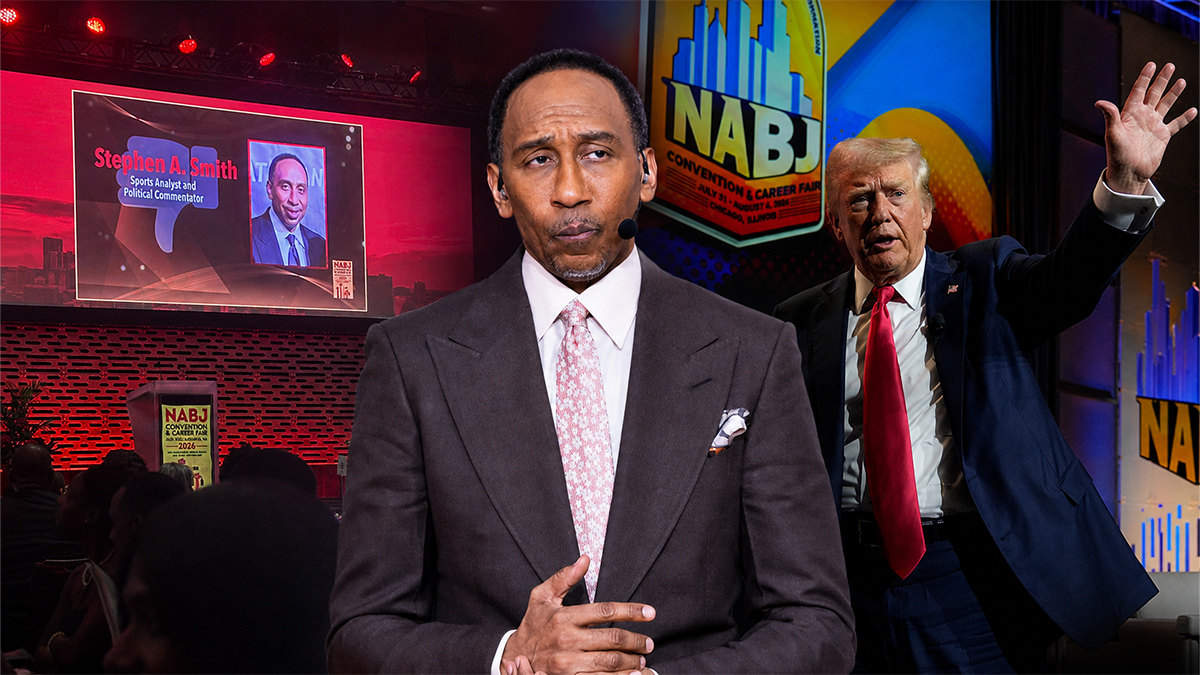
Stephen A. Smith has become one of the easiest targets in media, and the National Association of Black Journalists (NABJ) took direct aim at him.
The NABJ gave Stephen A. its “Thumbs Down Award” during its annual convention in Atlanta. The organization cited what it viewed as a pattern of commentary that had been harmful toward Black women in politics, sports and media.
For me, the question is not whether Stephen A. deserves criticism.
The bigger question is what the award accomplishes for Black journalists at a time when the profession itself is under enormous pressure.
Stephen A. Smith came through the NABJ pipeline
My perspective on this is shaped by experience.
As a communications student at Winston-Salem State University, NABJ was presented to us as something important. Networking mattered. Relationships mattered. Getting into rooms with Black journalists who had already built careers mattered.
I attended NABJ conventions in Indianapolis in 2006 and Las Vegas in 2007 and those experiences helped me professionally.
Relationships formed during that period continued after I left college. Some still exist today.
Stephen A. Smith was one of the voices pushing the organization.
He had gone from newspapers into national television. He talked openly about networking, relationships and making yourself valuable. For young Black journalists trying to understand the industry, his path represented something.
That is why this moment feels more complicated than a simple public rebuke.
Stephen A. was not some outsider to NABJ — he was a product. A part of the ecosystem.
The organization also benefited from his visibility.
NABJ hosted a live edition of ESPN’s First Take featuring Smith during its 2024 convention. The relationship between Stephen A. Smith and NABJ was not ancient history.
NABJ has faced its own platforming questions
The 2024 convention also created one of the biggest controversies in recent NABJ history.
Then-presidential candidate Donald Trump appeared at the convention in Chicago. His appearance drew criticism before he took the stage and even more after it.
Some members argued that a presidential candidate should face Black journalists directly.
Others believed NABJ gave Trump a platform he did not deserve.
There was a debate as to whether the NABJ was doing it journalistic duty or platforming someone harmful to America. Particularly Black America.
When does interviewing someone become amplifying them?
Those are questions the NABJ has had to answer for itself.
That is why the organization’s criticism of Stephen A. deserves a second look.
The issue is whether NABJ is applying a consistent standard to the use of large platforms.
Stephen A. Smith has been controversial for years
Another part of this is timing.
Stephen A. Smith did not suddenly become controversial in 2026.
He has made comments that angered Black people for years. He has clashed publicly with Black athletes, Black media figures and Black women.
None of that is new. Yet the NABJ continued to embrace Stephen A. when the relationship benefited both sides. That is where my skepticism comes in.
If the organization believed his platform had become harmful, why did this public rebuke come now? Why not earlier?
Why wait until criticism of Stephen A. had become easier and more popular? And after it ran into its own PR problems. That does not mean the criticism is wrong, but the timing is worth examining.
NABJ still has its own work to do
The NABJ remains important. It was founded at a time when Black journalists were still fighting for access to mainstream newsrooms. The organization has helped thousands of Black journalists build careers, find mentors and grow professionally.
I am one of the people who benefited from those opportunities.
But the organization has also faced criticism.
Some Black journalists have viewed NABJ as cliquish or elitist. Others have felt disconnected from the organization entirely. Those concerns are not new, but that does not erase NABJ’s value.
It does, however, mean that the organization should be careful when positioning itself as the final judge of another Black media figure.
Stephen A. Smith is, in many ways, a product of the same professional culture NABJ has long promoted. That connection cannot simply be ignored now that he is less popular with some parts of the Black media community.
Black journalists face a bigger problem
The journalism industry is shrinking as newsrooms continue cutting jobs. That’s not to mention the backlash against DEI, a concept that an organization like the NABJ flourished under.
Local television stations are reducing staff, newspapers are eliminating positions. Many outlets are closing. Artificial intelligence and automation are making it easier for companies to produce more content with fewer people. Black journalists are not insulated from any of that.
In many cases, they are more vulnerable.
That should be a central issue for NABJ in this moment.
How are Black journalists supposed to survive in this environment? What happens to the 15-year veteran who gets laid off? How does a reporter build an independent business? How can veteran journalists and younger creators work together?
Those questions matter more to me than whether Stephen A. Smith receives a thumbs down.
The viral moment is not the mission
The award created attention.
People talked about NABJ and Stephen A. Many praised the organization, as Stephen A. is clearly a lightning rod.
But the real test comes after the attention disappears. Will this create jobs for Black journalists? How will displaced journalists find new opportunities? How will Black-owned media companies grow? Will it help students enter a shrinking profession? Will it help Black journalists build businesses instead of waiting for legacy companies to hire them?
Those are the questions NABJ should be asking.
The organization already does meaningful work in many of these areas. That work deserves more attention, and should also receive more urgency.
Stephen A. is still part of the story
None of this means Stephen A. Smith should avoid accountability. If his words deserve criticism, criticize them. When his platform is being used irresponsibly, say so.
But NABJ should also recognize the complicated relationship it has with Stephen A. He is not simply a media personality the organization can criticize from a distance. Stephen A. is one of the Black journalists who rose through the networking culture NABJ helped build.
He worked in newspapers, developed relationships, moved into television and created a national brand. Eventually, Stephen A. became bigger than many of the traditional media structures around him.
There is a lesson in that story, as well as a warning.
But the future of Black journalism cannot be built around who receives approval or disapproval from an organization. It has to be built around survival, ownership and opportunity. That is why I keep coming back to one question.
What does the thumbs down accomplish?
If it leads to a larger conversation about standards, responsibility and the future of Black journalists, then maybe it matters.
If it only creates a viral moment, then Black journalism has much bigger problems to solve.