
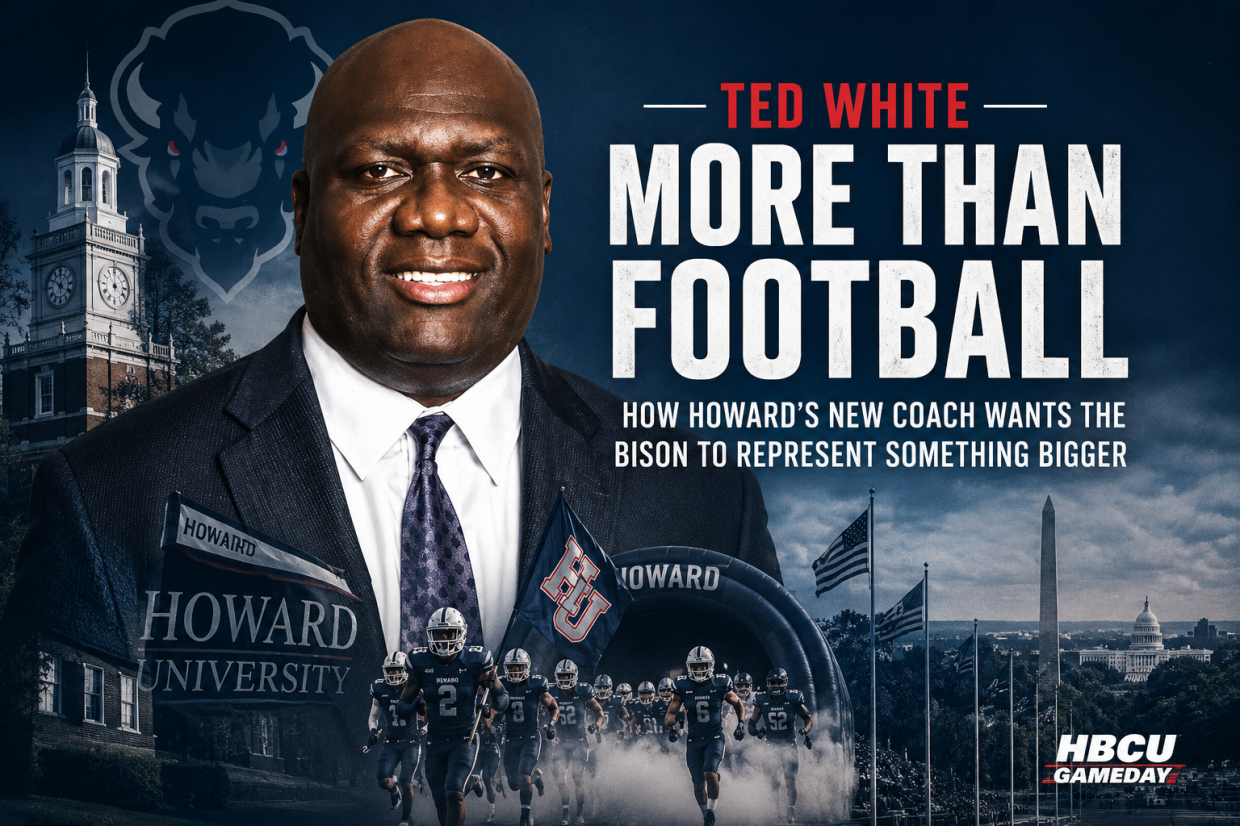
Ted White had an easy opportunity to spend his first MEAC Football Media Day talking about Howard University’s quarterback, the preseason poll or the expectations that come with taking over one of the conference’s flagship programs.
He certainly touched on those topics. Still, every few minutes the conversation drifted somewhere else.
Ask White about football, and he’ll eventually start talking about Howard University. Ask him about recruiting, and he’ll talk about Washington, D.C. Bring up the spring game, and he’ll explain why alumni and the community matter. Even a question about preseason expectations turns into a conversation about daily habits instead of preseason rankings.
By the end of the interview, a pattern had emerged. White wasn’t describing a football team in isolation. He was describing a football program that, in his mind, should reflect the university around it.
That starts with a reality every player eventually faces.
“As we know, this game has an expiration date. And when that expiration date happens, you have to be ready to go into this real world and being able to provide for your family. And that’s what we feel like is important for us as HBCU coaches, be able to give back to our players.”
Returning to Howard after coaching stops in the NFL, at the Power Four level and at other HBCUs changed how he sees the job.
“You get an opportunity to come back to a place where you once started your journey at,” White said. “You get an opportunity to see these guys as a 17, 18-year-old, and then you’re looking at them, and you’re like, ‘Man, I was once in those seats.’ And now you get a chance to really just dive in and give them the information that you’ve been able to collect around different stops… just giving them the information that can help them reach their full potential.”
Football is part of that information. Life after football is, too.
“We’ve been able to give our guys media training. We’ve been able to talk to our guys about mental health. … Alums have been able to come in and talk to our guys on how to create a résumé, how to interview for a job.”
That’s not a throwaway answer. It’s how White explained his offseason before mentioning a single play. Howard itself quickly became the next topic.
“Howard University is the number one HBCU in the country. We sit in the middle of Washington, D.C. We’re 15 minutes from the White House. That’s the selling point. You get an opportunity to be around brilliance every single day. Not just football players, but the regular student body also. And that’s what Howard University is about. Not just excelling on the football field, but excelling off the football field too.”
White never says Jordan Brand or facilities are the selling point. He says Howard is the selling point. That mindset carried over to the spring game. Instead of treating it as another practice, White wanted alumni, former players and the Washington community around the program again.
“When Howard was successful on a consistent basis, the community was involved. The community was involved. So I wanted to bring back that feel because when we win, everybody wins. And it takes a village to be able to raise a kid.”
Players noticed.
“The guys said they’d never seen a spring game like that,” White said. “I wanted the kids to see that it’s so much support for Howard University football. But obviously you’ve got to be able to put a good product on the field to allow guys to continue to come and see you play.”
Eventually, the discussion returned to football. I asked what Howard should look like this season, White finally answered the question every coach gets in July.
“When you turn on the film, I want you to see a physical brand of football from Howard University on the offensive side as well as the defensive side. I want you to see a disciplined team… a football team that’s very aware of situations and understand exactly what to do and just playing a smart brand of football.”
The preseason poll didn’t change his message.
“We just control what we control,” White said. “Either you prove them right or you prove them wrong.”
That’s a coach’s answer. The rest of the interview wasn’t. Most first-year coaches spend media day convincing everyone their football team will be better. Ted White spent much of his explaining why Howard football should be connected to something bigger than itself. If his first offseason is any indication, he isn’t trying to redefine Howard’s identity. He’s trying to make sure the football program reflects it.