
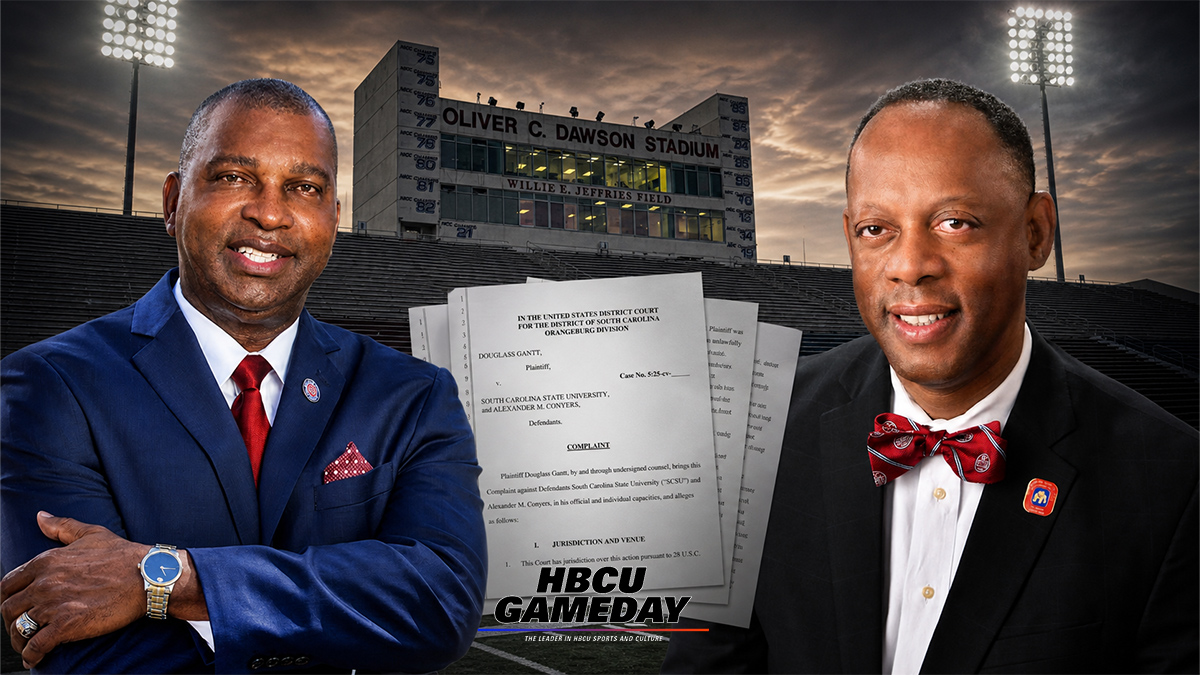
South Carolina State is facing a lawsuit from its Foundation that includes two major athletics-related allegations for the HBCU: a proposed football stadium endzone facility and a later request for $500,000 in NIL funding.
The lawsuit was filed May 4 in Orangeburg County by the South Carolina State University Foundation, Inc. It names South Carolina State University, President Alexander Conyers, and Board of Trustees Chair Douglass Gantt as defendants.
The complaint is much broader than athletics. It centers on control of Foundation assets, donor records, fundraising, and the relationship between the public HBCU and its independent charitable arm.
But the athletics angle stands out.
According to the lawsuit, the Foundation alleges Conyers wanted to use restricted Foundation funds for a football stadium project. It also claims he later asked the Foundation for $500,000 to support Name, Image and Likeness efforts.
Those allegations put athletics at the center of a larger question.
Who controls donor money once it is given to support South Carolina State?
Endzone facility allegation tied to restricted funds
The Foundation claims the dispute escalated after it stopped monthly salary supplement payments to Conyers.
According to the complaint, Conyers then began questioning Foundation spending related to its Annual Scholarship Gala and Tribute. The Foundation alleges he also requested detailed information about Foundation funds that went beyond what the existing Memorandum of Understanding required.
The lawsuit says those requests were made “under the guise of accountability.” The Foundation claims Conyers wanted access to information and money so he could repurpose funds.
The football-related allegation comes next.
The Foundation says Conyers revealed during an Alumni Association meeting that he wanted to build an endzone facility at South Carolina State’s football stadium. Conyers allegedly wanted to approach donors connected to restricted Foundation funds and ask them to remove those restrictions so the money could be used for the football stadium.
That is a significant claim.
Restricted funds are usually tied to donor intent. A donor may give money for a specific program, department, scholarship, or purpose. The Foundation argues that those funds cannot simply be redirected without proper approval and documentation.
The lawsuit says such a move would take scholarship money away from South Carolina State students. It also claims that redirecting those funds would take revenue away from the university.
NIL request adds another athletics layer
The lawsuit also points to a later request involving athletics.
According to the complaint, Conyers sent the Foundation a letter on Feb. 26, 2026 requesting $500,000 for security enhancements and another $500,000 for athletics-related purposes. The athletics money was described in the complaint as funds to support NIL.
The Foundation says Conyers asked it to access its reserve account to fund those requests. It also argues that the MOU does not provide a way for the university to request money from the Foundation’s reserve account.
That matters because NIL has become a major issue across college athletics.
At the HBCU level, NIL resources can be especially difficult to build. Schools are trying to compete for players, retain talent, and keep up with a changing marketplace. But the lawsuit raises a different issue.
Can a university president request Foundation reserve funds for NIL if the Foundation says those reserves are not available for that purpose?
The Foundation says no.
Broader fight over control
The complaint says the Foundation is an independent nonprofit. It says it exists to support South Carolina State, but is not directly controlled by the university.
The Foundation says its board has authority over its assets. It also says it has a duty to protect donor intent. The lawsuit repeatedly argues that the Foundation is not a source of money that university leaders can access whenever they choose.
The Foundation also alleges that Conyers and Gantt tried to gain more control over unrestricted funds. It claims they pushed for salary supplements, governance changes, donor information, and easier access to money.
The lawsuit says that effort eventually expanded into fundraising competition.
According to the complaint, South Carolina State announced its own Garnet and Blue Gala for April 18, 2026. That was one week before the Foundation’s 35th Annual Scholarship Gala and Tribute. The Foundation claims Conyers knew the event would compete with its gala and did not consult the Foundation before announcing it.
The Foundation says canceling or postponing its own gala would have cost between $78,000 and $110,000.
What the lawsuit seeks
The Foundation is asking the court to declare the university’s attempt to terminate its MOU invalid. It also wants the court to prevent South Carolina State from interfering with its fundraising, donor relationships, donor data, and charitable operations.
The Foundation is also seeking the return of donor records, gift histories, fund designations, and related data. It wants an accounting and restitution of any Foundation-designated funds it says were improperly retained, diverted, or misapplied.
For South Carolina State, this lawsuit comes at a sensitive time.
The school is already navigating public scrutiny after the Pamela Evette commencement controversy. Now, the state’s only public HBCU is facing a separate legal fight that touches athletics, fundraising, NIL, donor trust, and presidential authority.
The endzone facility and NIL allegations give the lawsuit a clear athletics connection.
But the bigger issue is still control.
The court may eventually decide whether the Foundation’s claims hold up. For now, the filing lays out a tense dispute over who gets to decide how donor money connected to South Carolina State is used.