
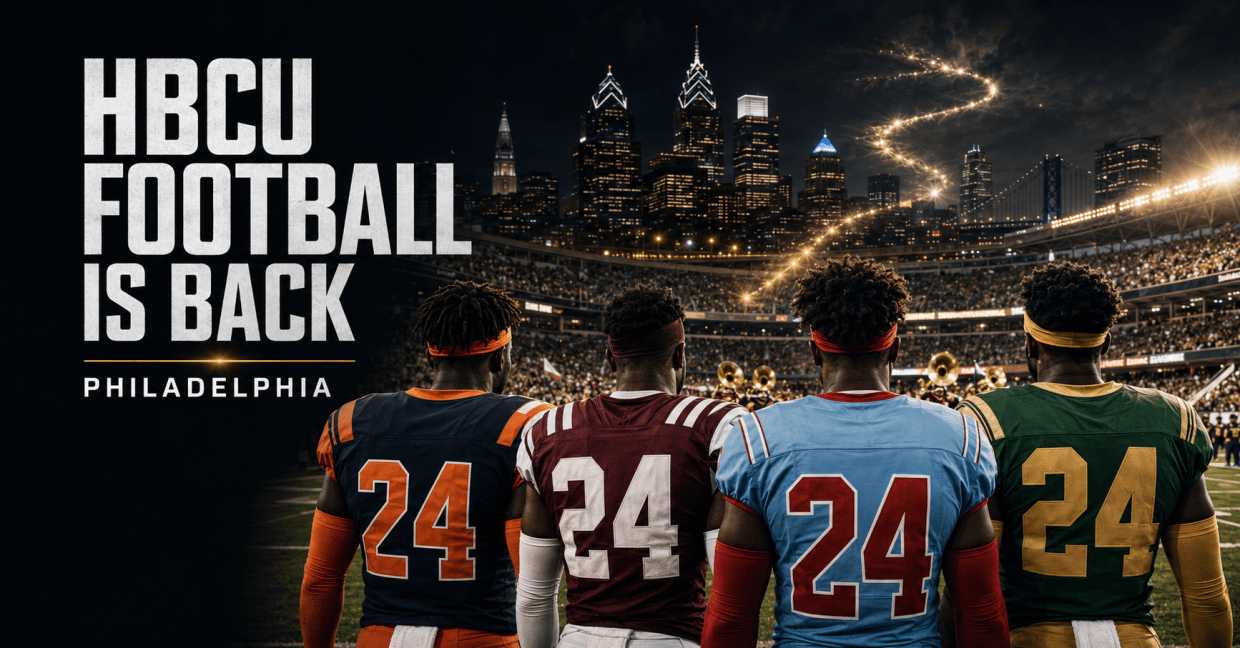
Philadelphia will host two HBCU football games on consecutive days this fall. One brings Lincoln University back to the city after a 16-year absence. The other builds upon the 47,266 fans who filled Lincoln Financial Field for Delaware State and Norfolk State last October.
Together, the games represent more than an expanded football schedule. Philadelphia is attempting to restore a connection to HBCU football that once ran through Lincoln, Cheyney and the players those programs sent into the NFL.
Lincoln will face Virginia Union on Friday, Oct. 30. Delaware State and Norfolk State will return for their MEAC rematch Saturday, Oct. 31. Both games will be played at Lincoln Financial Field with support from the City of Philadelphia and the Eagles.
The opportunity extends beyond one weekend. Philadelphia could provide HBCU football with a consistent Northeast stage for recruiting, alumni engagement and exposure. First, however, the city must reconnect a regional audience with a game that has become increasingly difficult to find close to home.
Philadelphia’s HBCU football roots run deep
Philadelphia is not being introduced to HBCU football. The city sits near two institutions that helped establish Black higher education in America.
Cheyney University was founded in 1837, while Lincoln University was founded in 1854. Their football rivalry became known as the Battle of the Firsts, a reference to the historic standing of both institutions.
Lincoln and Cheyney renewed that rivalry in Philadelphia in 2009. The official game record listed 3,500 fans at Northeast High School as Lincoln won the Wade Wilson Classic, 41-20. The schools returned to the city for another game in 2010.
However, Cheyney discontinued football after the 2017 season. Its departure eliminated Pennsylvania’s natural HBCU rivalry and reduced the sport’s visibility across the region. Lincoln also stopped playing games in Philadelphia, leaving the city without a consistent connection to nearby HBCU football.
Cheyney’s influence once reached the NFL. Former defensive back Andre Waters played safety for the Philadelphia Eagles, a connection the organization recognizes in its history of Eagles from HBCUs.
James “Big Cat” Williams also entered the NFL from Cheyney as an undrafted free agent. According to the Chicago Bears, he became a Pro Bowl offensive tackle during a 12-season career with the franchise.
Those connections matter because rebuilding HBCU football in Philadelphia also means recovering part of the city’s sports history. The tradition existed long before DeSean Jackson and Michael Vick became college coaches.
One crowd reopened the door
Delaware State and Norfolk State showed how much interest remained.
Last October, 47,266 fans entered Lincoln Financial Field for the inaugural Battle of the Legends. Former Eagles teammates Jackson and Vick created national attention, while Delaware State’s 27-20 victory gave the crowd a competitive game.
The attendance exceeded early expectations. Delaware State athletic director Tony Tucker told HBCU Gameday that people questioned the plan when the school first discussed moving the game to Philadelphia.
“You’re not gonna get … 10,000 people,” Tucker recalled hearing.
Instead, the event attracted more than four times that prediction.
“We basically shocked the world,” Tucker said.
He credited “the whole entire HBCU community” and what he called “a big shot in the arm from the City of Philadelphia and Mayor Parker.” The turnout suggested Philadelphia’s HBCU audience had not disappeared. It simply lacked a regular event around which to gather.
The game also received national exposure on ESPNU and “Good Morning America,” according to Delaware State. Bands, a step show, a fan zone and student opportunity programs helped turn the matchup into a broader HBCU experience.
Tucker now expects the return to draw “somewhere north of the 50,000 mark.” Reaching that number would strengthen the case for Philadelphia as a recurring HBCU football destination. Still, the addition of a second game may reveal even more about the region’s potential.
Lincoln’s return makes this a regional story
Delaware State–Norfolk State proved Philadelphia would support an event built around Jackson and Vick. Lincoln–Virginia Union will test whether the audience will support HBCU football without the same celebrity hook.
Lincoln finished 0-10 last season, including a 66-21 loss to Virginia Union. The Lions are also 1-16 in the series. Therefore, Friday’s game cannot depend on rankings or competitive balance to create its appeal.
Its value comes from Lincoln’s connection to Philadelphia. The university sits roughly an hour outside the city, recruits from the region and counts Mayor Cherelle Parker among its graduates. Bringing Lincoln back gives Philadelphia-area students and alumni a direct connection to their nearest active HBCU football program.
Support for Friday’s game would show that last year’s attendance represented more than Eagles nostalgia. It would suggest Philadelphia can support CIAA and MEAC programs while connecting Division II and Division I HBCU football within the same weekend.
That makes Lincoln–Virginia Union central to the rebuilding effort, not simply an opening act. Delaware State and Norfolk State bring the established crowd. Lincoln brings the local history Philadelphia must reclaim.
What One Philly HBCU Week is designed to become
The two games will serve as the centerpiece of One Philly HBCU Week, a new partnership involving Delaware State, Philadelphia and the Eagles. Organizers have not released a complete weeklong schedule. However, Delaware State has announced plans for expanded youth access, college and career programming, bands and other cultural activities around the games.
For now, the initiative is an umbrella for a developing HBCU football platform. Its importance will depend on whether the programming eventually reaches Philadelphia schools, neighborhoods, alumni chapters and prospective college students.
Parker connected that mission to her experience as a Philadelphia public-school graduate who attended Lincoln.
“I know firsthand what it means for a young person to walk into a room and see excellence that looks like them,” Parker said in Delaware State’s announcement.
That visibility can introduce local students to HBCUs before they begin making college decisions. Meanwhile, the games can provide participating schools with recruiting access, alumni engagement and a presence in the nation’s fourth-largest media market.
Delaware State President Tony Allen said HBCU alumni and families are concentrated throughout the Northeast corridor. Philadelphia’s location allows it to draw from New York, New Jersey, Delaware, Maryland, Washington and Virginia without asking one campus to carry the entire event.
The city does not need to create an HBCU audience from nothing. It must reconnect an existing audience to the institutions and football traditions already surrounding it.
The Eagles give the revival infrastructure
The Eagles’ involvement separates this effort from a promoter renting a large stadium for one game. Their participation provides Lincoln Financial Field, organizational credibility and connections to Philadelphia’s football audience.
Eagles chief operating officer Frank Gumienny confirmed that the stadium would host both matchups in partnership with the city. He said the organization expected to welcome the participating schools, families, alumni and supporters.
That support cannot guarantee a tradition. However, it gives HBCU football the infrastructure needed to build one. City involvement can connect the event to public schools and community programs, while the Eagles can help broaden its visibility.
Financial questions still matter. Organizers have not released the revenue model, sponsorship details or long-term agreements surrounding the weekend. Each school must receive enough institutional and financial value to justify returning.
However, those questions should serve the larger goal. The purpose is not merely filling an NFL stadium twice. It is rebuilding a dependable Northeast home for HBCU football.
Philadelphia has the opportunity to make it permanent
One successful crowd does not create a revival. Two games do not automatically establish a tradition, either.
The real measure will be whether Philadelphia continues bringing HBCU football back after Jackson and Vick are no longer the primary attraction. An annual weekend could rotate programs, strengthen Lincoln’s connection to the city and give Northeast alumni a recurring destination.
The foundation already exists. Philadelphia has the history, alumni population, NFL partnership and geographic location. Last year’s 47,266 fans proved the audience could still be activated.
This October represents the next step. Delaware State–Norfolk State can expand the crowd, while Lincoln–Virginia Union can reconnect the city with its local HBCU football roots.
Philadelphia is not trying to invent a new tradition. It is trying to bring one home and give HBCU football a stronger future in the Northeast.
Good article here.
I’m glad that The Lic is keeping both games. I was afraid that the Norfolk-Del State game was going dethrone the Lincoln University game, due to profitability measures.
This seems like a big win for everyone involve.