
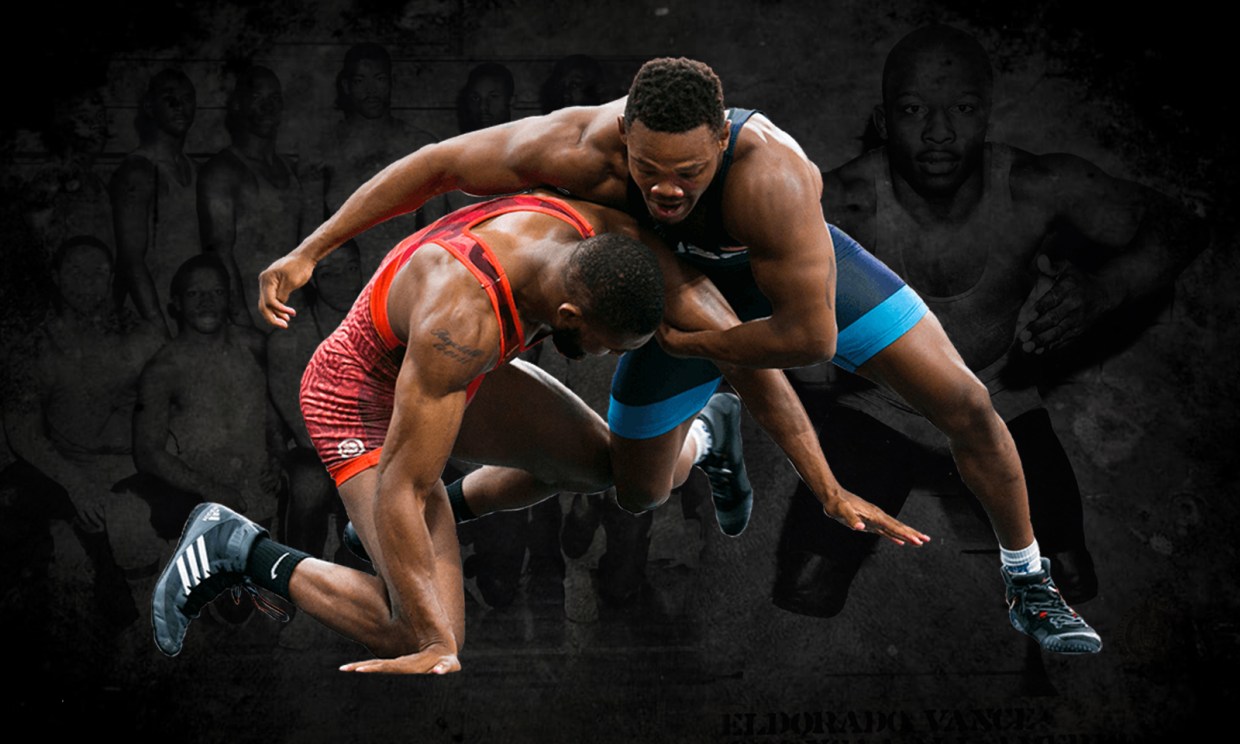
HBCU wrestling didn’t begin as an experiment. From the start, conferences organized it, sanctioned it, and competed seriously.
The Central Intercollegiate Athletic Association, founded in 1912, sponsored wrestling as early as the 1940–41 season. As a result, it became the first historically Black athletic conference known to support the sport. When Clarence Carter of Virginia State University won the 125-pound CIAA title in 1941, he didn’t symbolize possibility. He demonstrated reality.
Over the next several decades, CIAA programs such as Virginia State, Lincoln University of Pennsylvania, Howard University, Morgan State University, Norfolk State University, and Winston-Salem State University rotated championships and produced individual standouts.
At the same time, incomplete archives make this era harder to trace. I relied on yearbooks, old NCAA guides, archived newspapers, and alumni accounts to confirm results. Because of that reality, gaps in the record reflect gaps in preservation—not gaps in competition.
Competing Across Conferences: MEAC, CIAA, and Everyone Else
Wrestling in a non-HBCU conference gave me a different vantage point—one I didn’t fully appreciate until much later.
At Cheyney, our schedule crossed boundaries constantly. We wrestled MEAC and CIAA teams, lined up in Division I dual meets, and entered open tournaments where classification meant nothing. One weekend, we faced a Division I opponent. The next weekend, we prepared for an HBCU program with a reputation you felt even if no one explained it.
Because of that exposure, the mindset never changed based on conference. When we wrestled Morgan State or Winston-Salem State, we prepared for the standard. We didn’t talk about surviving those matches. Instead, we talked about challenging them.
At the time, we didn’t know the full history behind that standard. No one handed us a list of championships or All-Americans. Still, the competitive reality spoke clearly. You respected the room. You trained differently. You understood that a hard match against them carried weight.
Looking back now, that instinct makes sense.
The Standard Bearer: Morgan State and the Power of Elite Coaching
Among HBCU programs, Morgan State set the standard.
That status came from results, not reputation, and elite coaching made the difference.
Under legendary head coach James Phillips, Morgan State built one of the most consistent programs in NCAA Division II wrestling. Phillips earned Coach of the Year honors 12 times and developed more than 75 All-Americans, along with multiple national champions.
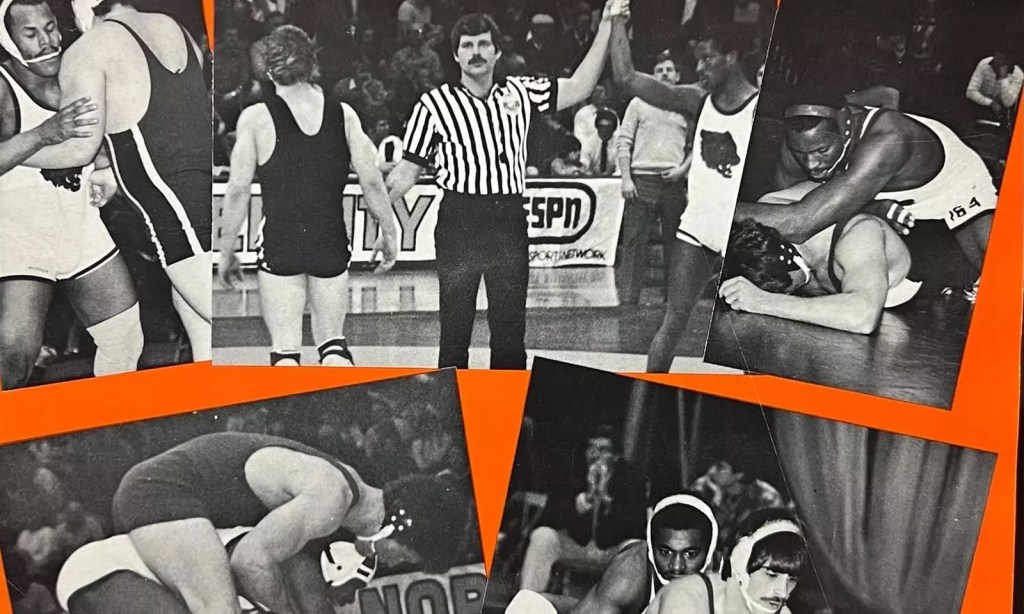
Wrestlers such as John Davis, a four-time Division II All-American, Greg Veal, a Division II national champion, and Emanuel Yarbrough, a national podium finisher, didn’t succeed by chance. Phillips built a system that emphasized development, discipline, and repeatability. As a result, Morgan didn’t flash excellence briefly. It sustained it.
From my perspective as a competitor, Morgan always represented the bar—even before I understood the depth of its legacy.
The Peak Years: HBCU Wrestling in the 1970s, 1980s, and 1990s
By the late 1970s and into the 1990s, HBCU wrestling reached its competitive peak, largely at the NCAA Division II level.
During the 1980s, Winston-Salem State dominated the CIAA, winning five straight team championships from 1980 to 1984 and later reclaiming titles in 1988, 1989, and 1990. At the same time, the Rams produced elite individuals. Donnell Rawls won an NCAA Division II national championship and later placed at the NCAA Division I Championships, proving HBCU wrestlers could succeed at the highest levels.
Meanwhile, Norfolk State produced national finalists and All-Americans such as James Lee and Kirwyn Adderley, reinforcing that excellence spread across multiple programs.
At Cheyney, competing in the Pennsylvania State Athletic Conference, the margin for error stayed razor thin. Kendall Southerland finished as a national runner-up. Herman Moultrie placed fourth in the nation. Between 1992 and 1995, I qualified for four consecutive national tournaments.
At the time, we weren’t chasing legacy. We focused on surviving brackets. Only later did I recognize how closely our experience aligned with a much longer competitive lineage.
Lost, Not Erased — and Hard to Recover
When people say HBCU wrestling disappeared, I understand the instinct. However, that explanation skips what actually happened.
The wrestling didn’t decline. Instead, administrative pressure, Title IX compliance challenges, rising costs, and shifting priorities pushed programs to close. As a result, competition stopped quietly. Record-keeping stopped with it.
While compiling this history, I encountered missing yearbooks, incomplete conference summaries, and fragmented tournament results. Because no centralized archive existed, confirming championships often required cross-referencing multiple sources. Over time, that lack of preservation made it easier for this era to fade from public memory.
That’s why this legacy feels lost rather than erased.
HBCU wrestling continued producing champions while documentation thinned. The silence came from neglect, not failure.
The Present: Proof the Standard Still Exists
This history matters because it connects directly to the present.
Today, Morgan State competes again at the Division I level. As of December 2025 and January 2026, wrestlers such as Eugene Harney and Javaan Yarbrough have cracked the Division I Top 33 national rankings, confirming that elite talent still flows through HBCU programs.
At the Division II level, Allen University and Bluefield State University are rebuilding varsity programs where HBCUs historically thrived.
Meanwhile, club teams at Florida A&M University and Xavier University of Louisiana maintain access and participation, keeping pathways open.
On the women’s side, Delaware State University launched the first NCAA Division I women’s wrestling program at an HBCU, creating opportunities that never existed during the sport’s first rise.
Final Word
I wrestled without knowing how much history stood beneath my feet.
The champions existed.
Elite coaching built them.
Quality wrestling sustained them.
What disappeared was the record—and the responsibility to protect it.
We weren’t erased. Instead, we were lost.
By telling this story accurately and honestly, I’m doing more than preserving history. I’m reconnecting today’s wrestlers to a standard that never vanished—it simply waited to be found again.