
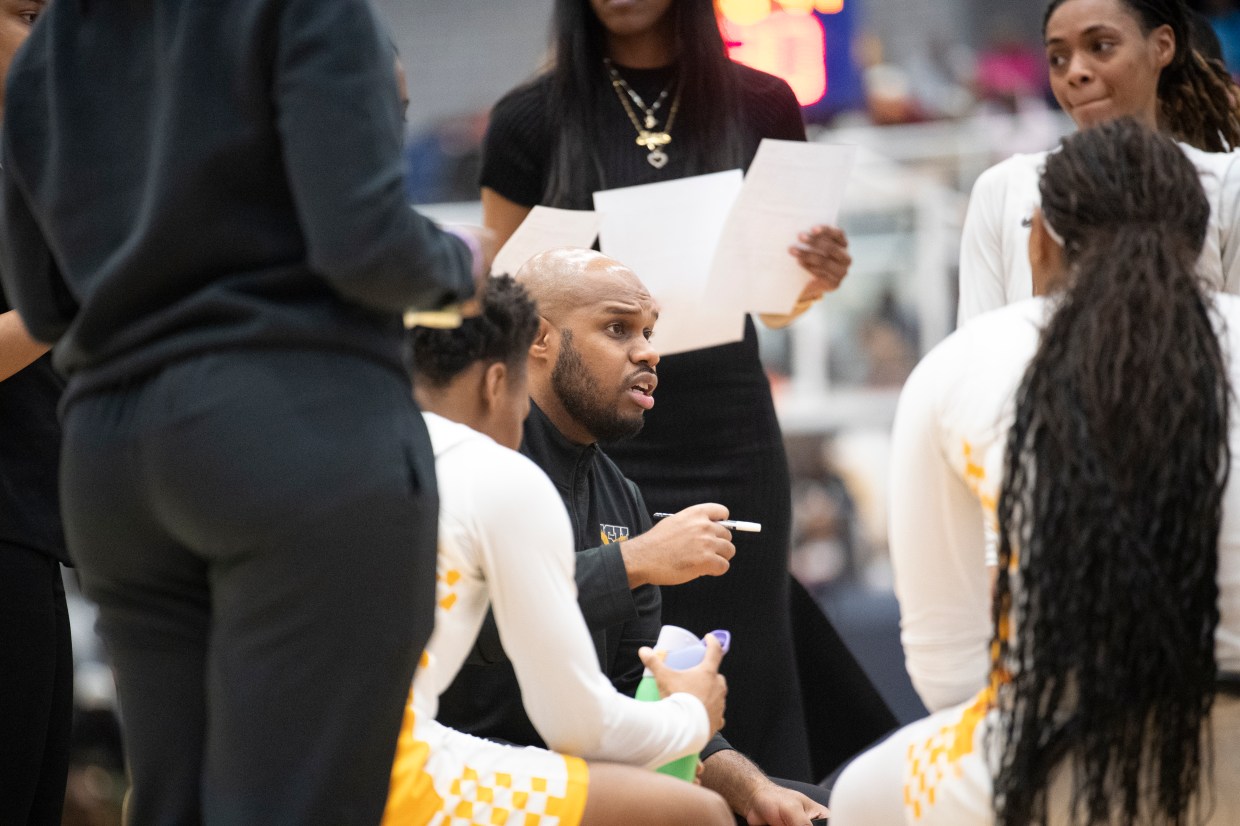
Coppin State women’s basketball didn’t ease into the season. Instead, Coppin State chose the gauntlet — a demanding nonconference schedule that tested the program early and prepared this HBCU for the realities of MEAC play, long before the games began to count.
From the start, head coach Darrell Mosley framed the challenge clearly.
“This is the very last and final game of the gauntlet,” Mosley said after nonconference play ended.
That wasn’t relief.
Instead, it marked intention.
The Gauntlet Was on the Schedule
The gauntlet wasn’t symbolic. Rather, it showed up directly on the calendar. Coppin State traveled to face Ohio State, Penn State, Towson, and Tennessee. In addition, the Eagles played neutral-site games against Oklahoma and Georgia, while mixing in road tests before MEAC play began.
That approach didn’t ease Coppin State into the season.
Instead, it forced early answers.
By the time the Baltimore HBCU reached January, the Eagles had already faced elite size, elite pace, and elite execution. As a result, Mosley saw exactly what he wanted his team to experience before conference play.
What the Gauntlet Exposed
Against power-conference opponents, teams can’t hide. Turnovers become points. Defensive lapses become runs. Consequently, belief gets tested quickly.
“I think it took us too long to actually believe that we can compete,” Mosley said.
Early on, that belief gap showed. However, as the gauntlet continued, Coppin State responded. The Eagles settled into possessions, competed physically, and handled pressure more consistently. Ultimately, the schedule didn’t flatter Coppin State — it strengthened them.

Why Mosley Trusts the Gauntlet
Mosley’s approach comes from experience, particularly from his time at Lincoln University.
“When I was at Lincoln, a Division II program not fully funded, we had to play Division I schools to raise money,” Mosley said.
“To get sneakers. To be able to feed them. To do bonding things that weren’t in the budget.”
That reality shaped his coaching philosophy.
As Lincoln improved, the competition increased.
“We started playing Maryland and Syracuse,” Mosley said.
“The check got bigger, but the beating got worse.”
Even so, those games built toughness and perspective. Today, Mosley applies those same lessons at Coppin State.
Lessons Carrying Into MEAC Play
Coppin State didn’t leave the gauntlet empty-handed.
“To be able to come out and win the rebounding battle with six-seven, six-eight players on the other side is phenomenal,” Mosley said.
That physical response matters, especially in the MEAC, where effort often decides close games.
At the same time, the gauntlet exposed Coppin State’s biggest challenge: turnovers. Against elite teams, mistakes turned into points immediately. Still, that lesson arrived early enough to matter. If corrected, it can pay off in conference play.
No Excuses Moving Forward
Despite being in his first season, Mosley didn’t ask for grace.
“No excuses about this being my first year,” he said.
“We got to do our homework. We got to prepare for everybody.”
That line defines where Coppin State stands. This isn’t a rebuild. Instead, it’s a recalibration.
The gauntlet didn’t define Coppin State’s season.
Instead, it framed it — and now Coppin State women’s basketball gets to find out what those lessons are worth in HBCU play.