

The Celebration Bowl, the HBCU national championship game, already occupies the same broadcast window.
For decades, the Army Navy Game has occupied some of the most protected real estate on the college football calendar. Played on the second Saturday of December, the rivalry stands alone — insulated by tradition, television exclusivity, and national attention — except in HBCU football, where the sport’s own national championship quietly shares the same December stage.
Now, that protection is back in the spotlight.
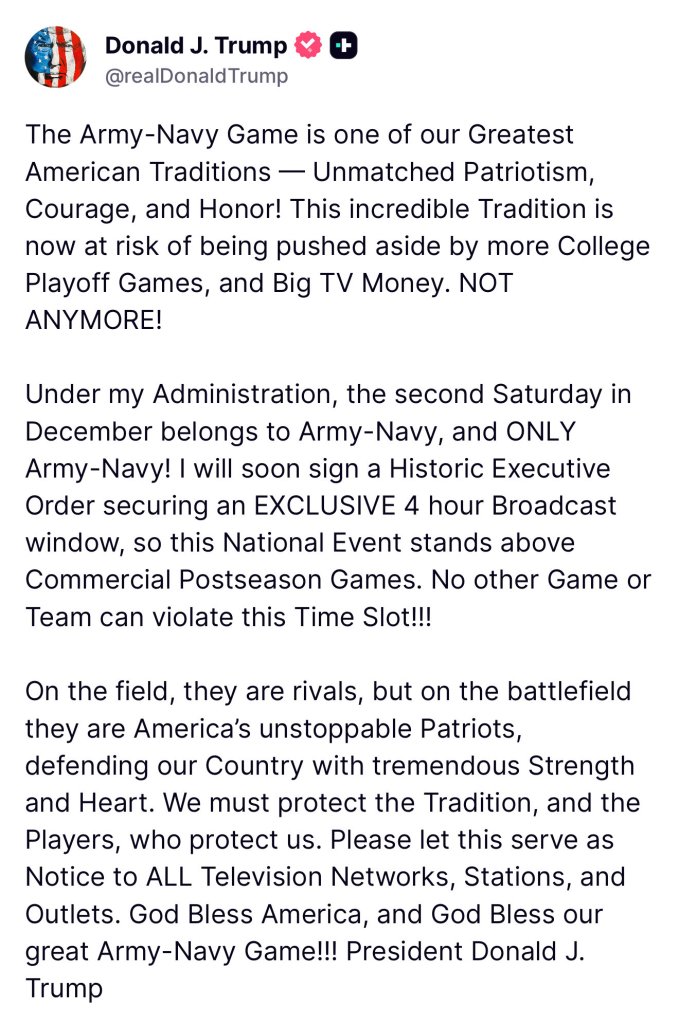
President Donald Trump recently vowed to “protect” the Army–Navy Game amid ongoing discussions about expanding the College Football Playoff. While the focus of those talks centers on CFP scheduling, the ripple effects could extend beyond the playoff — raising quiet but important questions for HBCU football, particularly the future positioning of its national championship game, The Celebration Bowl.
HBCU Football’s Biggest Stage Shares the Date
In 2025, the overlap was impossible to ignore.
The Celebration Bowl, widely recognized as the HBCU national championship game, kicked off at noon ET on Saturday, December 13, airing nationally on ABC from Mercedes-Benz Stadium in Atlanta. That same afternoon, the Army–Navy Game kicked off at 3:00 p.m. ET on CBS.
With most college football broadcasts running three to four hours, the Celebration Bowl was still live when Army–Navy began — placing HBCU football’s premier postseason event directly inside the same four-hour mid-December window now being discussed as “exclusive.”
For the past two years, the Celebration Bowl has been held on the same Saturday as Army–Navy. ESPN and ABC have continued to program the Celebration Bowl, recognizing both the audience and the symbolism of staging the HBCU championship on college football’s biggest December weekend.
What the Proposed Order Actually Targets
To be clear, the current conversation is not about HBCU football — at least not explicitly.
Donald Trump’s comments and the reporting surrounding them focus on the College Football Playoff, specifically preventing future CFP first-round games from infringing on Army–Navy’s long-standing standalone television window as the playoff expands.
There has been no public indication of:
- A blanket prohibition on all college football during that window
- Federal authority over non-CFP bowl games
- Or a direct challenge to existing HBCU football broadcasts
From a policy standpoint, the Celebration Bowl is not being targeted.
But context matters.
The Question That Can’t be Ignored
If the goal becomes a truly “exclusive” Army–Navy game window — one where no other college football broadcasts compete for attention — then HBCU football inevitably enters the conversation, whether named or not.
The Celebration Bowl is:
- A championship game
- One of the most-watched annual HBCU football events
- A nationally televised broadcast on a major network
Yet it remains absent from the discussion of exclusivity.
That omission exposes a familiar tension in college athletics: whose traditions are automatically protected, and whose are expected to adjust?
HBCU football has rarely been afforded institutional shielding. Its growth has come through innovation, strategic partnerships, and reclaiming space — not through formal guarantees. The Celebration Bowl itself was created to give HBCU football a championship moment independent of the FCS playoff structure, not one relegated to the margins.
Power, Precedent, and Visibility
Legally, an executive order dictating private broadcast schedules would face significant limitations. Networks operate independently. The Celebration Bowl is not governed by the CFP. And Army–Navy has coexisted with overlapping college football games — including HBCU football — for years without controversy.
But symbolism carries weight.
If exclusivity becomes the prevailing language around December scheduling, then future calendar reshuffling becomes a question of priorities. History suggests that when space tightens, HBCU football is more often asked to move than to be defended.
The Bottom Line for HBCU Football
As of now, nothing has changed.
The Celebration Bowl remains intact. No rescheduling has been proposed. No policy in Donald Trump’s proposed order explicitly threatens HBCU football’s championship stage.
Still, the 2025 calendar tells the story plainly: HBCU football’s national championship already exists in the same window now being labeled sacred.
As college football continues to reshape December around playoff inventory and television value, the real issue isn’t whether HBCU football is mentioned in the conversation.
It’s whether it’s considered.
And whether, when tradition is being protected, HBCU football is included in the definition of what matters.
Just luv great ? competition ?