
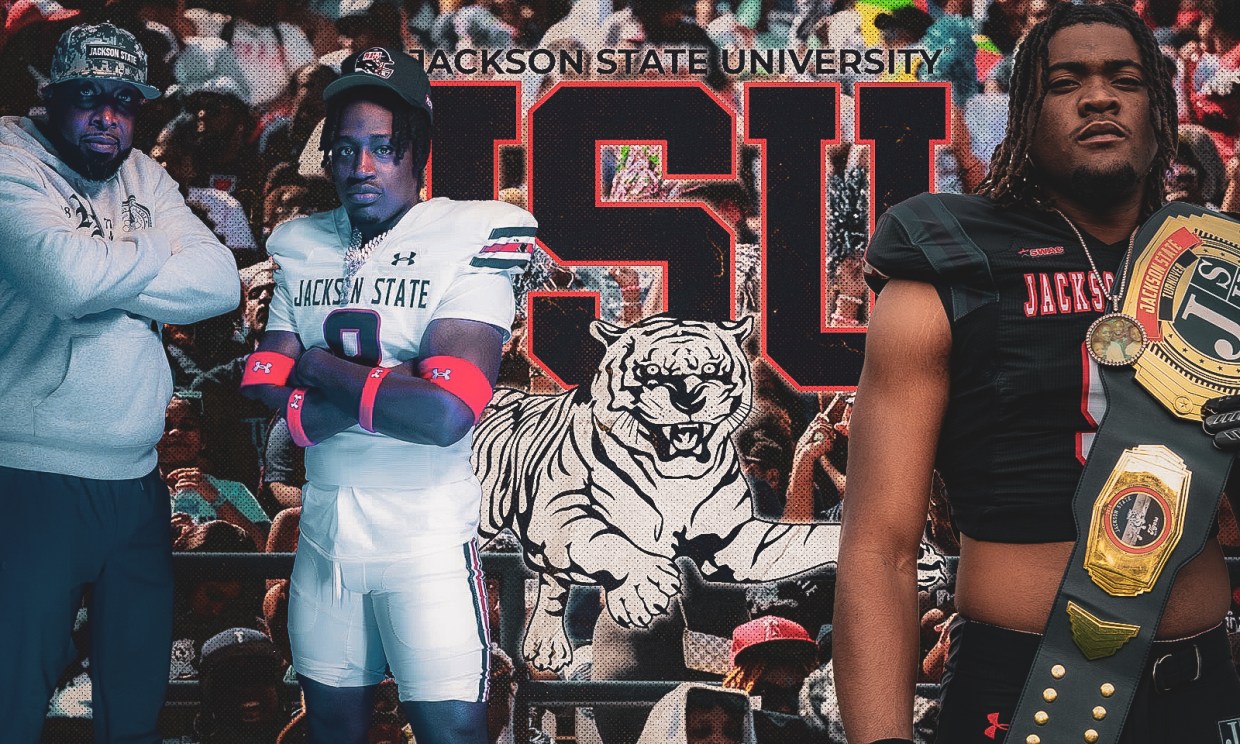
The NCAA Transfer Portal can take away just as fast as it gives. In the modern era of college football, that reality is unavoidable — even for one of the most visible brands in HBCU football. Jackson State has watched multiple stars leverage success in Jackson into Power Four opportunities this offseason.
Former All-SWAC running back Ahmad Miller turned a 1,000-yard season into an ACC commitment at Syracuse. Fellow Jackson State back Travis Terrell Jr. followed shortly after, committing to Purdue and continuing the growing HBCU-to–Power Four pipeline.
But instead of retreating, Jackson State responded.
Over the weekend, the Tigers made it clear that while the portal may take talent out, it can also be used to reload — aggressively, strategically, and publicly. Jackson State rolled out a massive transfer class, highlighted by Power Four experience, productive HBCU defenders, and Group of Five contributors, all under a unified message: #GuardTHEEyard.
The New Reality of HBCU Football
For years, there has been debate about whether HBCU football serves as a developmental pathway to higher levels of the sport. That debate no longer applies—not because HBCUs are losing talent, but because college football is inherently developmental.
Delaware State running back Marquis Gillis recently illustrated this truth in raw terms. After a dominant MEAC season, Gillis transferred to Arizona State, openly explaining the realities that players now face.
“The transfer portal is crazy,” Gillis told 247Sports. “I need to feed my family.”
That honesty cuts to the core of today’s NCAA Transfer Portal landscape. Players move because opportunity, timing, finances, and career windows matter. HBCU coaches understand this. Players understand this. And programs that survive and thrive are the ones that adapt.
Jackson State has adapted.
Reloading Through the Portal, Not Rebuilding
Rather than framing departures as losses, Jackson State treated the portal as a marketplace — one where experience, production, and fit matter more than star ratings alone.
According to Director of Player Personnel Mario Magana Jr., Jackson State hosted 28 official transfer portal visits and secured 25 commitments, a staggering conversion rate that underscores the program’s recruiting infrastructure and reach.
That class includes multiple defensive reinforcements and trench pieces designed to immediately stabilize the roster.
One of the headline additions is Jaekwon Bouldin, an in-state Mississippi lineman with Power Four experience. Bouldin committed to Mississippi State after starring at Mississippi Gulf Coast Community College, where his offensive line helped average more than 235 rushing yards per game. His return home adds size, pedigree, and depth to Jackson State’s front.
HBCU Talent Circulating Within the Ecosystem
Jackson State also leaned heavily on the talent within HBCU football itself.
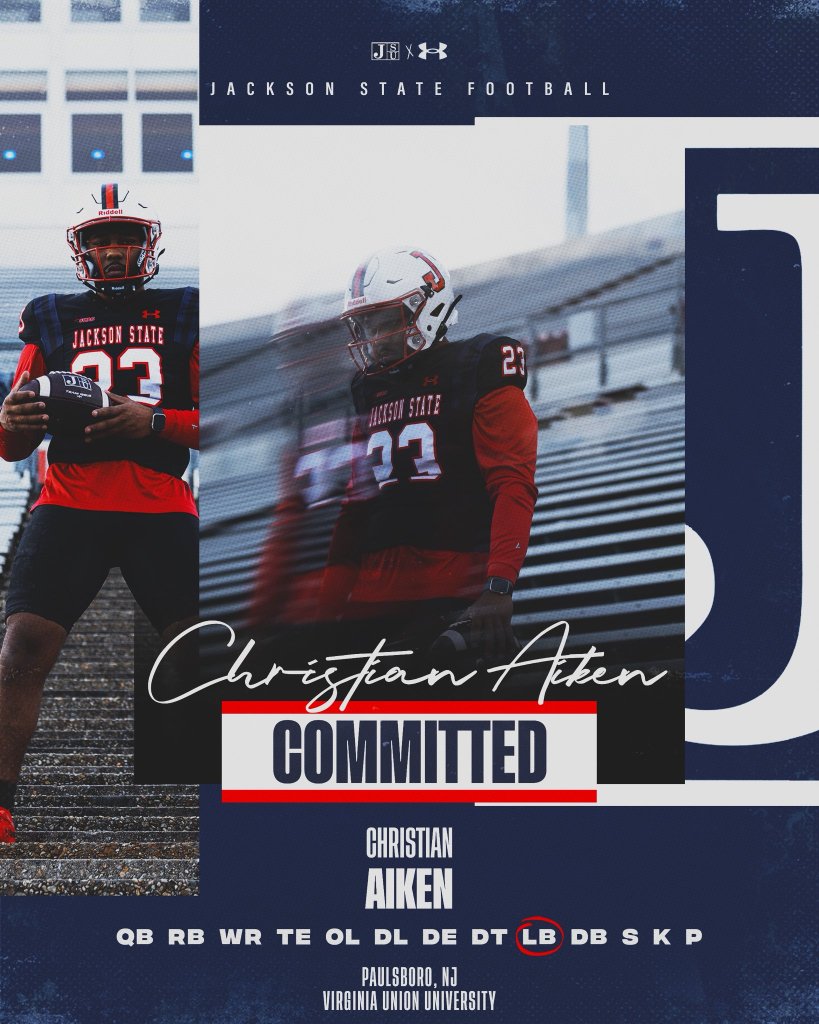
Former Virginia Union standout Christian Aiken arrives after a productive 2025 season in which he posted 24 total tackles, three tackles for loss, and 1.5 sacks. Aiken’s résumé reflects steady growth across multiple stops, with prior production at Pace University, where he led his team in tackles.
From Tennessee State, Micah Gay brings proven FCS production and versatility. Gay recorded 61 total tackles, 3.5 tackles for loss, and two interceptions in 2025, highlighted by an 11-tackle, two-interception performance against Howard. His physicality and range give Jackson State another experienced defensive chess piece.
These additions reinforce a growing truth: HBCU football is not only exporting talent upward — it is circulating and strengthening internally as well.
Group of Five Experience Joins the Mix
Jackson State also dipped into the Group of Five pool, adding multiple defenders with FBS experience.
Former Eastern Michigan defenders Duke Clayton and Messiah Blair bring length, athleticism, and time-tested competition against FBS opponents. Blair, once rated a three-star prospect and among the highest-ranked recruits in EMU history, brings pass-rush upside and special-teams value. Clayton adds depth to the interior after productive junior-college seasons and limited but meaningful MAC exposure.
In the secondary, Virgil Marshall arrives after stints at Western Kentucky and Eastern Kentucky, bringing experience in both bowl games and Conference USA play. His ball skills and positional versatility give Jackson State options in coverage-heavy looks.
Media as a Recruiting Weapon
While personnel decisions matter, Jackson State’s portal success cannot be separated from its media machine.
Over the weekend, Jackson State’s award-winning media team took over social platforms, rolling out high-quality photography, cinematic video, and coordinated graphics announcing each addition. Every post carried a unified brand identity and the now-signature hashtag #GuardTHEEyard.
In today’s college football landscape, media is no longer supplemental — it is central. Recruits want visibility. Families want professionalism. Players want to feel seen.
Jackson State understands this reality better than most.
The Tigers have built a recruiting ecosystem where traditional evaluations, NIL conversations, player development, and media exposure work together—not separately. That alignment continues to pay dividends in moments like this.
The Portal Gives, and the Portal Takes
Earlier this week, Jackson State also showed the other side of the portal coin when Kam Sallis opted to return to the program despite receiving Power Four interest. His decision reinforced that while some players move on, others buy in deeper.
That balance defines modern HBCU football.
Elite players will leave for Power Four opportunities. Others will stay. And programs like Jackson State will reload — not with hope, but with intention.
Jackson State Isn’t Falling Behind — It’s Adjusting
This NCAA Transfer Portal cycle has not weakened Jackson State’s brand. If anything, it has highlighted the program’s position in the new college football economy.
The Tigers continue to develop players good enough for the ACC and Big Ten. They continue to attract transfers with Power Four and Group of Five experience. And they continue to leverage media, infrastructure, and recruiting strategy to stay competitive.
In the new reality of college football, success is no longer defined by who you lose — it’s defined by how you respond.
Jackson State has responded loudly.