
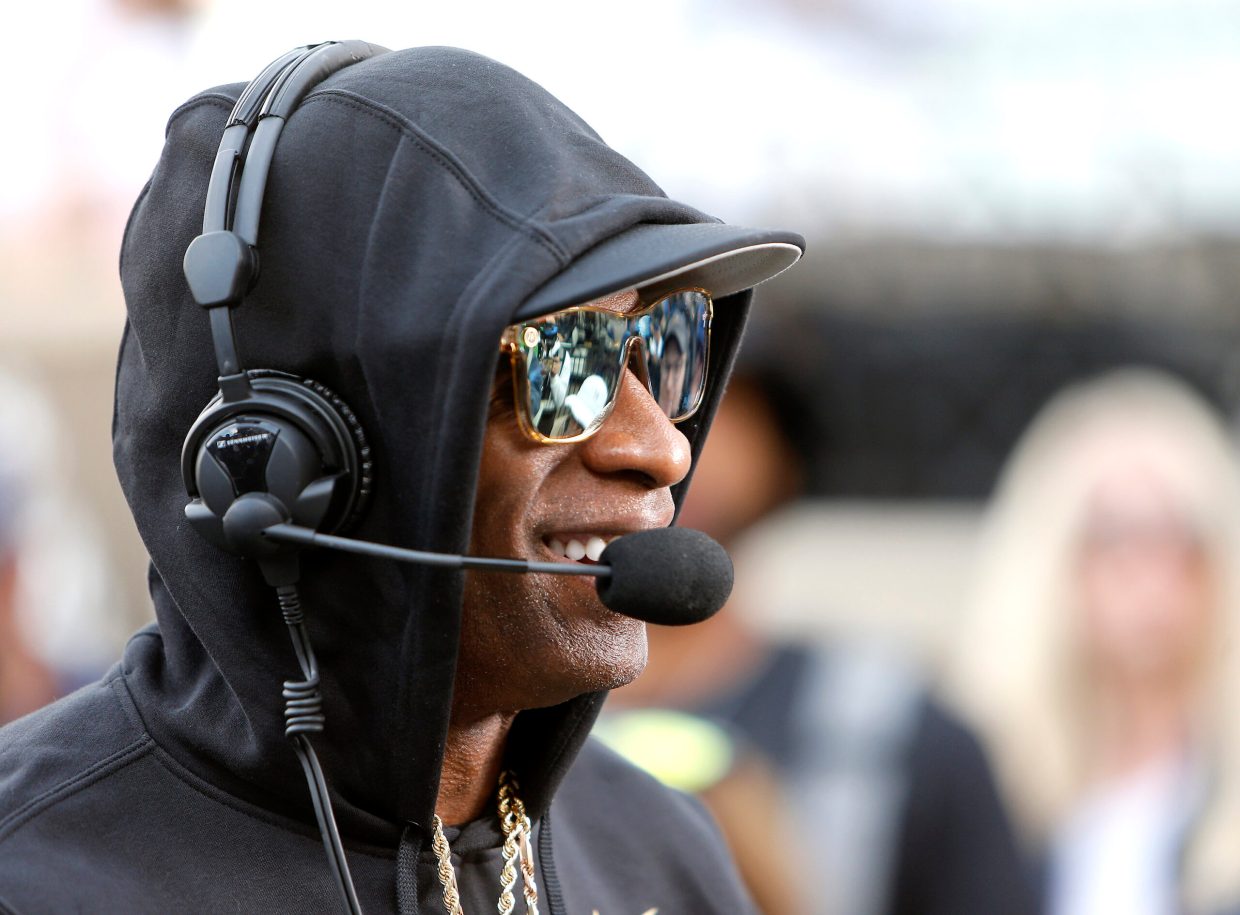
Deion Sanders is in the midst of a losing season at Colorado, but the former Jackson State head coach is finding vocal support from prominent figures who believe his impact extends beyond wins and losses.
The Buffaloes are 4–6 entering the final two games of the regular season, and last weekend Colorado delivered arguably the biggest victory of the Coach Prime era, knocking off No. 14 Houston 42–32.
The November 13 victory was Colorado’s first over an Associated Press top-15 opponent since 2007. It also kept the Buffaloes’ bowl hopes alive and provided a reminder of the possibilities that accompanied Sanders’ arrival in Boulder four years ago.
Still, the discussion surrounding Coach Prime has extended well beyond football.
The word “circus” has surfaced in conversations about Sanders and his program, a characterization that has drawn objections from supporters who believe it unfairly diminishes the work being done at Colorado.
While no single origin for the description has been established, its use has prompted a broader discussion about how Sanders, his players and the program are portrayed.
Among those pushing back are former NFL star Aqib Talib and former Colorado quarterback Charles S. Johnson. Meanwhile, sports commentator Skip Bayless is urging Colorado’s leadership to recognize Sanders’ value, and hip-hop pioneer Luther “Uncle Luke” Campbell believes Sanders should be a leading candidate for the Florida State coaching job.
Their arguments are not identical, but they share a common theme: Sanders’ influence should not be measured exclusively by the scoreboard.

Aqib Talib pushes back against the ‘circus’ characterization
Former NFL cornerback Aqib Talib took exception to the description of Sanders’ Colorado program as a circus.
Responding to a social media discussion questioning the language used to describe the Buffaloes, Talib pointed to his own family’s connection to the university.
“A circus??? My nephew attends CU!!! I guess he is part of the circus also!!!” Talib wrote on X.
He also questioned why Sanders’ leadership of young men, both on and off the football field, would warrant such a description.
Talib’s nephew, Yamil Talib, is a defensive end at Colorado, giving the former NFL standout a personal connection to the program.
His response followed comments from Regina Jackson, who questioned whether the term “circus,” when applied to Sanders and his players, carried racial overtones.
The exchange highlighted a sensitive dimension of the conversation. Although criticism of Colorado’s on-field performance is legitimate, some supporters believe the language used to characterize the program goes beyond ordinary football analysis.
Former Colorado quarterback challenges the narrative around Deion Sanders
Charles S. Johnson, a former Colorado quarterback, also responded to Jackson’s comments.
Johnson said he objected to what he described as coded language surrounding the Buffaloes, particularly given the academic performance of Colorado’s football players.
“I do not appreciate the coded language when describing our program,” Johnson wrote on X.
He also pointed to the team’s academic achievements and said he had not heard reports of Colorado football players having problems with the law.
Johnson’s response raises another question about the standards used to evaluate Sanders’ program.
While victories and championships remain central measures of success in college football, player development, academic performance and conduct away from the field are also responsibilities of a head coach.
For Johnson and Talib, those considerations appear to be getting lost in the public conversation.
Skip Bayless urges Colorado to recognize Sanders’ value
Veteran sports commentator Skip Bayless has offered another defense of Sanders, this one directed squarely at Colorado’s leadership.
In a November 17 social media post, Bayless expressed hope that university decision-makers would continue to recognize what Sanders brings to the institution.
He described Sanders as a powerful presence whose influence extends to the football program, university and surrounding community.
“The man is a powerhouse with rare vision,” Bayless wrote.
Bayless also expressed confidence that Colorado’s teams would continue improving under Sanders.
His argument reflects one of the central debates surrounding Coach Prime: how much value should be placed on the attention, visibility and cultural influence he brings to a university when the football results fall short of expectations?
Sanders transformed Colorado into one of college football’s most discussed programs almost immediately upon his arrival in 2023.
Whether that transformation can produce consistent winning seasons remains an unanswered question.
Luther Campbell wants Coach Prime at Florida State
While Bayless wants Colorado to appreciate Sanders’ presence, Luther “Uncle Luke” Campbell believes the former NFL superstar could make an enormous impact at another university.
Campbell recently named Sanders his preferred candidate for the Florida State head coaching position.
The endorsement is particularly notable because Sanders played at Florida State, while Campbell has long been associated with the rival Miami Hurricanes.
“Turn Prime loose in the state of Florida at his alma mater and it’s going to be a problem,” Campbell wrote on X.
Campbell argued that Sanders’ ability to attract elite recruits would make Florida State one of the most exciting programs in the country.
His comments represent a different kind of support. Rather than defending Sanders against criticism of his Colorado record, Campbell is suggesting that Sanders remains an attractive coaching candidate for a major college football program.
Campbell also listed former Florida A&M football coach Willie Simmons as a potential coach for the FSU job. Sanders hasn’t been linked to the Florida State opening in any public or official capacity.
A dramatic turnaround at Jackson State, an uneven run at Colorado
Sanders’ journey to Colorado began at Jackson State, where he helped bring national attention to HBCU football.
During three seasons leading the Tigers, Sanders compiled a 27–6 record, won back-to-back SWAC championships and made Jackson State a major presence in college football conversations.
His success created expectations that followed him to Colorado.
The Buffaloes went 4–8 in his first season in 2023 before improving to 9–4 in 2024, when quarterback Shedeur Sanders and Heisman Trophy winner Travis Hunter helped lead the program to the Alamo Bowl.
But the momentum proved difficult to sustain.
Colorado finished 3–9 in 2025, and this year’s 4–6 record has left Sanders at 20–27 through his first 47 games in Boulder.
The numbers explain why questions about his performance have intensified. Colorado has produced one winning season during his four-year tenure and is fighting to avoid a third losing campaign.
Yet the Buffaloes’ victory over Houston provided a significant counterpoint.
Colorado rallied from a 20–7 deficit, scored 28 consecutive points and rushed for 249 yards in its upset of the nationally ranked Cougars.
It was the type of complete performance Sanders has been seeking throughout the season.
Following the victory, Deion Sanders praised the resilience of his players and coaching staff, emphasizing that the team had continued fighting despite its struggles.
What should define the Coach Prime era?
The debate surrounding Sanders is unlikely to be settled by one victory or one losing season.
His supporters point to the young men he mentors, the attention he generates, the opportunities he creates and the transformation in visibility that has followed him from Jackson State to Colorado.
His critics can point to the same four-year record and reasonably question why that attention has not translated into more consistent success.
Those positions are not necessarily mutually exclusive.
Sanders can be credited with elevating the national profile of Colorado football while also being held accountable for the team’s performance.
But the recent statements from Talib, Johnson, Bayless and Campbell demonstrate that the conversation surrounding Deion Sanders is considerably broader than whether the Buffaloes win their next game.
For a coach whose rise began at an HBCU and whose influence has extended well beyond the football field, the question of how his tenure should be judged remains as complicated as ever.
And with Colorado coming off its biggest victory in nearly two decades, the conversation is far from finished.