

HBCU marching bands have always competed for bragging rights, crowd reactions and cultural prestige. But the Red Lobster Band of the Year competition is increasingly giving programs something more concrete to prepare for: a national standard.
Now in its fourth year, the competition has evolved into more than a December championship event. For some programs, the judging criteria and monthly evaluations are becoming part of how directors structure rehearsals, evaluate individual units and plan performances throughout the season.
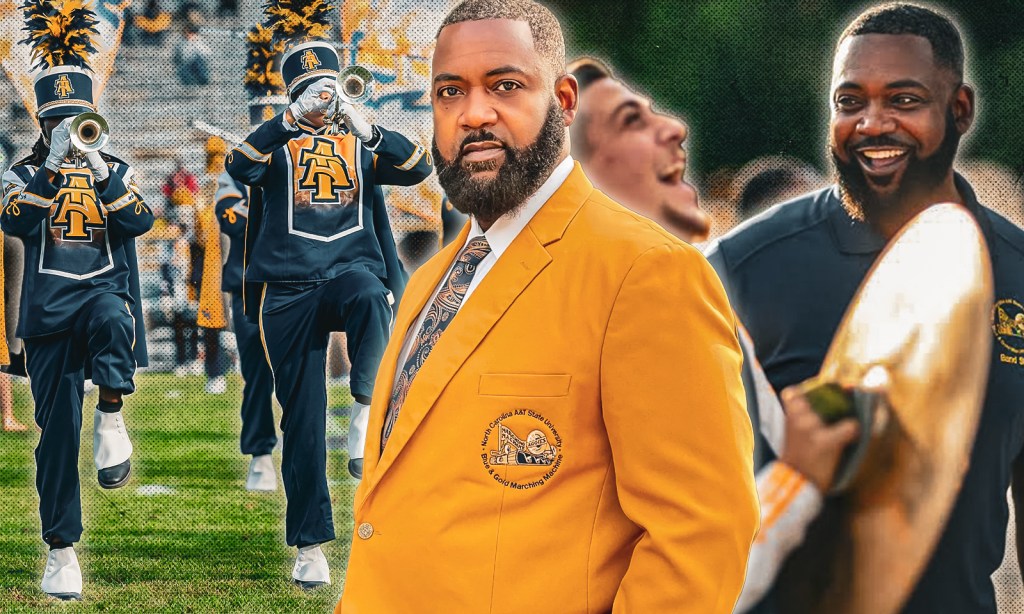
Former North Carolina A&T Director of Bands Dr. Kenneth Ruff knows that process from experience.
Ruff, now a co-chair for the Red Lobster Band of the Year, said the competition became a major part of how the Blue and Gold Marching Machine approached its season while he led the program.
“It was a major factor in what we did at A&T while I was there,” Ruff said. “I would sit down with staff at the very beginning of the year. I’d say, ‘Here’s the categories. Here’s what we need to do.’”
The work started before the first football game.
“Day one of band camp, I’m like, ‘Okay, Band of the Year is coming up,’” Ruff said. “You all want to participate, that means that we have to work.”
Many HBCU bands using rankings as a measuring stick
Ruff said North Carolina A&T did not simply wait for rankings to see where it stood.
Once scores arrived, he and his staff analyzed them and looked for areas where the band could improve. That could mean addressing musical performance, marching, auxiliary units or another part of the overall presentation.
Even individual units felt the urgency.
Ruff recalled speaking directly to Golden Delight, North Carolina A&T’s auxiliary, when he felt the group needed a stronger week because a performance was being prepared for Band of the Year submission.
That process, Ruff said, made the competition an educational tool regardless of whether a band ultimately won the championship.
“Even winning or losing, you’re still educating students and you’re still making your band program better,” Ruff said.
That philosophy reaches beyond North Carolina A&T.
Ruff said the evaluation system gives directors another structure for teaching students and identifying weaknesses within their programs.
“The rubric that’s provided to us as far as what we need to work on and the adjudication and the feedback, it all helps a band director just make his group better in all aspects of the program and all aspects of performance,” Ruff said.
Red Lobster Band of the Year demands complete performances
The competition is also pushing HBCU bands to think beyond one signature strength.
Red Lobster Band of the Year co-chair Professor Dowell Taylor said bands can no longer depend solely on the one area for which they are traditionally known.
Some programs may be known for power and volume. Others may have reputations built around musical finesse or marching precision.
Under the Band of the Year format, those areas are evaluated separately before being combined into an overall score.
“You have to kind of balance off your approach to the entire show,” Taylor said.
That emphasis appears to be affecting the field.
Taylor specifically pointed to Grambling State, Alcorn State and Miles College as programs that have elevated their performances since the competition began in 2023.
“They’ve upped the ante on what they’re presenting,” Taylor said, adding that programs are becoming more particular about every aspect of their performances.
Ruff has noticed similar development among Division II programs.
He said bands are paying closer attention to their drum majors, guards, percussion sections and musical execution instead of relying on one area to carry an entire performance.
HBCU bands already “on fire” in Year Four
The early results have Ruff excited about what could happen as the 2026 season progresses. While evaluating performances this fall, Ruff said the level of performance immediately stood out.
“When we started this year, bands have been on fire,” Ruff said. “They have really been doing some exceptional work.”
That creates another challenge for the programs involved.
The bands are not only competing against one another. They are attempting to improve from one evaluation period to the next before the field eventually narrows to the finalists who will compete for national championships in Atlanta.
For Taylor, that increasing competitiveness is exactly what the Red Lobster Band of the Year was designed to encourage.
Four years into the competition, the impact may be showing up long before anyone takes the championship field.
It is showing up during band camp, in staff meetings, in weekly rehearsals and in the details HBCU bands are now being forced to examine before they ever march into a stadium.