
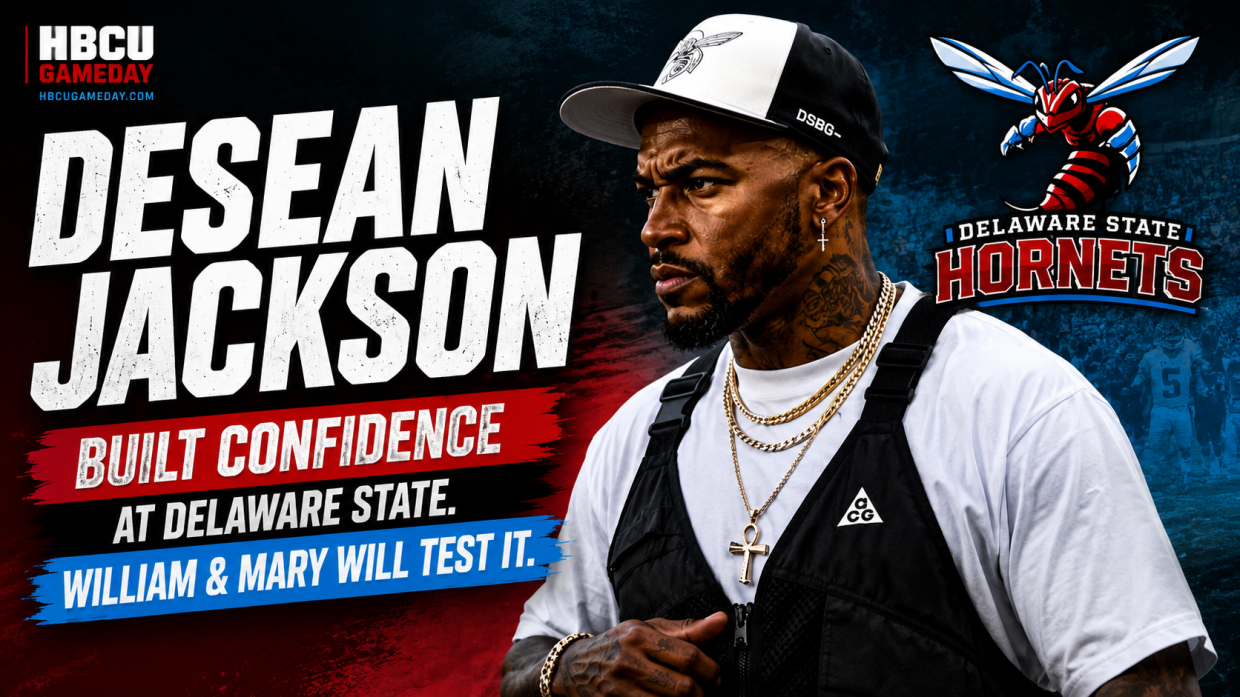
Delaware State had a seven-point lead and faced fourth-and-2 at its own 31-yard line against Stony Brook. DeSean Jackson left his offense on the field. He trusted the Hornets to convert rather than surrender possession.
Samari Collier was stopped, and Stony Brook took advantage of the short field. Delaware State soon found itself tied after previously holding an 18-point lead. The Hornets eventually survived Stony Brook 41-34, but Jackson’s fourth-down decision became one of the game’s most revealing moments.
Two days later, Jackson was asked during the Aug. 31 MEAC coaches call if he would make the same decision again. His answer offered a clear window into his coaching personality. “If I had the opportunity again, I’ll do it again,” Jackson said.
That answer matters because Delaware State football is beginning to carry some of Jackson’s confidence. He appears willing to accept risk and trust his players. He also prefers attacking situations instead of waiting for the game to dictate the terms.
The early impression is that Jackson coaches with some of the aggression that defined him as a player.
DeSean Jackson is putting his personality on Delaware State
Jackson spent 15 NFL seasons as a receiver whose game depended on speed, aggression and confidence. Defenses knew what could happen if he found space. Jackson still played as though the threat of failure should never prevent him from attacking.
That temperament is becoming visible in his first HBCU head coaching job. The comparison should remain measured because coaching Delaware State requires far more than bringing an NFL mentality to college football. Still, Jackson seems comfortable asking his players to execute in difficult situations.
The fourth-down call against Stony Brook failed, and the consequences arrived quickly. Delaware State gave the Seawolves favorable field position during a competitive fourth quarter. Stony Brook tied the game seven plays later.
The official Delaware State-Stony Brook box score shows the Hornets finished 0-for-2 on fourth down. Jackson’s response suggested one failed attempt would not change how he viewed the decision. His confidence survived the result.
There is a difference between reckless football and deciding what kind of team you want to build. Jackson is still early enough in his tenure for that distinction to develop. So far, Delaware State looks like a program being encouraged to attack rather than play afraid.
Delaware State football is sharing Jackson’s confidence
A head coach can have all the personality he wants. The real test comes when the roster begins reflecting it.
Delaware State showed some evidence of that against Stony Brook. The Hornets produced 518 total yards, with 259 rushing and 259 passing. Several different players gave the offense explosive options.
Quarterback Ui Ale, who won the Delaware State starting job late in preseason camp, threw for 259 yards without an interception. He also led Delaware State with 82 rushing yards. Jaylin Terzado caught six passes for 149 yards.
Samari Collier added 70 rushing yards and broke a 59-yard touchdown run. Delaware State had enough offensive options to build an 18-point advantage. Then the game changed.
Stony Brook rallied and eventually tied the score at 34. Delaware State had already lost much of the control it showed earlier. The Hornets could have allowed the collapse to decide the night.
Instead, Delaware State responded with an 11-play, 80-yard drive. Sean Weston Jr. finished it with a 16-yard touchdown run with 1:54 remaining. The Hornets found a way to recover after momentum had turned against them.
That response fits the personality Jackson has been trying to establish. He has talked about high expectations and physical football. He also wants Delaware State to create its own energy instead of depending on the environment.
Against Stony Brook, the Hornets needed that confidence once the game became uncomfortable.
The Stony Brook win also exposed problems
The victory gave Jackson plenty to correct before William & Mary. Stony Brook accumulated 456 yards and erased a lead that had reached 31-13 in the third quarter. Delaware State was explosive, but it was far from complete.
That distinction matters after an encouraging opener. One HBCU football victory should not become evidence that every problem has disappeared. Delaware State showed resilience while also giving William & Mary plenty to study.
The Hornets allowed Stony Brook back into a game they appeared to control. Better opponents may punish those stretches more severely. Jackson acknowledged after the opener that Delaware State still had areas to clean up.
That keeps the evaluation where it belongs. Delaware State looks dangerous and confident. It also remains a developing team with real weaknesses.
An experienced staff matters for DeSean Jackson
Jackson remains relatively inexperienced as a college head coach. That makes the structure surrounding him important.
Delaware State did not assemble a staff filled entirely with coaches learning alongside him. Assistant head coach and defensive coordinator Travis Clark works alongside offensive coordinator Nyema Washington. The group also includes coaches with extensive college and professional football experience.
The full staff is listed on Delaware State’s official football roster and coaching page. That experience gives Jackson another resource as he develops his own approach to running a college program.
Jackson does not need to pretend he has every answer. His responsibility is to establish expectations and determine the program’s direction. He also makes the final decisions while trusting assistants to manage their areas.
That structure may help explain why Jackson appears comfortable taking chances. Confidence becomes easier when a head coach trusts the preparation happening inside his building. His willingness to trust experienced assistants should be viewed as part of his development.
For a young college head coach, knowing whom to trust matters. Jackson appears increasingly comfortable with that balance.
DeSean Jackson already changed Delaware State’s expectations
Calling Delaware State ahead of schedule now requires context. The Hornets are no longer operating under the expectations Jackson inherited.
Delaware State went 1-11 before his arrival. The Hornets then improved to 8-4 overall and 4-1 in MEAC football during his first season. That turnaround changed the way people viewed the program.
Delaware State responded by signing DeSean Jackson to a contract extension through 2028 after one season. Expectations followed the wins.
The official 2026 MEAC preseason football poll placed Delaware State third. The Hornets received 40 points and two first-place votes. South Carolina State and North Carolina Central were the only teams picked ahead of them.
Delaware State is no longer being judged simply on whether Jackson can make the program competitive. The standard changed because Jackson changed it.
That is where the idea of being ahead of schedule becomes useful. Jackson accelerated the rebuild faster than many would have reasonably expected after the 2024 season. By Delaware State’s 2026 spring practice, the Hornets were refining a roster rather than constructing one from scratch.
Winning eight games created a different challenge. Delaware State now has to prove last season was sustainable. The Stony Brook victory offered encouraging evidence without settling that question.
The Hornets showed offensive versatility, quarterback options and explosive players. They also showed enough resilience to survive after losing an 18-point lead. At the same time, the defense showed problems that better opponents could exploit.
Both parts of the evaluation matter. Delaware State has moved beyond searching for signs of progress. Jackson raised the expectations around the program, and his team now has to play under them.
“We’re not ducking smoke”
Jackson does not sound interested in protecting Delaware State from difficult opponents. During the Aug. 31 MEAC coaches call, he made that position clear.
“We’re not ducking smoke. We’re not shying away from no smoke,” Jackson said.
William & Mary provides an immediate opportunity to test that confidence. The Tribe opened its season with a 35-32 road victory against then-No. 8/7 Villanova. William & Mary scored 13 points in the final 53 seconds to erase a 10-point deficit.
The Tribe then moved to No. 17 in the Stats Perform FCS Top 25. William & Mary also climbed to No. 19 in the AFCA coaches poll. Those rankings are listed in the Tribe’s official national rankings release.
That makes Saturday a useful test for Delaware State. Simply playing a nationally ranked FCS opponent does not prove anything. The value comes from seeing whether Delaware State’s strengths remain visible when the environment gets harder.
Jackson wants the Hornets to play aggressively, physically and with confidence. William & Mary gives Delaware State another chance to show whether those qualities travel.
William & Mary will test Delaware State away from home
Delaware State plays its first road game when it visits William & Mary at Zable Stadium on Saturday at 6 p.m. The matchup is listed on William & Mary’s official 2026 football schedule.
The Tribe will be playing its home opener after beating a top-10 opponent on the road. Delaware State enters trying to correct the stretches that nearly cost it against Stony Brook. That contrast makes the matchup particularly useful for evaluating Jackson’s team.
A road win would provide strong evidence that Delaware State can compete with a nationally ranked FCS opponent. A loss would not erase the Hornets’ progress. It could still show how close Delaware State is to becoming a consistent threat outside the MEAC.
Saturday also provides another test of the confidence Jackson has placed near the center of his program. Against Stony Brook, Delaware State created explosive plays and responded after momentum disappeared. The Hornets also learned how quickly mistakes can turn into points.
William & Mary should provide another measure of how Delaware State handles those difficult stretches.
Delaware State now has to make confidence sustainable
The fourth-down decision against Stony Brook may become a small detail in a long season. For now, it provides a useful snapshot of DeSean Jackson as a head coach.
He trusted his players and accepted the consequences when the call failed. Jackson also made it clear that one bad result would not change the way he wants Delaware State to play. That confidence has become increasingly visible throughout the program.
The next challenge is making it dependable.
Jackson wants Delaware State football to attack, trust its preparation and expect to belong in consequential games. The Hornets have already shown they can play that way in stretches. William & Mary is the next opportunity to see how consistently they can do it.