
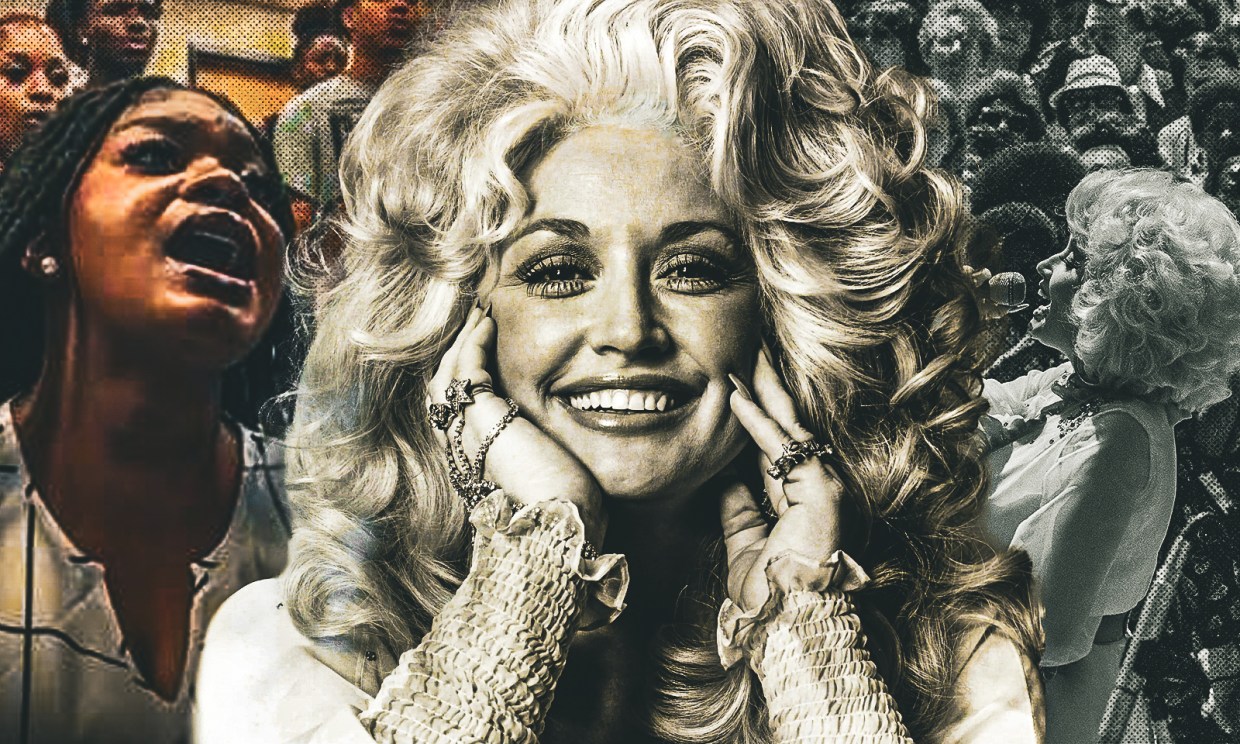
The Jackson State University Choir transformed a Dolly Parton classic into something that sounded right at home inside an HBCU music hall.
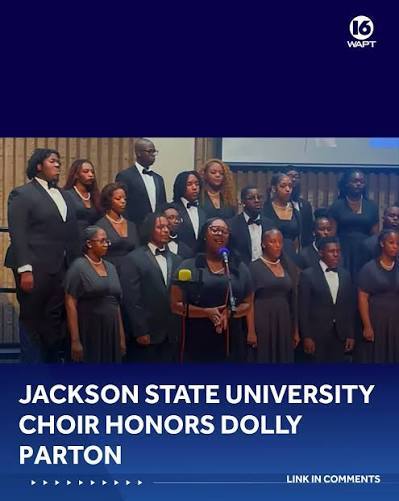
In a tribute honoring the life and legacy of the country music icon, the JSU ensemble performed a soul-stirring rendition of “Light of a Clear Blue Morning.” Sophomore music education major Asha White stepped forward for a solo that helped the performance travel far beyond the Jackson, Mississippi, campus.
White does not imitate Parton’s original recording. Her rich, church-shaped delivery opens another emotional door inside the song. The choir surrounds her with warm harmonies, minor chords, and a remarkably resonant bass section, allowing a country composition from 1977 to breathe through the traditions of gospel and Black choral music.
The result is less like a cover and more like a cultural translation.
“This will give you chills,” Jackson television station WAPT wrote while sharing video from the performance. “Get your tissues out.”
The response online was just as emotional.
One viewer said White’s voice evoked the spirituals she heard in church as a child. Others praised the men anchoring the arrangement, with one commenter writing, “Haven’t heard basses solid like that in a long while.”
Another viewer admitted that Jackson State’s musical culture had pulled them even closer to the university.
“I started following y’all because of the band, the Drumline, and the drum majors,” the commenter wrote. “Now it’s a whole new level of loving this university.”
A different side of Jackson State’s musical power
Jackson State is already home to one of the most recognizable brands in HBCU music.
The Sonic Boom of the South, its J-Settes and the university’s drum majors regularly command national attention. Their performances have made JSU one of the most visible institutions in the HBCU band world.
This moment belonged to the voices.
Filmed inside Jackson State’s F.D. Hall Music Center, the performance showcased the depth of the university’s music program beyond the stadium. It also introduced a much wider audience to White, whose delivery carried both the ache of mourning and the hope embedded in Parton’s lyrics.
“Light of a Clear Blue Morning” emerged from a difficult transition in Parton’s own career. Written as she sought a new beginning, the song looks beyond a season of struggle toward freedom and renewal.
That message took on added weight following Parton’s death at 80. Rather than choosing one of her most commercially recognizable songs, the JSU Choir reached for a composition about surviving the darkness long enough to see the light return.
Separate rehearsal footage also showed members of the Jackson State University Chorale singing “I Will Always Love You,” another Parton composition with an especially powerful history inside Black music.
Why Dolly Parton’s music resonates across cultures
Parton’s connection to Black audiences did not begin with this tribute.
Whitney Houston turned “I Will Always Love You” into one of the defining vocal performances in popular music. Her 1992 interpretation introduced Parton’s writing to another generation and permanently connected the country songwriter’s catalog to one of the greatest voices in Black music.
Parton later revealed that she used money earned from Houston’s recording to purchase a commercial property in a predominantly Black section of Nashville.
“It was a whole strip mall,” Parton recalled during a 2021 television appearance. She affectionately described the investment as “the house that Whitney built.”
The story has resurfaced since her death as an example of how Parton’s relationship with Black culture extended beyond musical appreciation. The success created by a Black woman’s voice was reinvested in a Black neighborhood rather than treated as a one-way cultural transaction.
Her catalog continued crossing those boundaries. Parton worked with artists including Mavis Staples, Dionne Warwick and Queen Latifah. Beyoncé later reconstructed “Jolene” for her 2024 album Cowboy Carter, with Parton publicly supporting the radically different interpretation.
She also made one of the most direct statements issued by a major country star during the racial reckoning of 2020.
“Of course Black lives matter,” Parton told Billboard. “Do we think our little white asses are the only ones that matter?”
For Black listeners, those moments helped distinguish Parton from artists who embraced Black musical influence without demonstrating the same respect for Black people.
A legacy that reached Mississippi communities
Dolly Parton’s impact also extended beyond recorded music.
Her Imagination Library has mailed free books to children from birth through age five since 1995. The program operates through local partners across the country, including United Way organizations in Mississippi that serve families in Hattiesburg, Forrest County, Lamar County, and Marion County.
Accounts of Parton quietly helping school bands purchase uniforms and instruments have also circulated for years. Those stories have gained renewed attention because many of the beneficiaries reportedly attended predominantly Black schools across the South.
The broad claim is difficult to document completely because Parton often gave without attaching her name to the donation. But her confirmed support of youth music, literacy, education, and underserved communities makes the connection between her legacy and a performance by young Black musicians especially fitting.
Jackson State did not need to manufacture an HBCU connection to honor Dolly Parton. The connection was already present in the music.
It could be heard in the Black vocalists who gave some of her compositions new lives. Felt in the Southern communities reached by her literacy work. And lived in the gospel, soul, and country traditions that have always borrowed from one another—even when the music industry tried to keep them separated.
The JSU Choir brought those traditions together once more.
Through Asha White’s soaring solo, a room full of rich harmonies and a bass section that practically became a character of its own, Jackson State offered Parton a tribute rooted in what HBCU culture has always done exceptionally well.
They took a familiar song, filled it with their own history, and made the world hear it differently.