
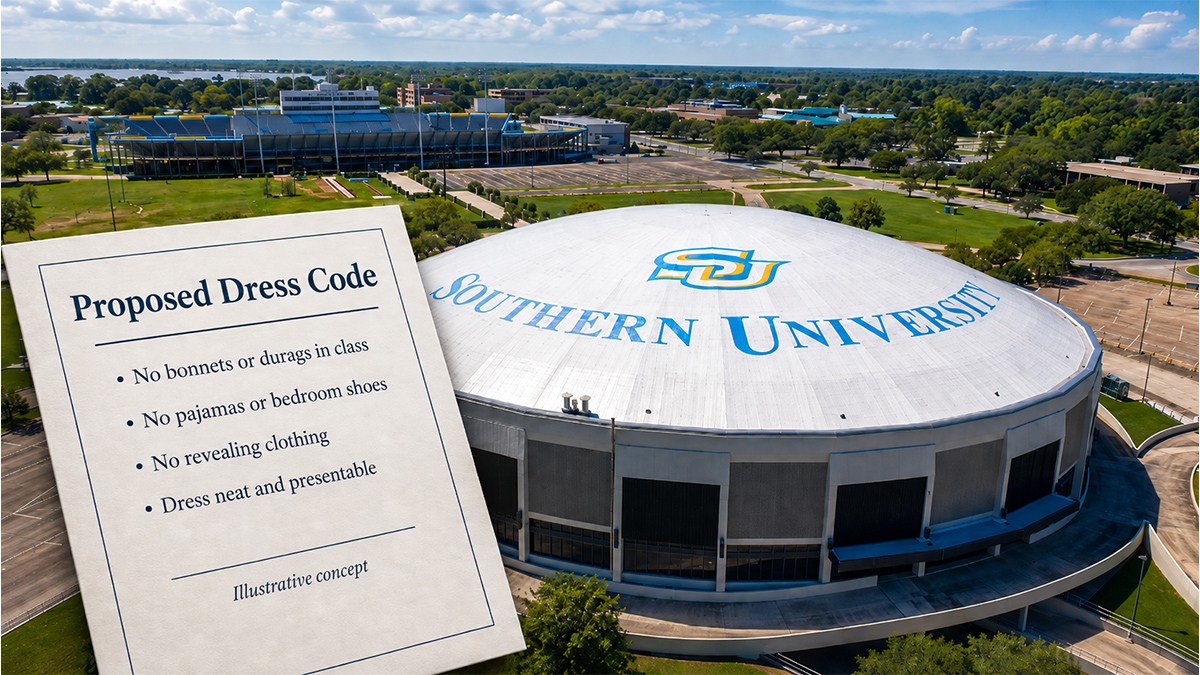
Southern University could become the latest HBCU to adopt a Dress Code, but a proposal from the chairman of its governing board would put the Louisiana institution in a notably different position than schools such as Tuskegee University.
Tony Clayton, chairman of the Southern University Board of Supervisors, said Friday that he wants leaders across the Southern University System to discuss implementing a dress code for students. Clayton said he plans to bring together the chancellors from Southern’s five campuses before the board’s next meeting on Sept. 18, according to the Louisiana Illuminator.
“I walked around campus the other day. I think we need it,” Clayton told board members.
The discussion comes as dress codes have become a topic of conversation across the HBCU landscape, most notably at Tuskegee University. The private Alabama HBCU announced new standards this summer that restrict students from wearing revealing clothing as well as bedroom shoes, bonnets and durags in classrooms and dining areas.
Tuskegee President Mark A. Brown has framed the policy as part of preparing students for professional life after college. The university has also emphasized career readiness through initiatives such as its Golden Tigers Community Closet, which provides students with professional and business-casual clothing.
The changes haven’t come without pushback.
Tuskegee junior Serenity Mitchell told the Alabama Reflector that the public rollout of the new Dress Code created an unfair impression of the student body.
“I think that releasing it in the way that they did made it look like students were kind of walking around here looking any type of way, and that’s just not true,” Mitchell said.
Southern University would be a different case
There is an important distinction between Southern University and the HBCUs currently cited as examples.
Southern University is part of a state-created public university system governed under the Louisiana Constitution. The Southern University System includes campuses in Baton Rouge, New Orleans and Shreveport, along with its law and agricultural centers.
Meanwhile, Tuskegee, Hampton University and Fisk University — HBCUs that have adopted campus dress standards — are private institutions. Hampton identifies itself as a private, independent university, while Fisk is also a private HBCU.
That public-private distinction could make a systemwide Southern policy a much different conversation.
Private colleges generally have broader latitude to establish institutional expectations for students who choose to enroll. A public university, however, operates as a government institution, meaning any broad policy regulating student appearance could invite additional scrutiny over how rules are written and enforced.
Clayton has not yet presented a specific Dress Code proposal, and no policy has been approved.
Student attire policies already vary widely throughout the HBCU community. Hampton and Fisk maintain dress standards, while Howard University and Morehouse College have attire requirements that apply in particular settings rather than across the entire campus.
Now Southern University could become the next HBCU to enter the discussion.
The difference is that unlike Tuskegee and several of the schools already enforcing dress standards, Southern is public — potentially adding another layer to a debate already generating strong opinions across Black college campuses.
There is nothing wrong with setting standards for Black Students. Some clothing are not appropriate for classroom, campus, dining and recreation. Nightclub Attire on campus should be restricted until after 7 pm. College Branded Clothing should be made available to students who need them.
Charles E. Campbell-Allen, HBCU Grad (JSU 90)
Hampton University did it long ago with President Harvey. There was some resistance in the beginning, but he wasn’t having it. It worked for Hampton U, as it should for All our HBCU’S.