

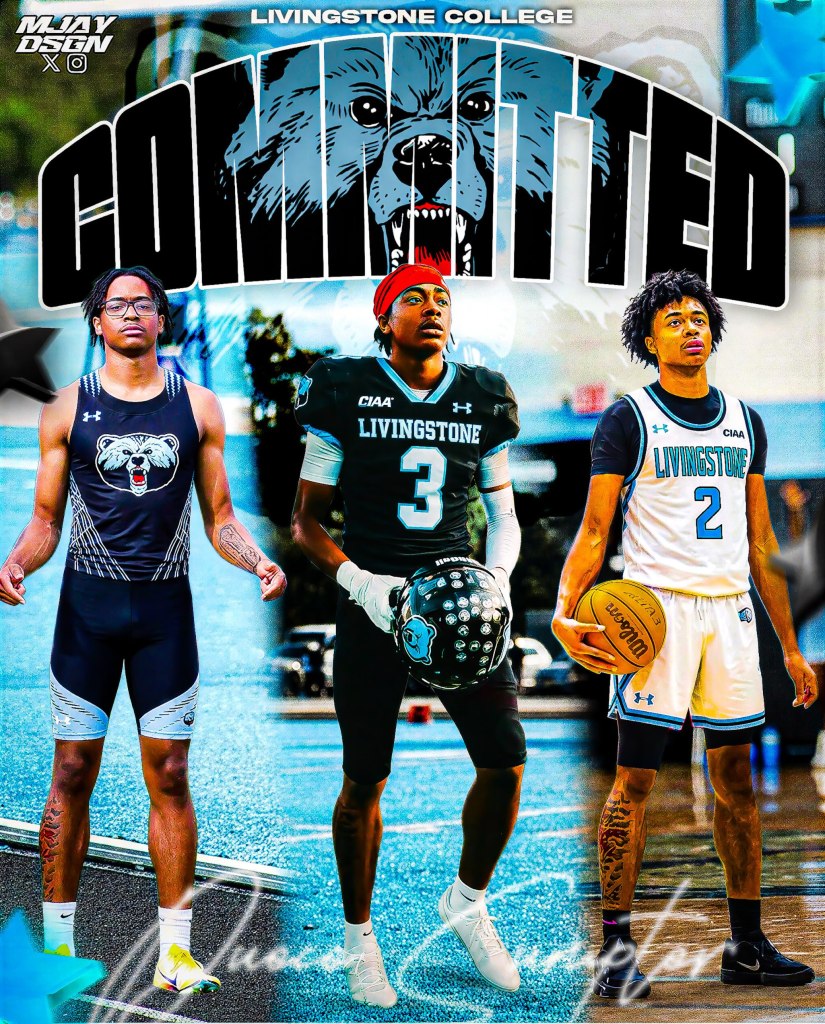
Duece Sumpter says he plans to play football, basketball, and run track at Livingstone College, embracing an old-school vision of the college athlete.
In an era when college recruiting decisions are often measured in NIL dollars, transfer opportunities, and social-media reach, Duece Sumpter is betting on an HBCU move that feels almost radical in 2026.
He wants to play everything.
Duece Sumpter, a Class of 2026 athlete from Durham, North Carolina, announced his commitment to Livingstone College in an Instagram post that says he plans to compete in football, basketball, and track and field for the Blue Bears.
“I begged God to bless me so he did it 3 times,” Sumpter said in the post.
The announcement describes the opportunity as a three-sport scholarship. Livingstone has not publicly announced the arrangement through its athletics website, so the specific scholarship structure and Sumpter’s eventual participation in all three sports remain to be confirmed by the college.
Still, the commitment itself offers one of the more intriguing recruiting stories of the 2026 cycle.
Sumpter has not played a college game, earned a roster spot, or navigated the enormous logistical challenge that awaits him.
But the mindset behind his decision belongs to an older tradition of college athletics—one in which the goal was not necessarily to specialize as quickly as possible, but to discover just how much an exceptional athlete could do.
A True Athlete Heads To An HBCU
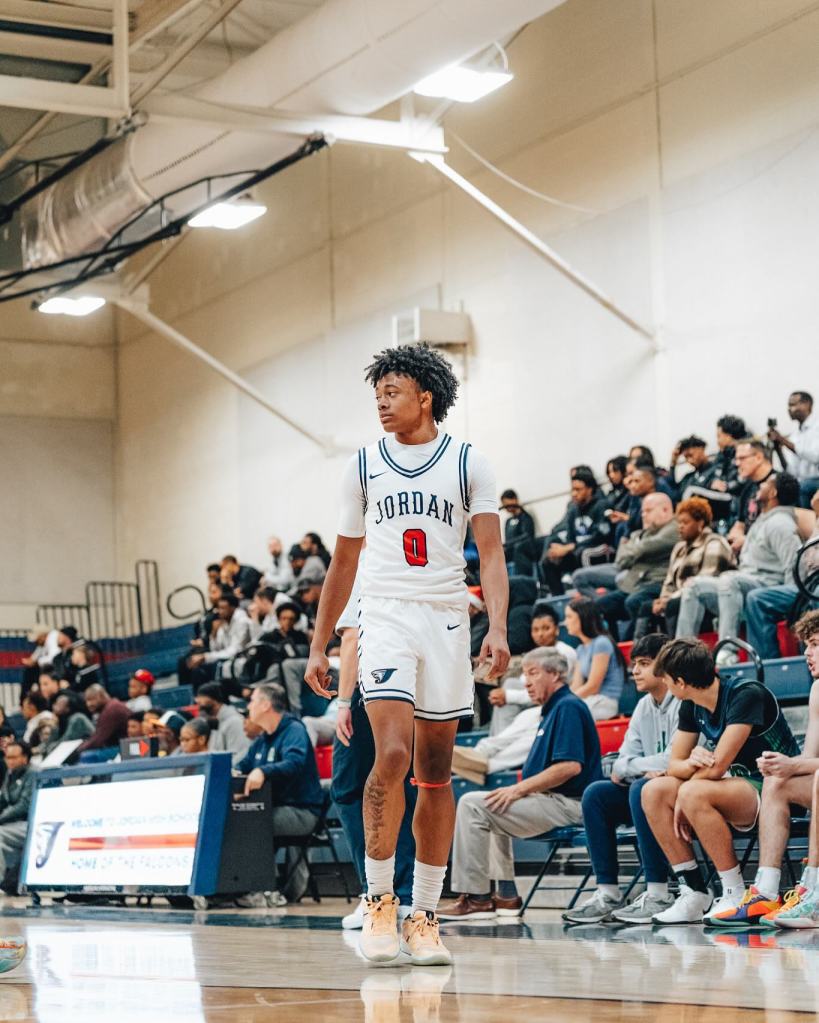
Sumpter played football and basketball at Jordan High School in Durham after previously attending Hillside.
His public MaxPreps profile lists the 6-foot-1, 170-pound senior as a shooting guard in basketball and a wide receiver/athlete in football. During his final basketball season, Sumpter averaged 13.4 points, 3.8 rebounds, and 2.1 assists across 24 games.
He also made 63 three-pointers, giving Livingstone’s basketball program a proven perimeter scorer if his three-sport plan comes together.
Football presents another opportunity to use his length and open-field athleticism. Track and field could provide the foundation connecting everything—speed for the gridiron, explosiveness for the basketball court, and a third competitive season in the spring.
Attempting all three will not be simple.
Football can extend deep into November, by which time college basketball is already underway. The physical recovery required to move directly from one contact-heavy season into another would challenge even a gifted athlete. Track would then arrive with little downtime following basketball.
That difficulty is precisely what makes Sumpter’s ambition worth watching.
Following An Old-School Athletic Tradition
Before specialization reshaped American sports, some of the country’s greatest athletes treated college as a laboratory for their talent.
Jackie Robinson became the first UCLA athlete to earn varsity letters in four sports: football, basketball, track and field, and baseball. Remarkably, baseball—the sport through which he would change American history—was considered his weakest during his time at UCLA.
Jim Brown also earned letters in four sports at Syracuse. He competed in football, lacrosse, basketball, and track and field before becoming one of the greatest football players ever. Brown’s brilliance was not confined to the gridiron; he was also an All-American lacrosse player.
Duece Sumpter is not announcing that he is the next Jackie Robinson or Jim Brown. Those names establish the historical tradition, not a projection for Sumpter.
The connection is the willingness to resist being placed in one athletic box.
Robinson and Brown approached college believing their ability could travel from one sport to another. Sumpter is arriving at Livingstone with a similar kind of curiosity: What if he does not have to choose yet?

An HBCU Where He Can Dream His Way
That question gives the commitment its greater significance.
Sumpter could have viewed a Division II HBCU as a smaller stage. Instead, he appears to see Livingstone as a place big enough to hold all three of his dreams.
That is part of the enduring value of HBCUs. Their importance cannot be measured solely by television contracts, recruiting rankings, or the size of an NIL collective. At their best, they give students room to become more fully themselves.
Livingstone, an NCAA Division II HBCU program and member of the CIAA, may offer Sumpter something increasingly rare in modern college sports: the freedom to chart an unconventional path.
There are still practical questions. Three coaching staffs must coordinate. Academic responsibilities must remain the priority. Sumpter must earn his opportunities in each sport, and the demands of the college level may eventually require him to narrow his focus.
But those are questions for later.
For now, a young athlete from the Bull City has chosen an HBCU and announced an audacious goal. In a recruiting culture increasingly built around choosing the biggest available platform, Sumpter has chosen the place where he believes he can build his own platform.
Perhaps the most interesting part of his commitment is not that it resembles something from the past.
It is that Sumpter believes there is still room for that dream in the future.