
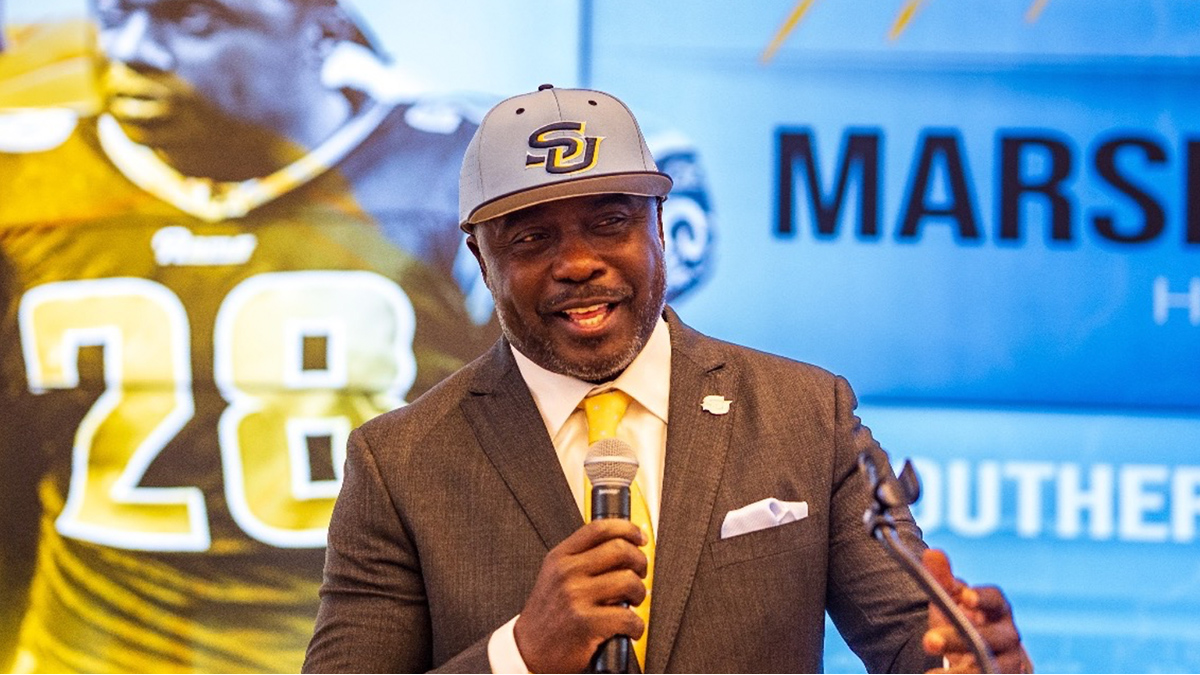
Marshall Faulk knows Southern University cannot keep pace with college football’s biggest spenders, and the first-year head coach at the Baton Rouge HBCU is not pretending otherwise.
During an appearance on The Rich Eisen Show, Faulk said his job is not to beat Power Four programs at their financial game. Instead, he wants to prepare his players to reach it.
“I’m not trying to keep up,” Faulk said. “I’m just trying to get my kids to the money game. The money game is in the FBS. You got to be in the Power 3, 4, or 5 to really make the kind of money.”
That answer may sound uncomfortable for an HBCU football coach trying to build a winner. It also matches what Marshall Faulk said at SWAC Football Media Day in July.
“I believe that the next level is no longer the NFL,” Faulk said then. “We get poached by the FBS. They want our players.”
Faulk argued that standout FCS players now have an intermediate destination before professional football. They can transfer to an FBS program, increase their exposure and potentially earn more money while remaining in college.
Marshall Faulk sees development as part of the job
At SWAC Media Day, Marshall Faulk did not frame that movement as something coaches could prevent. He said they must recognize the new landscape, develop their players and prepare them to navigate the next level.
Faulk took the point one step further with Eisen. He described modern college football as “straight business,” from NIL conversations to the transfer portal and the need for general managers.
Players understand that reality, too.
“The kids, they look at you and they’re like, ‘I want money,’” Faulk said.
Still, the Pro Football Hall of Famer does not oppose players getting paid. In fact, he said compensation has improved the sport by allowing athletes to share in revenue generated through television contracts and the College Football Playoff.
“Paying the players has really, really helped the game,” Faulk said. “It has.”
His position carries both honesty and risk for Southern. The Jaguars need talented players long enough to compete in the SWAC. At the same time, Faulk is openly telling them that Baton Rouge may not be the final stop if they perform well enough to attract FBS money.
Southern can turn the portal reality into a recruiting pitch
That approach could cost Southern proven players. It could also become one of Marshall Faulk’s strongest recruiting tools.
The message is simple: Come to Southern, receive coaching from a former NFL MVP and prepare for the best opportunity available. For some players, that destination could be the NFL. For others, it may be an FBS program first.
Faulk said at SWAC Media Day that coaches must develop players who are capable of moving up. His latest comments remove any ambiguity about where he believes that level sits in today’s financial hierarchy.
Southern is not positioned to outspend the richest programs in college football. No HBCU or FCS school is. Faulk appears willing to measure part of his program’s success by whether it can develop players those schools want.
That challenge arrives as Faulk attempts to rebuild a program that finished 2-10 last season. SWAC voters picked Southern fifth in the West, leaving the Jaguars with little margin for losing their best talent.
That does not solve the competitive problem facing Southern or the SWAC. Developing players only to lose them can turn every offseason into another rebuild.
But Marshall Faulk is not selling his players a version of college football that no longer exists. He is telling them exactly where the money is—and making it clear that he intends to help them get there.