
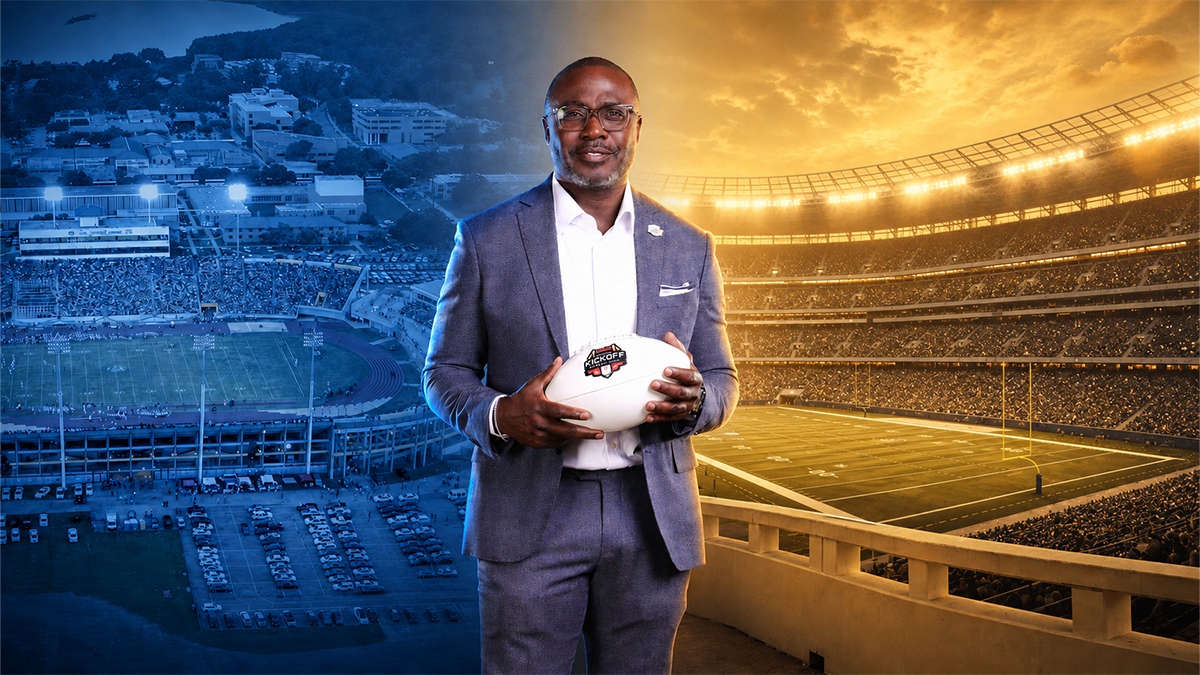
NFL legend Marshall Faulk is new to HBCU coaching and the SWAC, but Southern University’s rookie head coach already understands where the FCS now sits in college football’s transfer hierarchy.
Faulk has spent his football life chasing the sport’s highest level. Now, in his first season leading Southern, he believes the meaning of “the next level” has changed for many HBCU players.
“I believe that the next level is no longer the NFL,” Faulk said during SWAC Football Media Day. “We get poached by the FBS. They want our players.”
It was a striking assessment from a man who reached football’s ultimate destination. However, Faulk did not present the movement from the FCS to the FBS as something SWAC coaches could simply stop.
Instead, the first-year Southern coach described it as a reality that coaches must recognize and help their players navigate.
“They have an opportunity to maybe go somewhere and make good money while they’re in college,” Faulk said. “The game has changed. The landscape of college football has changed.”
Faulk said HBCU coaches must prepare their players to take advantage of those opportunities.
“I believe that we as coaches, we have to look at it for what it is and start preparing these kids and coaching them and making sure they have the capacity to move on to the next level,” he said.
SWAC coaches see the same FCS reality
Faulk may be a rookie SWAC head coach, but veteran coaches across the conference supported his reading of the landscape.
Grambling State head coach Mickey Joseph offered perhaps the clearest explanation of what transfer losses mean at the HBCU level.
“You’re not losing a backup,” Joseph said. “You’re losing a starter. So, we’re losing starters. We have to replace starters.”
Joseph said Grambling State has lost 15 players to the portal since he took over the program. His description of the conference’s changing role closely tracked Faulk’s point.
“We were known as the recruiters,” Joseph said. “Now we’re the developers, and now they come get our players.”
That development can benefit an individual player. Joseph said he remains happy when one of his athletes receives a financial opportunity after entering the portal. Still, each departure forces an FCS program to replace proven production with fewer resources than the school recruiting that player.
Arkansas-Pine Bluff head coach Alonzo Hampton has lived that cycle at the game’s most important position. UAPB will enter Hampton’s fourth season with its fourth different starting quarterback.
“Let’s be real,” Hampton said. “In this era that we’re in right now, if your quarterback plays well, he’s going to get in the portal or they’re going to graduate.”
Bethune-Cookman head coach Raymond Woodie summarized the challenge in another way. HBCU coaches want to establish continuity, but the modern transfer system can turn every offseason into another reconstruction project.
“You’re really trying to build a culture, but you’re building rosters,” Woodie said.
Marshall Faulk accepts the new assignment
Faulk’s comments did not sound like surrender. The NFL legend views player advancement as part of his responsibility at Southern.
That approach creates a complicated balance. SWAC programs need veteran players to compete for conference championships and reach the Celebration Bowl. Those same coaches also want their players to earn money and pursue opportunities at the FBS level.
Faulk enters the job with credibility few coaches can match. Southern named him its 22nd head football coach in December after he spent the 2025 season coaching running backs at Colorado. The Pro Football Hall of Fame inducted him in 2011 after a career that included 12,279 rushing yards and 136 total touchdowns.
Yet Faulk’s NFL résumé does not shield Southern from the forces reshaping HBCU football. It won’t stop a player from going across town to play for Lane Kiffen at LSU.
The SWAC still produces professional talent. Faulk’s larger point is that the path between an HBCU and the NFL may now include another college stop.
For coaches across the FCS, finding and developing players remains essential. Keeping those players long enough to build a championship roster has become the harder part.