
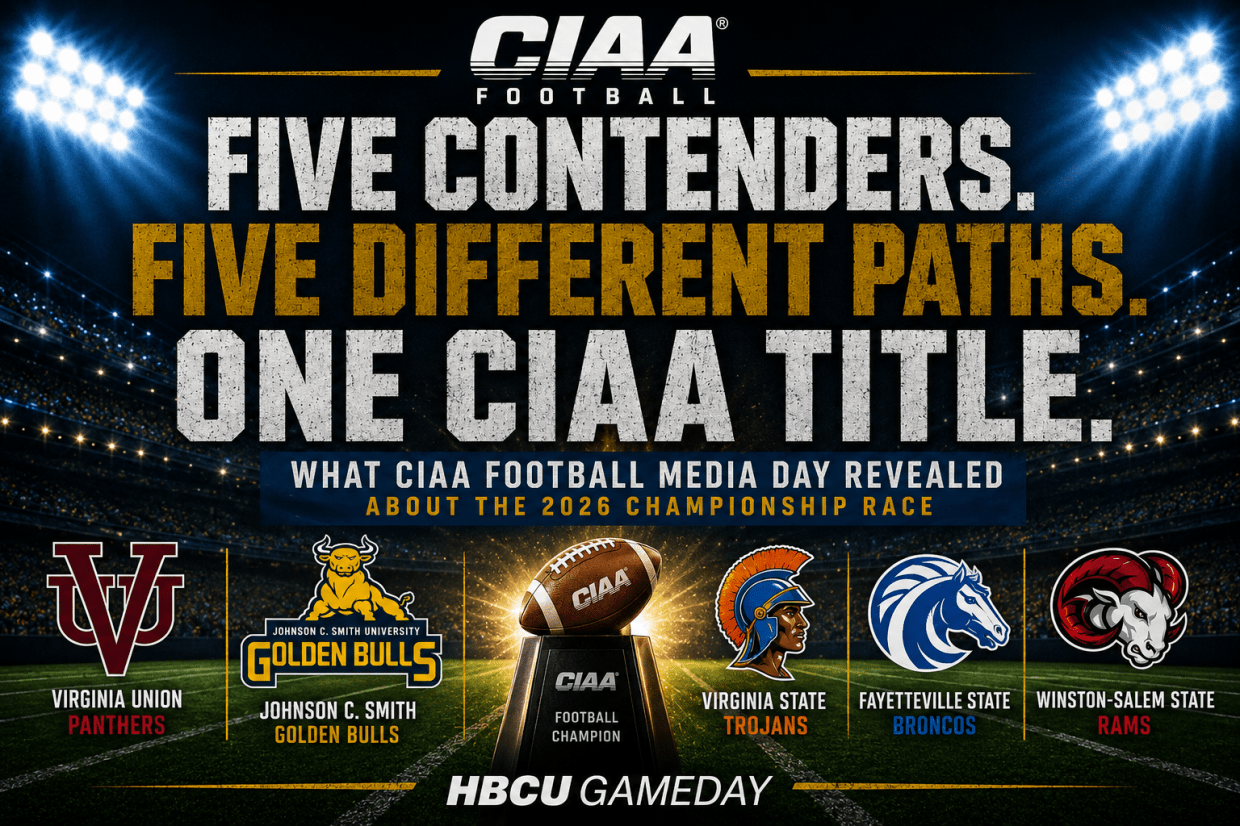
The CIAA preseason poll identified Virginia Union as the team to beat entering the 2026 HBCU Football season. By the end of Football Media Day in Baltimore, however, one conclusion stood above the rankings: every legitimate contender believes it has found a different formula for winning the conference championship.
Virginia Union is relying on championship experience. Johnson C. Smith is fighting complacency after reaching the top. Virginia State continues to value continuity in an era dominated by the transfer portal. Fayetteville State is focused on correcting the weakness that cost it opportunities last season, while Winston-Salem State is attempting to restore one of the conference’s proudest programs through culture and accountability.
Those philosophies may ultimately shape the CIAA race as much as talent, schedules or preseason rankings. The programs expected to compete for a championship agree on the destination. They simply disagree on the best road to get there.
Championship Programs Begin With Standards
“Every member of our roster that’s returning has played in a championship and a playoff game.” — Dr. Alvin Parker
Virginia Union enters the season carrying expectations few Division II programs can match. Four consecutive NCAA Division II playoff appearances have transformed success from a goal into the program’s standard, and head coach Alvin Parker made it clear that experience is his team’s greatest asset.
Rather than discussing preseason rankings, Parker repeatedly returned to the habits that built the Panthers into a perennial contender. His “Play for 11” philosophy emphasizes accountability, discipline and sacrificing individual recognition for the success of the entire team.
That message carries more weight because nearly every returning contributor has experienced championship football. Players understand the preparation required to win the CIAA because they have already navigated deep postseason runs. Instead of teaching a championship culture, Parker is protecting one that already exists.
Experience alone does not guarantee another title, but it gives Virginia Union a foundation that every other contender is trying to match.
Johnson C. Smith Refuses to Let Success Become Satisfaction
“Perfume is great to smell, but it’s dangerous to taste.” — Maurice Flowers
Maurice Flowers delivered one of the most memorable lines of Media Day, but the quote represented something larger than clever wordplay.
Johnson C. Smith enters 2026 with heightened expectations after winning the CIAA championship. Flowers understands that defending success often proves more difficult than achieving it. His concern is not whether players remember last season. It is whether they become satisfied by it.
Flowers emphasized that the Golden Bulls’ standards have not changed because of one championship. Daily preparation, coaching continuity and consistent recruiting remain the foundation of the program. Winning the conference title validated that process, but it did not replace it.
Championship teams rarely decline because they lose talent alone. They often decline because urgency disappears. Flowers’ message suggested Johnson C. Smith intends to protect its competitive edge by demanding the same habits that produced last season’s success.
Every Contender CIAA Is Building Differently
Virginia State Continues to Believe in Continuity
“The championship will come through Petersburg.” — Henry Frazier III
As college football becomes increasingly dependent on the transfer portal, Virginia State continues to invest in continuity and player development.
Henry Frazier III believes successful programs are built over time rather than reconstructed every offseason. His approach prioritizes relationships, accountability and developing players within the program instead of searching for annual roster solutions.
That philosophy runs against many current trends in college football, yet it reflects Virginia State’s confidence in its culture. Rather than chasing short-term roster improvements, the Trojans continue building around players who understand the expectations of the program.
If continuity once again proves capable of competing with transfer-heavy rosters, Virginia State will remain firmly in the championship conversation.
Fayetteville State Is Concentrating on the Details
“We struggled against the pass.” — Richard Hayes
Most coaches spend media day emphasizing strengths. Richard Hayes chose honesty instead.
Rather than celebrating another successful season, Hayes immediately identified Fayetteville State’s biggest weakness. The Broncos struggled to consistently defend opposing passing attacks, and Hayes made no attempt to avoid that discussion.
His willingness to publicly acknowledge the issue reflected a program focused on improvement instead of recognition. Championship teams rarely improve by ignoring weaknesses. They improve by confronting them before opponents expose them again.
Fayetteville State already possesses the physical talent to compete for another CIAA title. Whether the Broncos can address their defensive shortcomings may determine whether they merely contend or return to championship form.
Winston-Salem State Begins a New Chapter
“Pressure is for the unprepared.” — Tory Woodbury
No contender enters 2026 facing more uncertainty than Winston-Salem State, but Torry Woodbury showed little interest in discussing pressure.
Instead, the first-year head coach repeatedly emphasized preparation, leadership and accountability. His comments focused less on offensive and defensive schemes than on creating the daily habits necessary to rebuild one of the CIAA’s traditional powers.
Programs rarely return to championship form overnight. They establish standards first and allow victories to follow. Woodbury’s approach reflects that belief.
If Winston-Salem State returns to conference contention, the foundation will likely be the culture Woodbury is building now rather than any single tactical adjustment.
Five Philosophies, One CIAA Championship
CIAA Football Media Day revealed more than preseason expectations. It offered insight into how the conference’s leading programs define championship football.
Virginia Union believes experience creates consistency. Johnson C. Smith refuses to let success become complacency. Virginia State continues to trust continuity over constant roster turnover. Fayetteville State is committed to correcting its weaknesses, while Winston-Salem State is rebuilding through preparation and accountability.
Only one philosophy will produce the 2026 CIAA champion, but every contender left Baltimore convinced its approach can carry the program to the top. That contrast may become one of the defining stories of the HBCU football season and one of the most compelling races in the CIAA.
Media Day revealed that the CIAA’s leading contenders are pursuing the same championship through very different philosophies. The standings will determine which blueprint succeeds, but the conference race now has a much clearer identity heading into the 2026 season.