
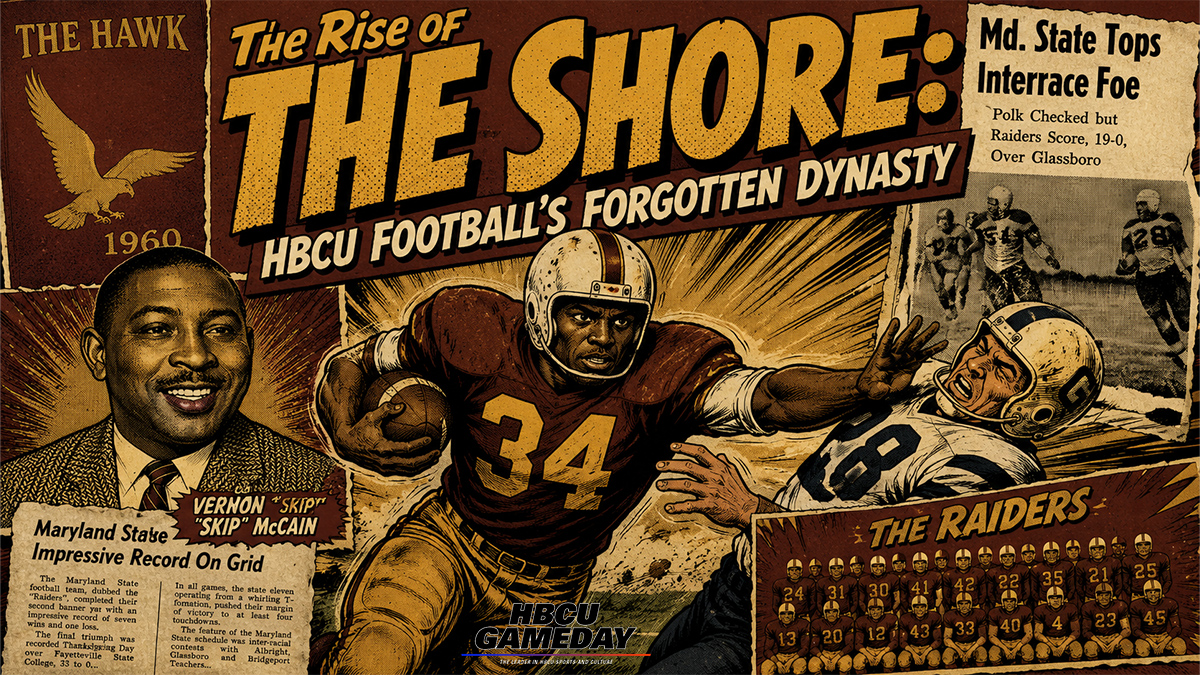
HBCU football at Maryland Eastern Shore remains one of the enduring “what if” questions in Black college sports. But to understand why the school no longer has a program, you have to go back more than a century to when football first took root on the Eastern Shore.
Long before the school became the University of Maryland Eastern Shore, it was known more simply as Princess Anne. That was the name people around the region used for the institution and for its football team, which played as the Trojans.
The program’s roots stretch back to 1924, when football became part of campus life on Maryland’s Eastern Shore. Those early years were not especially fruitful. Princess Anne played in a much different era, when the school was still evolving academically and athletically, and wins were hard to come by.
In the early 1930s, Princess Anne joined the Mid-Atlantic Athletic Association, or M3A, alongside regional rivals like Delaware State, Bordentown and Cheyney. But the Trojans were more survivor than power in those years, and the program continued to struggle after that league dissolved in 1939.
Then came World War II.
Like many colleges, Princess Anne saw football interrupted by the war, and that break created a clear divide between the program’s early struggles and what came next. When football returned, so did a new vision for the institution.
Maryland State became a HBCU power and pro football factory
That new vision started at the top. John Taylor Williams, a former Langston football All-American, took over as president and brought with him an ambition to build both the school and its athletic program. In 1947, Princess Anne posted an undefeated season, a sign that something was beginning to change.
By 1948, the HBCU had a new name — Maryland State College — and Williams made the hire that would transform its football future. He brought in Vernon “Skip” McCain from Tennessee State, a former Langston star himself.
McCain was more than a football coach. He became the architect of Maryland State’s football identity. He served as athletic director, head basketball coach and football coach, and under his watch the school stopped looking like an outpost and started looking like a destination.
UMES rise did not happen inside the comfort of a conference race.
For much of its climb, Maryland State operated as an independent, which meant it had to prove itself week after week against whoever was willing to line up. McCain’s teams played some of the best HBCU competition in the country and built a reputation by beating them. They also stepped across racial lines and took on white colleges during an era when that still carried real significance. In 1948 it defeated three white schools: Albright, Glassboro (Rowan College) and Bridgeport (CT).
It showed how ambitious the program had become. Maryland State was no longer just trying to fit into Black college football. It was testing itself against a wider world.
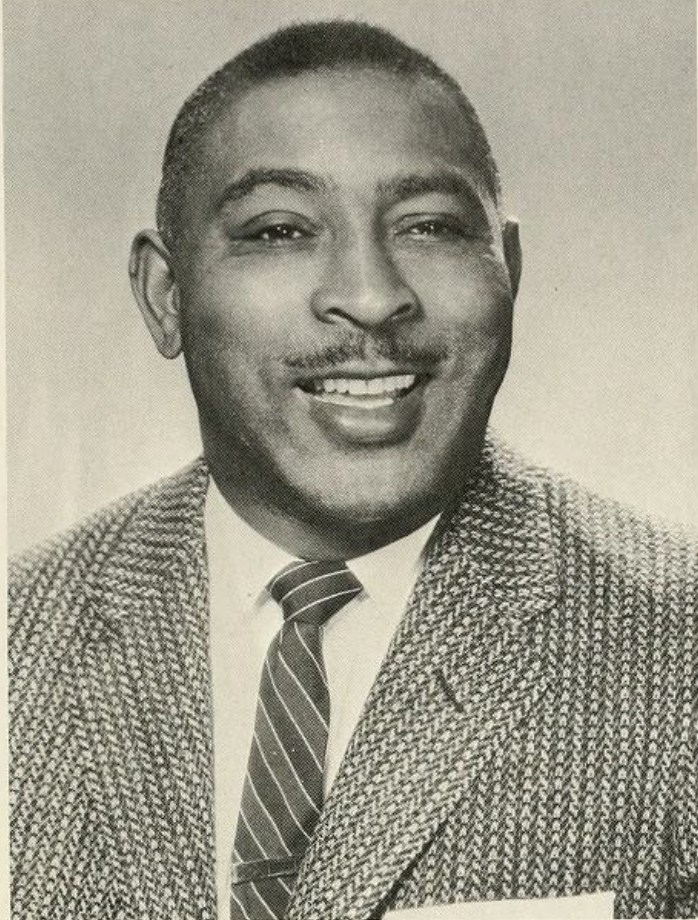
Skip McCain turned Maryland State into a destination
That confidence became a hallmark of the program.
McCain recruited to Princess Anne and then Maryland State as if geography did not matter. Others saw a small, isolated campus on the Eastern Shore. He saw possibility. Over time, his teams turned that belief into results.
Maryland State became one of the most respected independent powers in Black college football, strong enough that it routinely beat CIAA opponents before it was even admitted into the conference. That success did not go unnoticed.
In the early 1950s, Afro-American sports editor Sam Lacy criticized the CIAA for failing to recognize what was happening on the Eastern Shore. Maryland State, he argued, was growing too strong to ignore. By then, McCain was building exactly the kind of program that forced the old guard to pay attention.
The CIAA finally did.
Maryland State joined the conference in 1954, and that move gave formal recognition to what had already become clear on the field. The school was no longer a struggling former Trojan outfit trying to find its place. It was a legitimate football force.
The independent years had hardened it. CIAA membership gave it a platform. It responded with three CIAA titles in its first seven seasons.
Maryland State became a CIAA power and pro football factory
From there, the rise only grew.
McCain turned Maryland State into a dominant program and a pro football factory. His teams won at an elite rate, winning 106 games against just 21 losses and six ties. The talent pipeline that flowed out of Princess Anne became impossible to miss. From the late 1950s into the 1970s, the school produced player after player who reached pro football.
Names like Johnny Sample, Emerson Boozer, Roger Brown and Art Shell helped cement the school’s legacy well beyond the Shore.
That is why Maryland Eastern Shore football still carries so much emotional weight.
The program did not emerge from nowhere, and it did not become meaningful by accident. It began in 1924 in modest form and struggled through the Princess Anne years. It survived conference instability and wartime interruption. Then it was reshaped by new leadership, elevated by Skip McCain, and hardened as an independent willing to play anyone. Even white schools.
By the time Maryland State entered the CIAA, it had already become one of the strongest programs in Black college football
That was the rise. The fall would come later, when the financial and structural realities of sustaining that kind of success in a changing era caught up with the program. But that is Part II.
Hello. This is wonderful. UMES is my family school. I didn’t want to go anywhere else. Along with two brothers, my husband and my self this the best place to be. I love to see the football program return but quite an endeavor.
Part One: Cover Letter
Dear Mr. Gaither,
Thank you again for your recent article chronicling the rise of football at Maryland State College. As a UMES alumnus, I found your work both informative and affirming. You captured a period in our institution’s history that many people, including some within the UMES community itself, either never knew or have long forgotten.
After reading your article, I felt compelled to share the attached correspondence.
The document is not intended as a rebuttal to your article. In many respects, it is a continuation of the conversation you began.
For years, I have been involved in efforts to better understand the history, challenges, and unrealized potential of the University of Maryland Eastern Shore. What began as an interest in restoring football eventually evolved into something much larger. The deeper we looked, the more we discovered that football was not an isolated issue. Instead, it became a lens through which many of us began examining broader questions about the institution’s mission, development, and treatment within Maryland’s higher education system.
That realization shaped the attached letter.
It is not fundamentally about football.
It is not fundamentally about athletics.
Rather, it is an attempt to explore what has happened to UMES over the last half century and why so many alumni, students, former faculty, and supporters continue to ask questions that have never been fully addressed.
As you will see, the document connects a number of issues that are often discussed separately: the suspension of football in 1979, under the current universities administration the loss of the marching band, the dismantling of the music program, the economic realities of Somerset County, the role of Maryland’s 1890 land-grant institution, the impact of public policy decisions, and the continuing concerns regarding institutional growth and opportunity on Maryland’s Eastern Shore.
Whether one agrees with every conclusion is not the point.
The point is that these issues may be more interconnected than many people realize.
In fact, if there is one reaction I hope readers have after reviewing the attached letter, it is this:
“I had no idea all of this was connected.”
Over the years, discussions about UMES have often focused on individual events or personalities, isolated decisions, or specific controversies. The attached document attempts to place those events into a broader historical context and to ask questions that many alumni believe deserve thoughtful examination.
I have intentionally framed several of those issues as questions rather than conclusions because I believe they warrant investigation rather than assumption. Journalists, historians, policymakers, and institutional leaders may ultimately arrive at different answers, but the questions themselves remain important.
As someone who has taken the time to tell the story of UMES football’s rise, you are uniquely positioned to explore the circumstances surrounding its disappearance and the larger institutional story that accompanied it.
Whether that becomes Part II of your series or simply contributes to your understanding of UMES, I hope you find the attached document informative and worthy of consideration.
Thank you for your commitment to preserving and telling the stories of HBCUs. Too often, those stories are reduced to headlines, statistics, or isolated moments. The history of UMES, like the history of many HBCUs, is far more complex and deserving of deeper examination.
I would welcome the opportunity to speak with you should you have questions or wish to discuss any of the issues raised in the attached correspondence.
Respectfully,
Wayne Jearld
UMES Class of 1970
Executive Director, Hawks for Football, Inc.
(443) 889-7033
Par Two: The Real Story
Dear Mr. Gaither,
Your recent article on the rise of Maryland State football was both informative and important. You accurately captured how a small institution on Maryland’s Eastern Shore became one of the most respected programs in HBCU football under the leadership of President John T. Williams and Coach Vernon “Skip” McCain.
But as I read your article, I could not help but think that the more important story may be what happened next.
The rise of Maryland State football is inspiring.
The decline of UMES deserves investigation.
Like many alumni, I have spent years studying the history of the University of Maryland Eastern Shore and advocating for its future. What I have learned has convinced me that football did not disappear because of a single budget crisis, a single president, or a single decision.
Football became one of many casualties in a much larger story.
The official narrative has remained remarkably consistent for nearly half a century: football is too expensive.
Yet football was suspended following the 1979 season with the understanding among many supporters that the suspension would be temporary and that the program would eventually return.
That was forty-six years ago.
Since that time, multiple governors have served Maryland.
Multiple Boards of Regents have governed the University System of Maryland.
Multiple chancellors have led the system.
Multiple presidents have occupied the office at UMES.
Yet one outcome has remained unchanged.
Football has never returned.
Not as an NCAA program.
Not as a club program.
Not even as a serious institutional priority.
At some point, reasonable people must ask whether this is truly the result of independent decisions by individual administrators or whether it reflects a broader policy choice that has persisted regardless of who occupies positions of authority.
The question becomes even more significant when football is viewed alongside what else has been lost.
Today UMES does not have football.
It does not have a marching band.
Its music program has been dismantled.
Think about that for a moment.
What HBCU with a proud athletic tradition, a rich cultural legacy, and aspirations for growth willingly abandons football, a marching band, and music education?
Those losses are not merely athletic or cultural.
They are institutional.
They affect student recruitment, campus life, alumni engagement, public visibility, and economic development.
And that brings us to a question far larger than football.
UMES is Maryland’s 1890 land-grant university.
That designation was never intended to be symbolic.
The land-grant mission was designed to create educational opportunities, economic advancement, research capacity, agricultural innovation, and community development.
Yet UMES sits in Somerset County, the poorest county in Maryland.
Imagine what the Eastern Shore might look like today if Maryland’s 1890 land-grant university had been fully empowered to fulfill its mission during the last fifty years.
Imagine the jobs.
Imagine the businesses.
Imagine the research activity.
Imagine the entrepreneurial development.
Imagine the economic impact generated by a thriving university operating at its full potential.
Instead, many alumni have watched a different story unfold.
Just thirteen miles from UMES sits Salisbury University, a predominantly white institution that has experienced decades of growth in enrollment, facilities, academic offerings, visibility, and political influence.
No fair-minded observer can ignore the contrast.
One institution became the university of choice on Maryland’s Eastern Shore.
The other has spent decades fighting to preserve programs, maintain enrollment, and defend its mission.
Again, that did not happen because of geography.
It happened because of policy decisions.
Every budget decision is a policy decision.
Every capital project is a policy decision.
Every academic program approval is a policy decision.
Every institutional priority is a policy decision.
Those decisions accumulate over time.
Eventually they produce winners and losers.
Many of us believe UMES has spent decades on the losing end of those decisions.
The irony is that Maryland taxpayers already acknowledged a portion of this history.
The state agreed to a settlement of approximately $577 million arising from the long-running HBCU higher education case. That settlement was intended to address decades of inequities affecting Maryland’s historically Black institutions.
Yet serious concerns remain.
Why are academic and programmatic issues that formed the basis of that litigation still being raised today?
Why, in 2023, after the State of Maryland committed hundreds of millions of dollars to resolve longstanding inequities affecting its HBCUs, did the University System of Maryland continue to permit Salisbury University to duplicate several mission-essential academic programs and encroach upon the historic 1890 land-grant mission of UMES?
Why do so many stakeholders believe the underlying issues were never fully resolved?
Those are questions worthy of journalistic investigation.
The same is true for football.
For more than twenty-five years, alumni groups, former athletes, and organizations such as Hawks for Football have repeatedly requested meaningful discussions regarding football restoration.
The responses have changed.
The outcome has not.
The answer is always no.
The feasibility studies are changing.
The presidents change.
The governors change.
The chancellors change.
The Board of Regents changes.
Yet football remains absent.
That consistency deserves examination.
Because football is not the real issue.
Football is evidence.
It is evidence of a larger question.
Has Maryland’s 1890 land-grant university been given a genuine opportunity to become what it was intended to become?
Or has it been managed according to a vision that accepts limitation rather than growth?
That is the question many alumni have been asking for decades.
It is also why so many of us view the UMES story through the lens of modern-day structural inequality.
Not the overt segregation of the past.
Not separate water fountains or separate schools.
But a more sophisticated system in which resource allocation, political influence, institutional priorities, and public policy decisions produce outcomes that are strikingly familiar.
The rise of Maryland State football was not an accident.
It occurred because visionary leaders were permitted to build.
The question for your readers is equally simple.
Why have succeeding generations not been given the same opportunity?
I hope Part II explores that question.
Because until it does, the story of football at UMES remains unfinished.
Respectfully,
Wayne Jearld
UMES Class of 1970
Executive Director, Hawks for Football, Inc.
443-889-7033
wjearld@gmail.com
Part Two: Story Line
Dear Mr. Gaither,
Thank you again for your recent article chronicling the rise of football at Maryland State College. As a UMES alumnus, I found your work both informative and affirming. You captured a period in our institution’s history that many people, including some within the UMES community itself, either never knew or have long forgotten.
After reading your article, I felt compelled to share the attached correspondence.
The document is not intended as a rebuttal to your article. In many respects, it is a continuation of the conversation you began.
For years, I have been involved in efforts to better understand the history, challenges, and unrealized potential of the University of Maryland Eastern Shore. What began as an interest in restoring football eventually evolved into something much larger. The deeper we looked, the more we discovered that football was not an isolated issue. Instead, it became a lens through which many of us began examining broader questions about the institution’s mission, development, and treatment within Maryland’s higher education system.
That realization shaped the attached letter.
It is not fundamentally about football.
It is not fundamentally about athletics.
Rather, it is an attempt to explore what has happened to UMES over the last half century and why so many alumni, students, former faculty, and supporters continue to ask questions that have never been fully addressed.
As you will see, the document connects a number of issues that are often discussed separately: the suspension of football in 1979, under the current universities administration the loss of the marching band, the dismantling of the music program, the economic realities of Somerset County, the role of Maryland’s 1890 land-grant institution, the impact of public policy decisions, and the continuing concerns regarding institutional growth and opportunity on Maryland’s Eastern Shore.
Whether one agrees with every conclusion is not the point.
The point is that these issues may be more interconnected than many people realize.
In fact, if there is one reaction I hope readers have after reviewing the attached letter, it is this:
“I had no idea all of this was connected.”
Over the years, discussions about UMES have often focused on individual events or personalities, isolated decisions, or specific controversies. The attached document attempts to place those events into a broader historical context and to ask questions that many alumni believe deserve thoughtful examination.
I have intentionally framed several of those issues as questions rather than conclusions because I believe they warrant investigation rather than assumption. Journalists, historians, policymakers, and institutional leaders may ultimately arrive at different answers, but the questions themselves remain important.
As someone who has taken the time to tell the story of UMES football’s rise, you are uniquely positioned to explore the circumstances surrounding its disappearance and the larger institutional story that accompanied it.
Whether that becomes Part II of your series or simply contributes to your understanding of UMES, I hope you find the attached document informative and worthy of consideration.
Thank you for your commitment to preserving and telling the stories of HBCUs. Too often, those stories are reduced to headlines, statistics, or isolated moments. The history of UMES, like the history of many HBCUs, is far more complex and deserving of deeper examination.
I would welcome the opportunity to speak with you should you have questions or wish to discuss any of the issues raised in the attached correspondence.
Respectfully,
Wayne Jearld
UMES Class of 1970
Executive Director, Hawks for Football, Inc.
(443) 889-7033
wjearld@gmail.com