
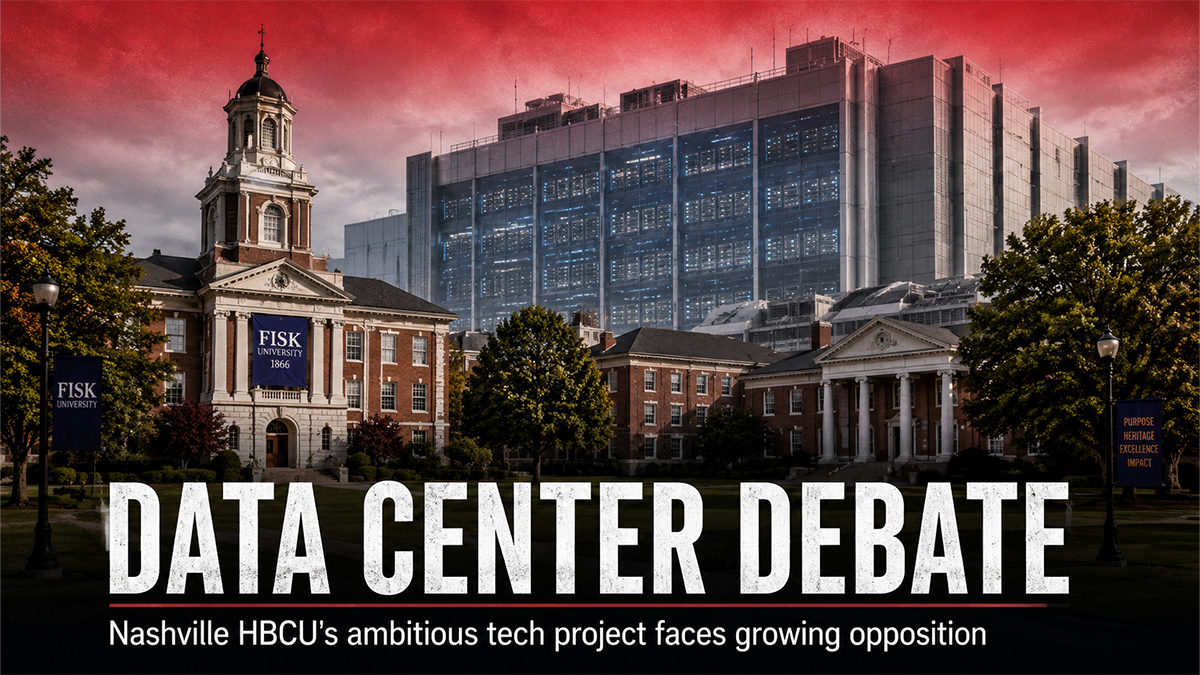
NASHVILLE, Tenn. — A proposed data center project at Fisk University is drawing increasing resistance from community members and alumni of the HBCU. This adds a new challenge to one of the most ambitious campus development plans in the school’s history.
Fisk University unveiled its “Quantum Leap” master plan in May. It is a $1 billion vision that includes new student housing, academic facilities, an arena, and a 100,000-square-foot innovation center anchored by a 30-megawatt data center. University officials have promoted the project as a way to position the historic institution at the forefront of technology and artificial intelligence while creating long-term financial sustainability.
Now, opponents are organizing.
According to reports from Nashville media outlets, two petitions have emerged opposing the proposed data center. Critics argue that residents have not received enough information about the project and fear potential environmental impacts associated with large-scale data centers.
The concerns mirror debates taking place across the country as communities wrestle with the rapid expansion of data centers needed to support artificial intelligence and cloud computing. Questions surrounding energy consumption, water usage, noise levels and impacts on surrounding neighborhoods have become increasingly common as new facilities are proposed.
One North Nashville resident told local media that the lack of public discussion has become a major issue for neighbors living near the campus. Organizers have spent recent weeks distributing information and gathering signatures from residents who say they want more transparency before the project moves forward.
Fisk says project can benefit students and community
Fisk University officials have maintained that the university’s proposal would be different from many controversial data center developments seen elsewhere.
The planned facility would occupy approximately five acres on the southern portion of campus and combine academic, research and technology functions with commercial data center operations. University leaders have repeatedly emphasized a commitment to sustainability and minimizing community impact.
Project leaders have also argued that data centers are likely to become a larger part of Nashville’s future regardless of who develops them. Their position is that Fisk can create a model that balances technological advancement with community responsibility while generating resources that support the university’s educational mission. That argument has not fully eased concerns.
Several community members and alumni have questioned whether any large data center can avoid the environmental and infrastructure challenges that have accompanied similar projects nationwide. Others want additional public meetings and greater transparency about potential commercial partners before construction begins.
The debate comes as Fisk pursues the largest development initiative in its 159-year history. While university leaders view the project as a transformational opportunity, growing opposition suggests the road to construction could be more complicated than originally anticipated.
For now, the future of Fisk University’s proposed data center may depend as much on community trust as technological innovation.