
For years, conversations around HBCU athletics often centered on tradition, culture and survival.
At Winston-Salem State University, the conversation now sounds a lot more like modern college sports business.
Over the last 13 months, WSSU has quietly undergone one of the more interesting athletic department transformations in NCAA Division II. The HBCU has reshaped its leadership structure. It hired a CFO to help run athletics, used a national search firm to identify an athletic director, explored NIL infrastructure, leaned into sports betting revenue realities and introduced a developmental basketball model more commonly seen in professional sports organizations than CIAA programs.
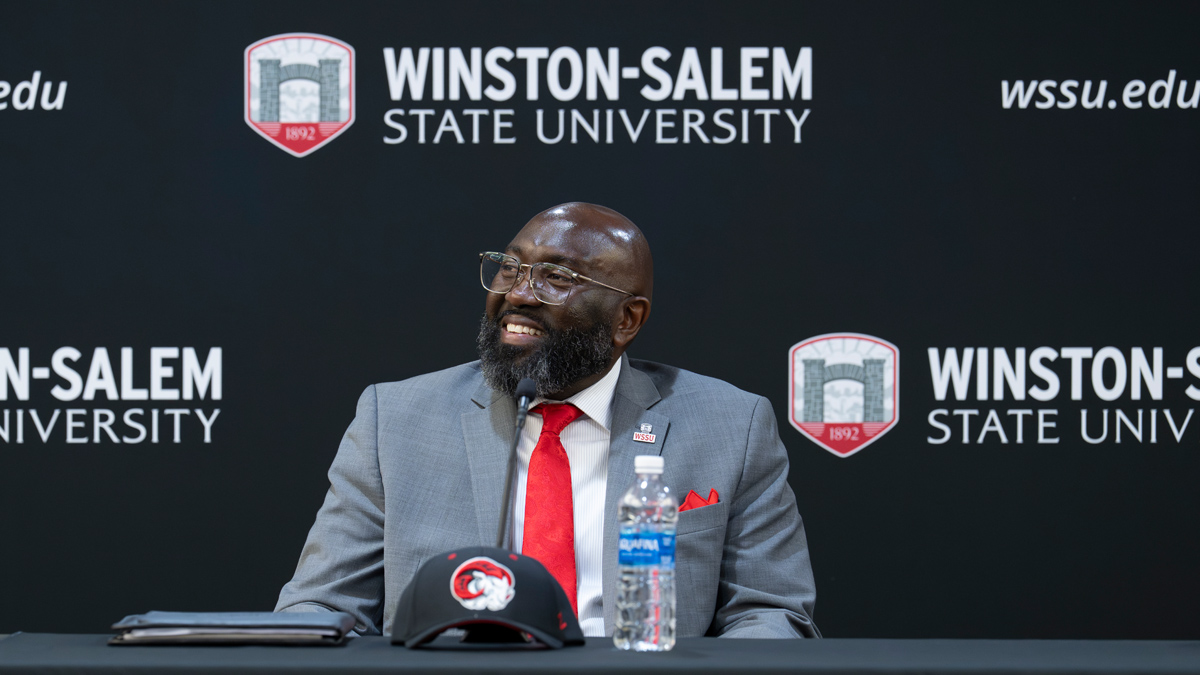
The changes culminated this week when WSSU officially introduced Eric Burns as permanent athletic director after a national search that drew more than 80 applicants.
For Chancellor Bonita Brown, the move was never just about filling a position. It was about repositioning athletics in an era where college sports increasingly resembles a business enterprise.
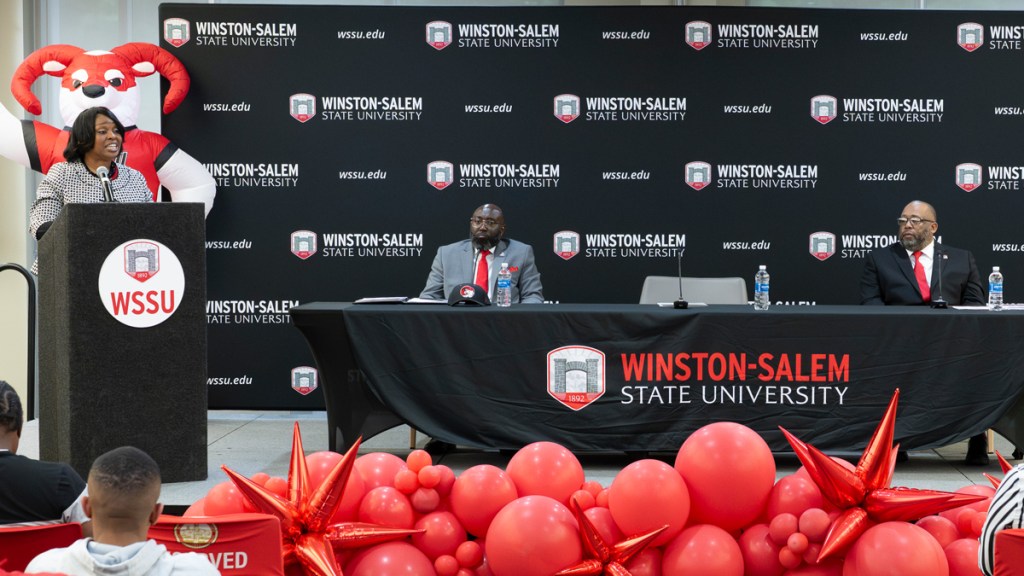
“It’s a new day in the athletics world,” Brown said during Tuesday’s press conference. “A lot is changing all the time, from the NIL to the portal to the different rules and requirements.”
Winston-Salem State made use of search firm
Brown said WSSU intentionally hired Parker Executive Search, which specializes in athletics leadership. That decision alone stood out at the Division II level, where many athletic director searches remain regional or internally driven.
“When I talked to this firm, I liked the energy,” Brown said. “They knew the reputation and the brand of Winston-Salem State University. So I knew they could sell it to others who might be interested.”
The result was a candidate pool Brown described as unusually competitive for a CIAA athletic director opening.
“We had over 80 applicants for that role,” Brown said. “At the end of the day, Mr. Burns rose to the top because of his thoughtfulness, his strategy, and his understanding of the athletic world.”
A CFO running athletics?
Burns’ background also reflects how much college athletics has changed.
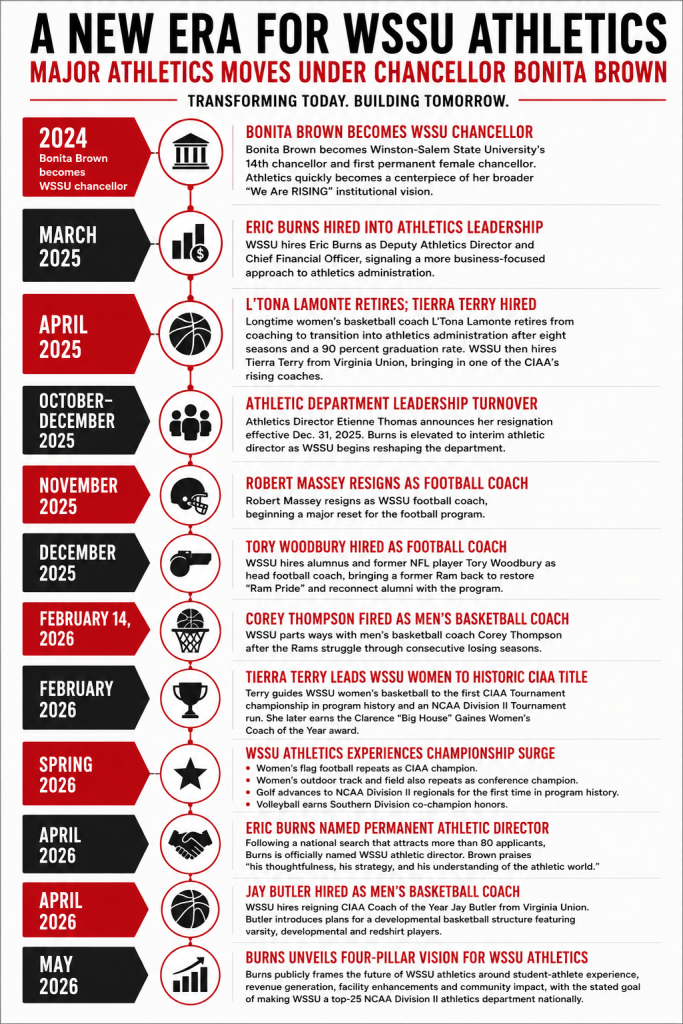
Before becoming athletic director, Burns joined WSSU in March 2025 as deputy athletic director and chief financial officer. His background includes senior fiscal roles at UNC School of the Arts, UNC Greensboro and Fayetteville State.
That résumé may sound more corporate than traditional athletics, but that was part of the point.
“I needed someone who had connections and networks and understood money, budgeting, and resources, and how to bring people together,” Brown said. “Someone who understood that student experience and was going to create that culture and environment.”
Since assuming the interim role last October, Burns has overseen two major hires. He led the hire of football coach Tory Woodbury last December. He also spearheaded the move that brought new men’s basketball coach Jay Butler from CIAA rival Virginia Union.
Burns’ own vision for WSSU athletics sounds less like old-school athletic department messaging and more like a strategic operating plan.
“My vision is rooted in four pillars,” Burns said.
Those pillars include transformational student-athlete experience, increased revenue generation, facility enhancements and community impact.
“We will aggressively pursue new revenue streams through fundraising, corporate sponsorships, and alumni engagement,” Burns said. “By aligning athletics with institutional advancement efforts, we will create meaningful opportunities for our supporters to invest in the future of WSSU athletics.”
WSSU balancing HBCU tradition and modern realities
The changes come as WSSU experiences one of the most successful stretches in recent athletic department history.
Women’s basketball won its first CIAA Tournament title earlier this year under Tierra Terry. Women’s flag football repeated as CIAA champions. Women’s outdoor track and field also repeated as conference champions, while golf advanced to NCAA Division II regionals for the first time ever.
At the same time, the department has faced modern financial pressures familiar across college athletics.
Earlier this year, supporters launched fundraising campaigns around the women’s basketball program during its postseason run. Burns has also openly discussed sports betting revenue, NIL policies and budget management.
According to university documents, sports betting revenue currently serves primarily as “budget relief” rather than a source for major expansion projects at the HBCU.
“We are in the process of developing a policy,” Burns said about NIL. “Now it’s about the education. We have to educate our donors on the things that we can do.”
Burns added that WSSU is exploring collective-style NIL support while trying to create “guardrails and parameters” around how supporters can assist athletes.
That conversation looks very different than the one many Division II schools were having even two years ago.
The Jay Butler hire signals another shift
The hiring of men’s basketball coach Butler may be the clearest sign yet that WSSU wants to think differently.
Butler arrives from Virginia Union after winning CIAA Coach of the Year honors. But perhaps more notable was his discussion of creating a developmental basketball structure at the HBCU.
“We’re going to have a developmental team here,” Butler said. “We’re going to have a group that’s redshirting. And then we’re going to have a varsity team.”
That structure could create a 30-to-35-player ecosystem blending varsity players, developmental prospects and redshirts. It also reflects how roster management has evolved in the NIL and transfer portal era.
“Our foundation is gonna go get good high school kids, and then we’re gonna take a peek in that portal,” Butler said.
For Brown, the transformation happening at WSSU is about more than wins.
“Athletics is the front door to the university,” she said. “It is one of the first ways you will experience and see a university and see who we are, our pride, our discipline, and our commitment to excellence.”
At many HBCUs, athletics departments are still fighting just to keep pace.
WSSU is trying something different. It is attempting to modernize while holding onto the culture that made Ram athletics matter in the first place.