
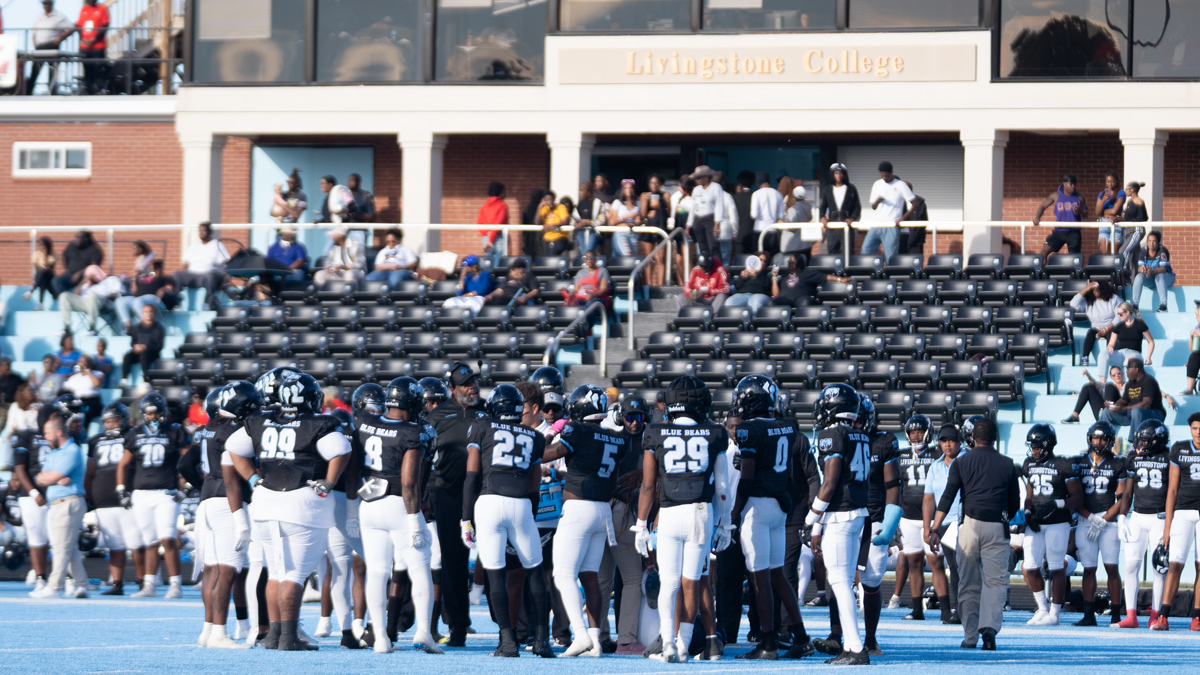
In HBCU football circles, Livingstone College has quietly become a place where talent is built, sharpened, and sent onward to Division I opportunities. The end of the 2025 season only made that reality clearer.
Four key defenders from Livingstone College have moved on to Division I programs since the season ended.
DL Kenyon Garner to Florida Atlantic.
DL Jordan-Lebron Downey to New Mexico State.
DL David Jones to Mississippi Valley State (FCS).
DB Dallas Johnson to South Alabama.
Those moves weren’t coincidences. They were the result of a system that has taken shape since former NFL standout Sean Gilbert arrived in 2020, bringing with him an expectation that development, not hype, would define the program.
“We push our guys to their maximum potential,” assistant head coach and co-defensive coordinator Mark Williams told HBCU Gameday. “And if that happens to mean they have to go somewhere else, we’ve done our job.”
Built, not bought
Livingstone College is the oldest HBCU football program in the country having hosted the first black college football game in 1892. It is a private school started by the AME Zion Church with just over 1,000 students. Needless to say, it doesn’t recruit the way power programs do. It can’t and it wasn’t made to.
Williams says he sees hundreds of messages daily from hopeful prospects, but the evaluation process goes deeper than size or measurables.
“Your film doesn’t lie,” Williams said. “But I don’t just watch the player. I watch somebody else on his team. I want to see the lazy plays. I want to see how much effort you give when you’re tired.”
That philosophy has shaped one of the most productive defensive fronts in the CIAA. The numbers back it up. Livingstone finished 2025 with 31 sacks, despite not having the depth or resources of larger programs.
The results showed up individually as well.
Kenyon Garner became the headline act. The sophomore defensive lineman dominated Division II football. He finished with 54 tackles, 27 tackles for loss, and 14 sacks, earning CIAA Defensive Player of the Year honors. Opponents double-teamed him weekly. It didn’t matter.
Williams wasn’t surprised. A player recruited out of Florida to become an offensive lineman in 2024 kept losing weight and he told Williams he wanted to play on the defensive line. Williams listened, and the rest is history.
“I knew from the time camp started,” he said. “Just watching his summer work, I knew he was going to be a guy.”
Garner’s jump to Florida Atlantic put a national spotlight on what had been brewing. But he wasn’t alone.
Strength in numbers
Jordan Downey followed a different path. The Canadian defensive lineman developed into a disruptive interior presence before transferring to New Mexico State. Dallas Johnson, a steady corner with range and toughness, earned his opportunity at South Alabama.
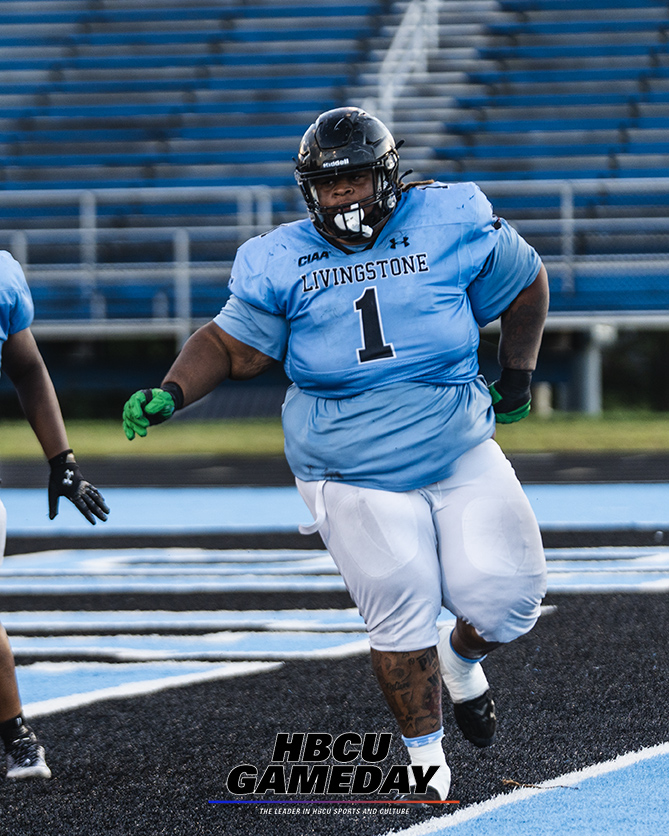
Jones became a viral moment when Livingstone handed the ball to a 350-pound defensive lineman near the goal line. He scored three rushing touchdowns in 2025. The clip spread everywhere.
But Williams says Jones’ story fits the same mold as the others.
“He had running clips in his highlight tape,” Williams said. “Some coaches would laugh at that. I didn’t. You never know when you’ll need that skill set.”
Jones’ impact went beyond novelty. He totaled 30 tackles and 3.5 tackles for loss in 2025 while anchoring the middle of the line. He accepted double teams. He freed linebackers. He did the work others don’t always see.
That mindset translated into opportunity. Mississippi Valley State offered Jones a full scholarship and a chance to compete at the Division I level.
A pattern years in the making
What’s happening now didn’t start in 2025. It’s the continuation of a trend that has been quietly building at Livingstone College for several seasons.
Jordan Robinson was one of the first modern examples. He arrived in Salisbury in 2021, developed within the program, then made the leap to Division I, first at Kentucky. From there, Robinson continued his climb, transferring to Cincinnati before landing at Virginia in 2025, where he became part of a program resurgence at the Power Five level. His path underscored what Livingstone’s coaches already believed — development at the HBCU level could translate anywhere.
Then there was Kevin Larkins. Larkins earned his opportunity to transfer to Kentucky, tasted the Power Five experience, and ultimately returned to Livingstone, where he rejoined the defense and became an All-American presence. His journey highlighted another reality of the modern era: sometimes players leave, sometimes they come back, and the relationship doesn’t have to end either way.
Those examples laid the groundwork for what followed. Over time, Livingstone defenders stopped being “surprises” on recruiting boards. They became known quantities.
“We’ve had several guys come in, perform at a high level, and leave,” Williams said. “And a couple of those guys are draft eligible right now. Their careers started right here at Livingstone College.”
That matters — not just for recruiting, but for credibility.
Coaching in a year-to-year reality
For Williams and the rest of the staff, the biggest adjustment hasn’t been schematic. It’s been emotional and philosophical.
There was a time when development meant stability. You recruited a player, shaped him, and expected to watch his entire career unfold in your uniform. That expectation no longer exists.
“You kind of have to accept that this is what it is now,” Williams said. “Especially after COVID, with the portal going year to year and NIL.”
Players now arrive knowing that a strong season can change their lives quickly. Coaches know it too.
“If D1 and D2 all had the same facilities, the same food, the same resources, a lot of these guys would stay,” Williams said.
Instead, the HBCU has leaned into being a launch point. Williams described it as a double-edged sword — painful at times, but ultimately validating.
“It’s a lot of positive to it because some of these kids are able to change their family’s lives,” he said.
That mindset reframes success: Championships and wins still matter. But so does upward mobility.
Livingstone College is the rule, not the exception in today’s landscape
Williams and the coaching staff at Livingstone College see things with clear eyes. They understand their role is to find diamonds in the rough. They also understand the implications.
They know that if their players are successful, if they dominate and separate themselves, attention will follow. And if that attention leads them elsewhere, the door won’t close behind them.
Williams doesn’t shy away from that truth. He prepares for it.
“Big schools are trapped in the portal world,” he said. “If you’re not top 100, top 300, they’re not even looking at you. So they come and get your best guys.”
Rather than fight it, Livingstone has chosen to master it.
The names can change each year. The destinations change. But the pattern stays the same.
Salisbury has become a proving ground — a place where overlooked players arrive hungry, leave better, and carry the imprint of an HBCU that understands its role in modern college football.
Whether it’s good or bad is debatable. What isn’t debatable is that it is the new norm for most HBCUs and most college football programs in America. At least Livingstone knows where it stands in today’s college football eco-system.
I haven’t heard a word about Education, through out the whole conversation of the Portal from the beginning stages. Is it just about football, or future success in life. Most that enter the Portal will never reach the Next Level, and that’s reality. Where is the Education Component in this?