
Every fall, small college football programs, including HBCU programs, sign contracts to get blown out by the sport’s biggest budgets, and everyone calls it smart business. Guaranteed money, what fans and coaches call “money games,” keeps HBCU athletic departments running in a sport where the gap between programs is now measured in dollars, not talent. What concerns me is what a 50- or 60-point loss does to the young man on that sideline. They keep the lights on. For the athletes who play them, they are anything but FundaMENTAL.
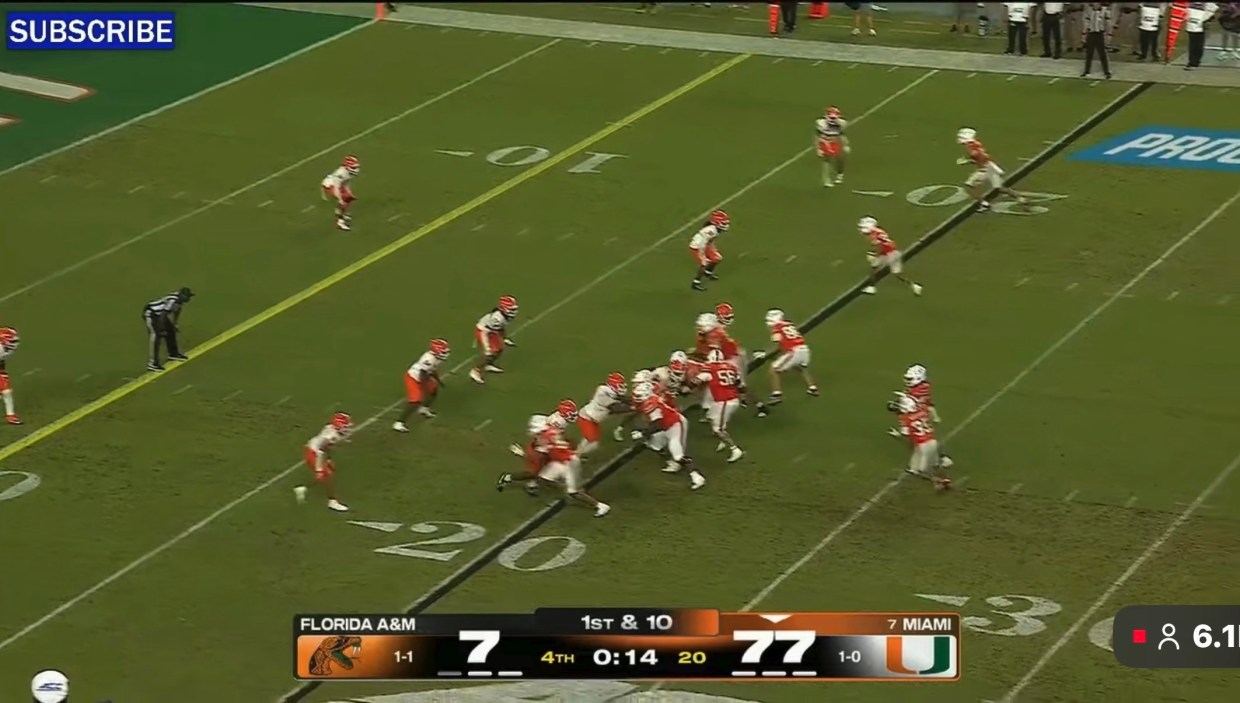
Florida A&M’s September is a good example. The Rattlers opened their season in Miami at the Orange Blossom Classic against South Carolina State, losing 31-13. Rather than fly home and back four days later, FAMU stayed in South Florida for a Thursday night game against the University of Miami, where they lost 77-7 and managed just 107 yards to Miami’s 856. That game paid out $760,000.
Similar trips have occurred across the MEAC, SWAC, and other conferences. Tennessee State took $600,000 to lose 63-3 to Georgia, the same Georgia that paid UMass $1.9 million for one game. Morgan State earned $600,000 in a 70-7 loss to Arizona State, and Grambling brought home $1 million from Ohio State. North Carolina A&T lost 68-7 to UCF. These deals have funded HBCU football for decades because the budget gap between a Power Four department and a MEAC or SWAC one isn’t measured in degrees. It’s measured in zeros.
HBCU programs have legit needs
I understand why programs keep signing up. What concerns me is what happens after the final whistle. I ask this as a board-certified Psychiatric Mental Health Nurse Practitioner who treats chronic stress and as a certified Mental Game Performance Coach trained to understand what happens inside an athlete’s head when the scoreboard turns against him.
A 50- or 60-point loss doesn’t register the way a close game does. In performance psychology, this is learned helplessness, the pattern that sets in when effort and outcome no longer feel connected. Self-talk collapses, composure erodes, and for young men whose sense of self is tied to being an athlete, identity takes a direct hit. After that UCF game, NC A&T coach Shawn Gibbs said: “I don’t think it’s worth it… is that worth it? I don’t know.” When coaching at an HBCU, Deion Sanders refused several of these matchups and called them “demoralizing.” “What do you tell a 19-year-old walking off that field, down 40 in the third quarter?”
For many HBCU athletes, these games come after years of stress unrelated to football: growing up with little, being first-generation, and spending four years in institutions never built with them in mind. Research on Black college students shows a heightened physiological stress response linked to chronic, race-related adversity. A blowout doesn’t happen to a blank slate. It happens to young men who’ve already carried more than their share and have fewer mental health resources than their opponents.
Mental health access barriers exist
Joonyoung Lee, De’Suan Dixon, Aaron Goodson, and Duncan Simpson conducted a recent study of HBCU student-athletes and published it in the journal Psychology of Sport and Exercise in March 2026. The study surveyed 205 student-athletes across six HBCUs in the southeastern U.S., with IRB approval from Jackson State University, and included qualitative interviews with 19 additional student-athletes. Findings revealed that 59 percent screened at risk for clinical depression and 51 percent showed mild to severe anxiety, well above general college rates. The barriers to seeking help were consistent: stigma, cultural expectations equating emotional control with masculinity, and underfunded counseling and sport psychology staffing. Prior access to mental health services cut depression risk by 46 percent and anxiety risk by 54 percent. Treatment and mental skills training work, but access is what these programs can’t afford, which is why they’re playing these games in the first place.
Tennessee State’s Reggie Barlow, pushing for a $1 million minimum on these contracts, put the physical risk plainly: “You are putting them up against guys that are bigger, stronger.” Eleven years ago, Southern University’s Devon Gales was paralyzed during a tackle in a 2015 game against Georgia. Every player who boards that bus or plane knows the story.
Where Is The Line?
None of this means HBCUs should or could walk away from the money. Edward Waters University president Dr. A. Zachary Faison put it well: the calculation must include recruiting perception, player health, competitive development, and program image, not just the check. If these games continue, conferences and the NCAA owe these athletes more than a payout: a required mental performance debrief within 48 hours of every lopsided loss, ongoing psychiatric and sports psychology support, and a real share of that guarantee money earmarked for mental and behavioral health staff.
A program can survive a 70-point loss. Whether the 18- or 19-year-old on that field can survive it, not just physically but mentally, depends on whether anyone trained to protect his mind is in the building. Right now, at most of these schools, no one is.
By Janelle R. Baker, Ph.D., APRN, PMHNP-BC, MGPC-C
Owner, The Mind in the Mirror, PLLC
janeller.baker@themindinthemirror.com