
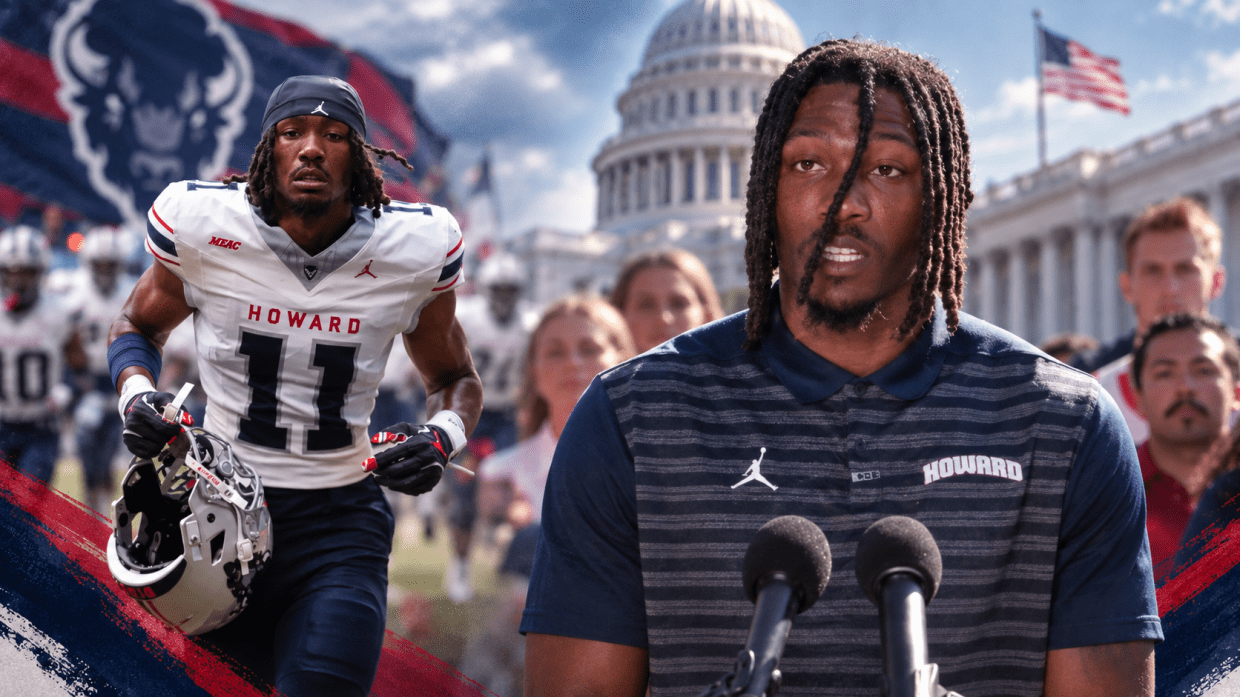
HBCUs are finding themselves in the middle of a complicated debate involving the NCAA, Congress and the future of college athletes, with a Howard University football player now publicly advocating for legislation that several Black political and athlete-rights organizations have opposed.
Howard University student-athlete Kedrick Green urged Congress to pass the Protect College Sports Act this week. The Senate is considering legislation designed to establish national rules for college athletics.
“As a college student, I believe that the Protect College Sports Act is about giving student athletes like me something we all deserve: security and a fair opportunity,” Green said on Capitol Hill.
Green pointed specifically to protections involving Name, Image and Likeness compensation, scholarships and athlete health and safety.
“It protects our right to earn from our Name, Image and Likeness while putting safeguards in place so athletes aren’t taken advantage of. It protects scholarships, strengthens health and safety standards and creates a more consistent rule around NIL, transfers and eligibility,” Green said.
The legislation would establish a national NIL standard while providing scholarship and health-care protections. It also includes restrictions involving athlete agents and creates rules covering transfers, eligibility, recruiting and enforcement.
For Green, the issue also involves the resources available to schools such as Howard University.
“For HBCU students like myself at Howard University and conferences like the MEAC — stability matters. We need a system that gives us an opportunity to compete and grow — not where the rules constantly change depending on where you play,” Green said.
HBCUs find themselves in a complicated position
Green’s comments arrive as several major HBCU organizations have lined up behind federal college sports legislation.
HBC4Us represents the CIAA, MEAC, SIAC and SWAC and describes unified advocacy on NCAA governance, student-athlete rights and public policy as part of its mission.
Supporters of the Protect College Sports Act argue that a national framework could provide stability for athletic programs operating with significantly different resources.
The Senate Commerce Committee said in June that 24 athletic conferences and 267 colleges and universities supported the legislation, including HBCUs and current student-athletes.
But that institutional support has created an unusual divide within Black organizations.
The Congressional Black Caucus announced in August that it could not support the legislation in its current form.
The CBC argued that Congress should not grant broad legal protections to powerful college athletic institutions without stronger representation, protections and economic opportunities for athletes, particularly Black athletes.
That opposition followed the CBC’s earlier resistance to the SCORE Act. In December 2025, the caucus argued that the proposal would limit athletes’ labor and employment rights while providing broad protections to the NCAA and athletic conferences.
The CBC again urged the Senate to slow the process in June, saying Black athletes and communities should have a greater voice in shaping federal college sports policy.
Howard University athlete offers another perspective
Green’s advocacy complicates the idea that the debate can simply be divided between institutions and athletes.
He is a Black athlete competing at an HBCU and says the legislation provides protections he believes athletes need.It is also what HBCU commissioners are pushing.
“At the end of the day, this is about protecting athletes who make college sports possible. So I hope Congress passes this act,” Green said.
The competing positions illustrate a broader issue for HBCUs.
The interests of historically underfunded athletic departments and the individual economic rights of athletes can overlap. They are not always identical.
For HBCU conferences, greater stability within the NCAA structure could provide predictability in an era of rapid changes involving NIL, revenue sharing and athlete movement.
Critics remain concerned about how much authority and legal protection Congress should give the NCAA, conferences and schools in exchange for that stability.
That leaves HBCUs occupying a unique place in the debate.
Organizations representing Black colleges see federal legislation as a potential way to protect institutions operating far outside the financial scale of major Power Four programs. At the same time, Black lawmakers and athlete advocates have questioned whether the same legislation sufficiently protects athletes whose labor drives the college sports economy.
Green is making a case that there are Black HBCU athletes who see the issue differently. But how much of that is influenced by HBCU leadership that knows it could be further left behind if things don’t change?
For Congress, the challenge is determining whether one federal framework can provide the stability HBCUs say they need while addressing the concerns raised about athlete power, representation and economic rights.