
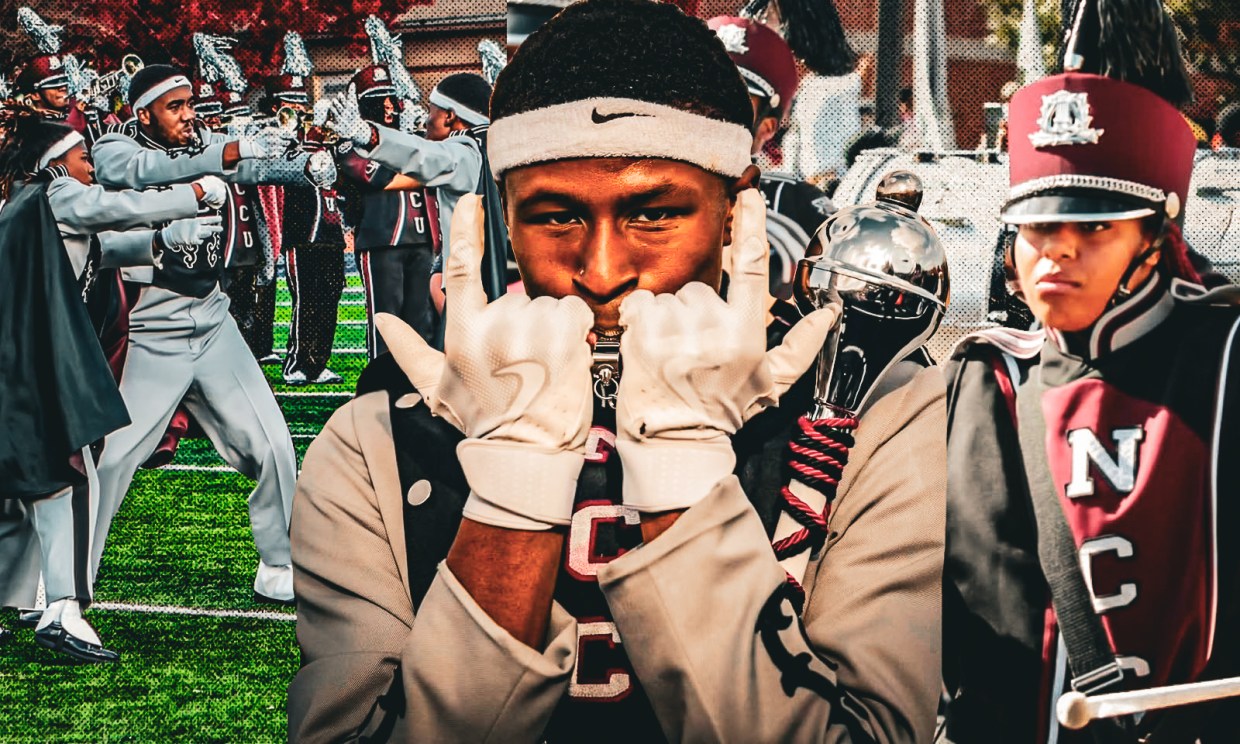
A viral altercation involving the NCCU Sound Machine and members of North Carolina A&T’s football equipment staff added another heated chapter to one of HBCU culture’s fiercest rivalries.
DURHAM, N.C. — The latest Aggie-Eagle Classic produced a close football game, a lengthy weather delay and a viral sideline confrontation rooted in one of HBCU band culture’s most serious unwritten rules.
Members of the North Carolina Central University Sound Machine marching band and North Carolina A&T’s football equipment staff became involved in a brief physical altercation Saturday at O’Kelly-Riddick Stadium.
Video of the incident quickly circulated across social media, showing band members exchanging aggressive shoves with members of the Aggies’ support staff in gray jackets as rain fell near the sideline.
According to reports and accounts from the scene, the confrontation began when members of the A&T equipment staff attempted to walk through the Sound Machine while the HBCU band was lined up to take the field before halftime.
To someone outside the culture, that might look like an effort to take the shortest available route.
Inside HBCU band culture, it can be interpreted as something much more disrespectful.
Why walking through an HBCU band crosses a line
An HBCU marching band standing in formation is not simply a collection of musicians waiting for its turn to perform.
The line represents discipline, precision and institutional pride. Band members spend countless hours learning to move as one unit, maintain exact spacing and protect the formation regardless of what is happening around them.
Walking directly through that formation disrupts the unit and invades a space band members have been trained to hold.
There is also a practical safety concern. Musicians may be carrying heavy brass instruments, drums and other expensive equipment while preparing to move. Dancers and auxiliary performers may also be working within limited space and visibility.
An unexpected person cutting through the ranks creates the possibility of collisions, damaged instruments or injuries.
Standard etiquette is simple: Walk around the band.
That rule carries even more weight when the person crossing the formation represents the opponent. During a rivalry game, what might otherwise be dismissed as a careless shortcut can be viewed as a deliberate challenge.
The viral video does not show the entire sequence leading to the confrontation, and neither university had released a public statement about the incident shortly after the game. What it captured was a tense but brief push-and-shove that was contained internally before escalating further.
The moment nevertheless spread quickly because it combined three powerful elements: a physical confrontation, HBCU band culture and the Aggie-Eagle Classic.
The bands are part of the rivalry
The 98th meeting between North Carolina Central and North Carolina A&T was never going to be just another football game.
The rivalry began in 1922 and has developed into one of the most important annual events in Black college sports. North Carolina A&T leads the all-time football series 54-39-5, but NCCU has taken control of its most recent chapter.
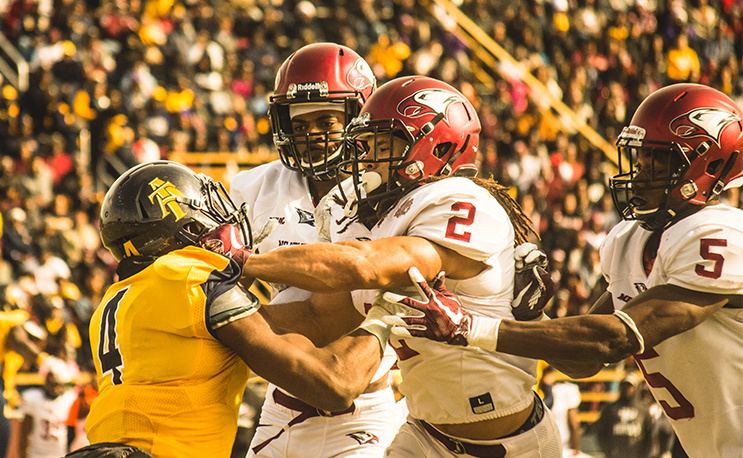
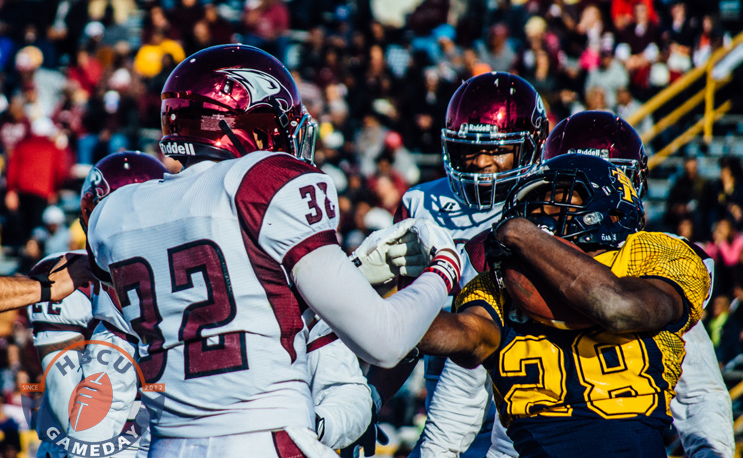
The Eagles’ 30-22 victory Saturday marked their fifth consecutive win over the Aggies.
The game was originally scheduled for the evening before concerns about severe weather moved kickoff to noon. A 101-minute lightning delay interrupted play, but the rivals still delivered a finish that came down to the final snap.
A&T reached the NCCU 3-yard line during the closing seconds with an opportunity to tie the game. An offensive pass interference penalty pushed the Aggies backward before NCCU defensive back Javion Martin intercepted the final pass in the end zone.
The result continued an Eagles winning streak that included a record-setting 62-20 victory in 2025.
Deeper than football
But the football players have never carried this rivalry alone.
North Carolina A&T’s Blue and Gold Marching Machine and NCCU’s Sound Machine serve as extensions of their universities. Their performances create another competition inside the competition, with each band trying to establish musical, visual and cultural supremacy.
Halftime is not an intermission at the Aggie-Eagle Classic. It is one of the main events.
The competition often continues after the final whistle during the “Fifth Quarter,” when the bands exchange selections from the stands and make their closing arguments before students, alumni and fans.
Every arrangement, dance routine and musical response can carry a message. Every visual detail matters. Even how a band enters, exits or occupies space can become part of the contest.
That environment helps explain why walking through a rival band’s formation could ignite such a quick and emotional response.
Another combustible chapter in the Aggie-Eagle Classic
The Aggie-Eagle rivalry has crossed the line from heated competition to physical confrontation before.
In 2007, an NCCU player stomped on the Aggie logo at midfield following an Eagles victory in Greensboro. The gesture triggered a bench-clearing brawl and became one of the rivalry’s most infamous moments.
Saturday’s sideline incident was significantly smaller and involved different parts of the two programs, but it came from the same combustible mixture of proximity, pride and history.
These schools are separated by roughly 55 miles. Their students, alumni, football programs and marching bands compete for bragging rights that stretch far beyond a single Saturday.
That connection is what has allowed the Aggie-Eagle Classic to endure through conference changes, neutral-site experiments and shifting eras of football dominance. The game has been played at campus stadiums, Carter-Finley Stadium in Raleigh and Bank of America Stadium in Charlotte, but its intensity has traveled wherever the rivalry has gone.
In 2027, the Classic is scheduled to return to Charlotte as part of the Duke’s Mayo Classic.
The viral HBCU band video from Durham will likely become another piece of rivalry folklore before then. It was more than a random sideline disagreement. It was a collision between two support units that understand they are participating in something much bigger than football.
At the Aggie-Eagle Classic, everyone represents the institution.
And sometimes, even crossing the wrong line can become part of the rivalry.