
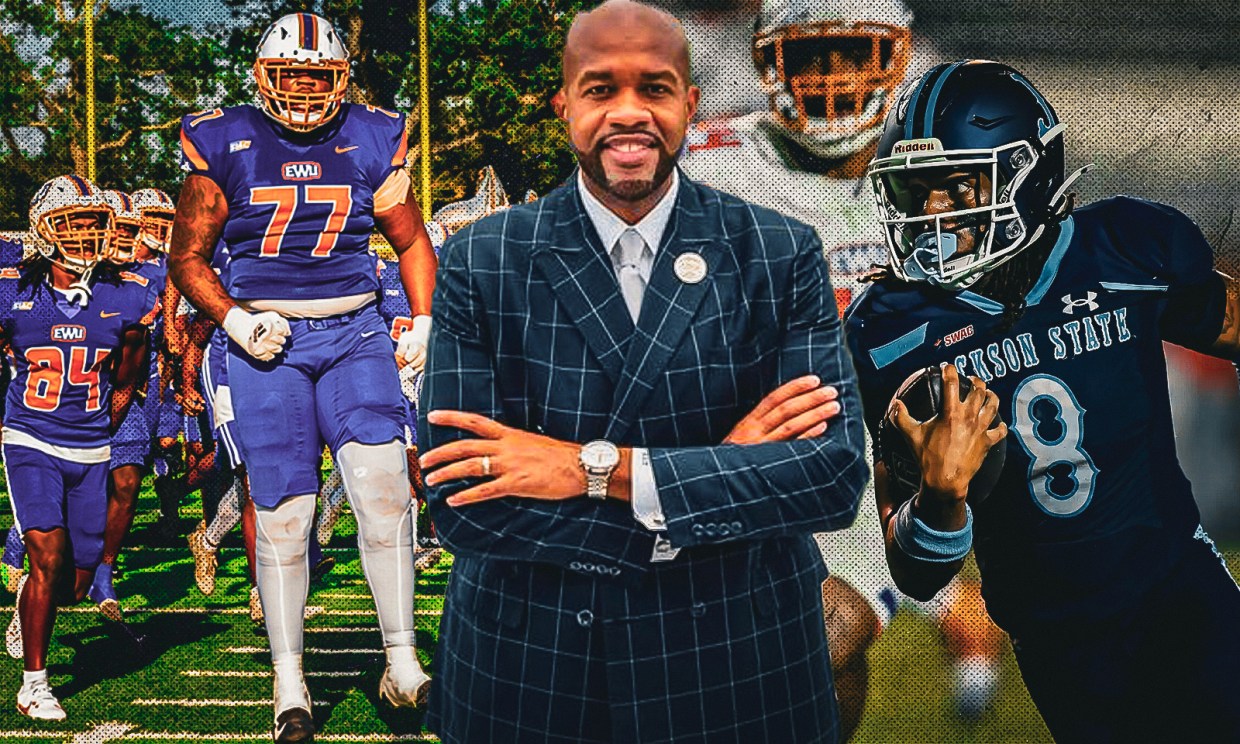
Edward Waters University did not leave Jackson, Mississippi, with just a 52-point loss. The HBCU left with a new line in the sand.
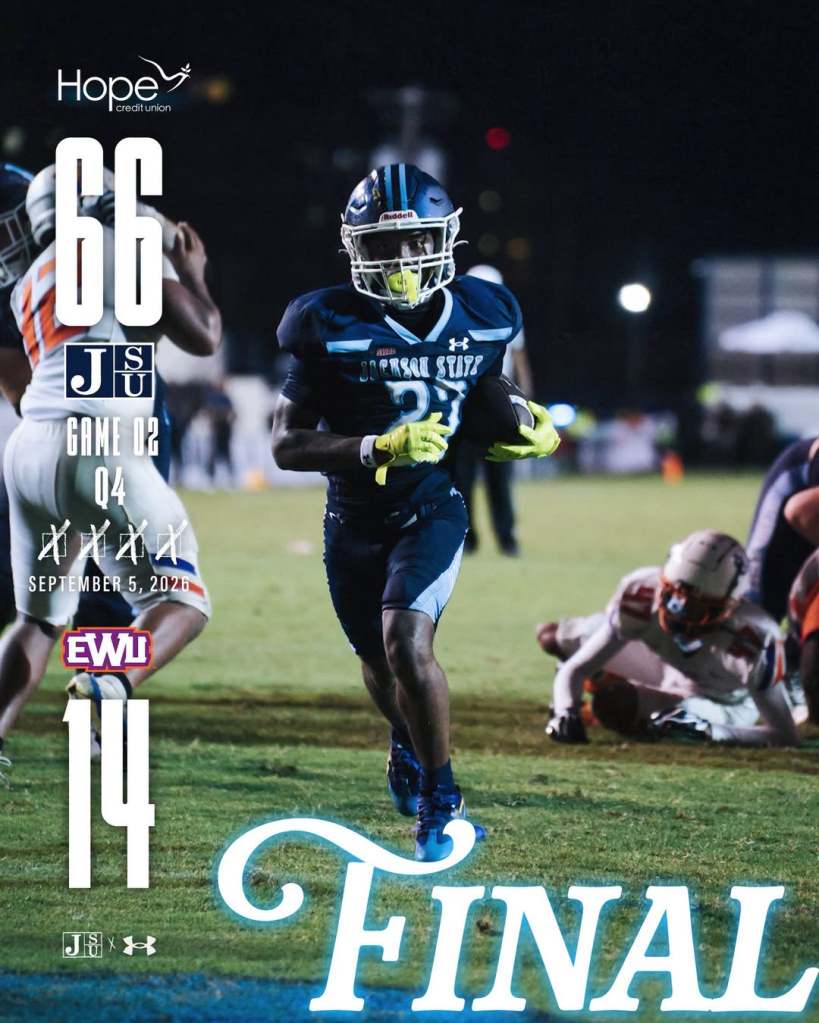
Hours after Jackson State defeated Edward Waters 66-14 in the Hope Labor Day Classic, EWU President A. Zachary Faison Jr. issued a remarkably candid public statement.
He praised his football team, apologized for placing it in a competitively uneven game, and announced that the university will no longer schedule Division I opponents unless the terms materially advance its program.
The final score may have sparked the conversation, but Faison made it clear that his decision was about more than one difficult Saturday.
It was about the price Edward Waters was paid to take the loss, the structural gap between the programs and whether a traditional “money game” still made financial or competitive sense for the Division II HBCU.
“I owe you an apology, because the position we placed you in Saturday was not your doing and it was not your coaches’,” Faison wrote. “That game went on our schedule two years ago, and I enthusiastically supported it. The decision was mine, and I own it.”
That level of public accountability is rare in college athletics. Presidents routinely approve the contracts that send football teams into guarantee games. But they rarely address the players afterward, saying the bargain was not worth it.
Faison did exactly that—and then showed his math.
Edward Waters cleared roughly $30,000 from Jackson State game
According to Faison, Edward Waters received a $65,000 guarantee for traveling to Jackson State. Travel and related expenses cost approximately $30,000 to $35,000, leaving the university with roughly $30,000.
“The economics do not work,” he wrote.
For an athletics department operating without the financial scale of a major Division I program, $30,000 is not a trivial amount. But Faison argued that it was not enough to justify everything the game demanded from Edward Waters’ players, coaches and program.
His comparison with the larger HBCU money-game economy made the difference even sharper.
At least 15 games between Division I HBCUs and FBS opponents are expected to produce more than $6.9 million in guarantees during the 2026 season. Florida A&M is reportedly receiving $740,000 to play Miami. Morgan State is getting $600,000 from Arizona State. Tennessee State received $600,000 for its trip to Georgia. Howard is due approximately $1 million across games at Indiana and Rutgers.
Those games can carry the same competitive dangers, but the payouts can fund scholarships, staffing, facilities and other needs at a transformational level. Edward Waters took on a significant competitive mismatch for a fraction of that return.
Faison pointed directly to Tennessee State as an example. One week after losing to Jackson State by only two points, TSU lost 63-3 at Georgia. His point was not that Tennessee State suddenly became a lesser program. It was that moving up a level can distort what a scoreboard appears to say—and that Tennessee State was at least paid enough to make the trade defensible.
Edward Waters was not.
A scoreboard cannot explain the scholarship gap
Jackson State did what strong programs are supposed to do. T.C. Taylor’s team produced 704 yards of total offense and controlled a matchup it was built to win. Jackson State recorded the 66-14 final in the first meeting between the programs.
Faison congratulated Jackson State and made it clear that EWU had not been mistreated. Jackson State negotiated terms that served its program, and Edward Waters agreed to them.
His concern was the structure behind the result.
Edward Waters entered the game with 29 football scholarships funded. Division II permits a maximum of 36. Faison compared that with an FCS limit of 63, giving Jackson State access to more than twice the funded scholarship inventory EWU put on the field.
“We are not being measured,” Faison wrote. “We are being mismeasured.”
That distinction sits at the center of his argument. A game can be scheduled between two HBCUs, promoted as a classic and played in front of a celebratory Black college football crowd. None of that makes the competitive resources equal.
The consequences can last beyond the final whistle.
Faison argued that the 66-14 score will follow Edward Waters coaches into recruiting conversations. Prospects may see the margin and conclude that the Division I product is inherently superior, even if the result grew from a comparison between programs operating under different scholarship structures and budgets.
“It is not superior. It is different,” he wrote. “Superior and different are not synonyms.”
HBCU money games face a new question
Money games have long occupied an uncomfortable but important place in college football. A smaller program travels to face a better-resourced opponent, absorbs the competitive risk and returns home with a guarantee that helps support its athletics operation.
For Division I HBCUs visiting FBS programs, a six- or seven-figure check can make the bargain understandable even after a lopsided loss. For a Division II HBCU taking a five-figure guarantee to play an FCS opponent, the calculation can be much harder to defend.
The question is not simply whether Edward Waters could have played better in Jackson. Faison acknowledged that it could. The larger question is what the university gained by accepting a matchup in which both the financial return and the competitive terms were stacked against it.
His answer was clear: not enough.
Going forward, Edward Waters will not consider a Division I matchup unless it expects to clear at least $100,000 after expenses. The Tigers plan to prioritize Division II opponents from leagues such as the SIAC, CIAA, Conference Carolinas and Gulf South Conference. Games that can support postseason goals and put EWU on more competitive footing. Faison’s policy and financial threshold were detailed following the loss.
That does not mean every Division II-versus-FCS HBCU game should disappear. Some carry rivalry value, regional relevance or a payout that materially changes the equation. But Faison’s statement challenges schools to stop treating every guarantee as good business simply because a check is attached.
Edward Waters lost by 52 points at Jackson State. Its president responded by refusing to let that scoreboard become a judgment on his players alone.
Instead, he turned the scrutiny toward the people who signed the contract—and started with himself.