
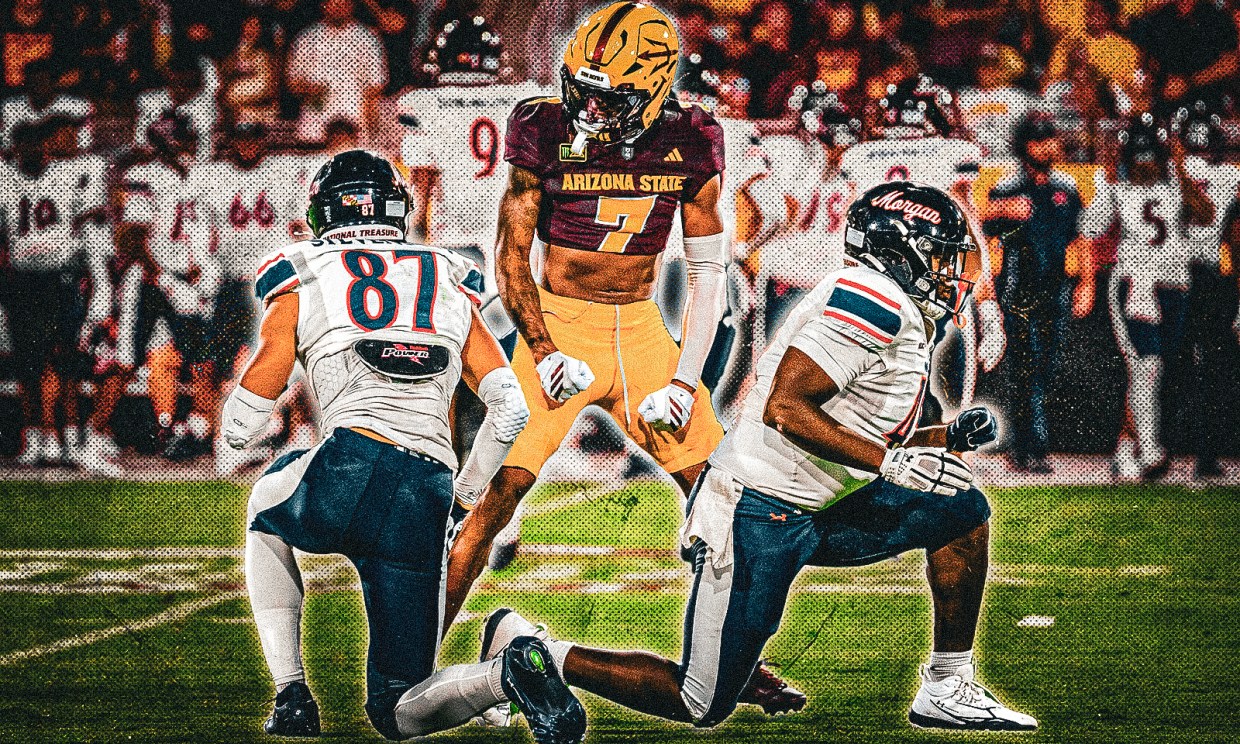
Morgan State traveled nearly 2,300 miles to collect one of the largest guarantee checks on the HBCU football calendar from Arizona State out of the FBS Big-12 conference.
The game itself did not last the full 60 minutes.
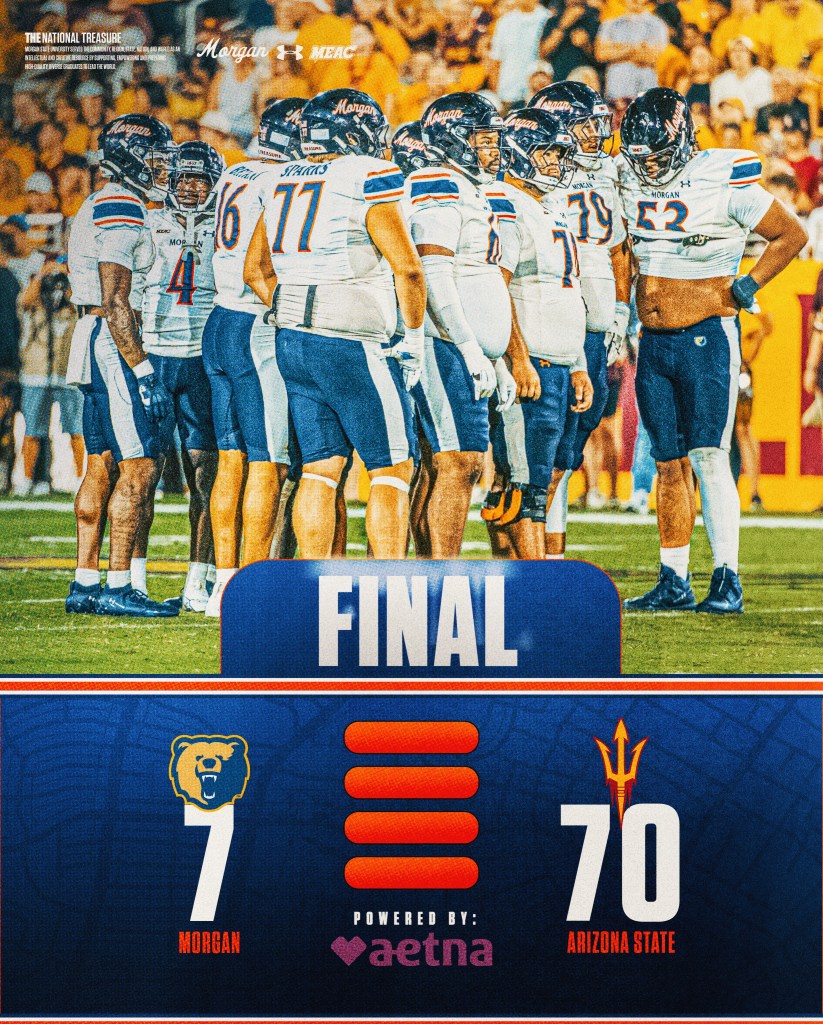
Arizona State defeated Morgan State 70-7 on Saturday night in Tempe, with the two programs agreeing to shorten the fourth quarter from 15 minutes to 10 after the Sun Devils built a 63-point lead.
It was not technically an NCAA “mercy rule.” College football does not have an automatic rule that ends or alters a game once the score reaches a certain margin.
But the unusual finish looked and felt like one.
Morgan State head coach Damon Wilson asked officials about shortening the final period after Arizona State carried a 70-7 lead into the fourth quarter. When the request reached Sun Devils head coach Kenny Dillingham, he immediately agreed.
“The referees came over and said [Wilson] asked if we could shorten the quarter, and I said, ‘Yeah, of course, whatever he wants, we will do,’” Dillingham said following the game. “I’ve never been a part of a game like that. I didn’t know that was legal. I learned something today.”
It was legal because of a rarely discussed section of the NCAA rulebook that allows coaches and officials to reduce the remaining playing time.
The decision also placed Morgan State directly in the middle of a larger conversation that was already unfolding across HBCU football: When does the value of a money game stop being worth the score?
The NCAA rule behind the shortened game
What happened at Mountain America Stadium was permitted under NCAA Football Rule 3-2-2-a.
The rule allows the playing time of any remaining period to be shortened through a mutual agreement between the opposing head coaches and the referee. There is no required scoring margin and no automatic trigger.
That distinction matters.
Unlike the mercy rules commonly used in high school football, the NCAA does not automatically institute a running clock or end a game when one team takes a 35-, 50- or even 60-point lead. Coaches can agree to shorten the remaining quarters, but normal clock rules still apply during the time that remains.
Morgan State and Arizona State settled on a 10-minute fourth quarter. Neither team scored during the abbreviated period, leaving the final margin at 63 points.
It was a rare procedural decision at the end of a game that had become noncompetitive almost immediately.
Arizona State overwhelmed Morgan State
Arizona State scored on its opening possession and needed only 30 seconds to take the lead on a 46-yard touchdown run from Kyson Brown.
The Sun Devils scored again 76 seconds later.
By the end of the first quarter, Arizona State led 28-7. The lead grew to 49-7 by halftime and 70-7 with 4:34 remaining in the third quarter.
Quarterback Cutter Boley produced a record-setting debut for Arizona State, completing 21 of 27 passes for 387 yards and six touchdowns. His 387 passing yards were the most by a quarterback making his Sun Devils debut.
Arizona State finished with 681 yards of total offense, averaging 9.6 yards per play. The Sun Devils generated 432 passing yards, 249 rushing yards and 32 first downs without punting once.
Morgan State finished with 188 total yards and 11 first downs. The Bears completed 11 of 24 passes for 86 yards and punted eight times.
Their only touchdown came during a four-play, 75-yard drive in the first quarter. Jordan Barnett capped it with a two-yard run that briefly cut Arizona State’s lead to 21-7.
The official attendance was 54,004, with the game kicking off in 99-degree heat.
For the opportunity, Arizona State paid Morgan State a guaranteed $600,000.
What did Morgan State receive for $600,000?
The financial difference between this game and the one that caused Edward Waters University President A. Zachary Faison Jr. to publicly rethink guarantee games is substantial.
Edward Waters received $65,000 to play Jackson State. After accounting for approximately $35,000 in expenses, Faison said the Division II HBCU netted only about $30,000 from a trip that ended in a 66-14 loss.
The 52-point defeat prompted Faison to declare that Edward Waters would no longer schedule opponents with significantly greater resources for less than $100,000.
Morgan State’s situation fits that mold.
The Bears received $600,000—ten times the gross guarantee Edward Waters collected—and Morgan State athletic director Dena Freeman-Patton characterized the matchup as an opportunity rather than a financial necessity before the game.
That money can support more than one Saturday afternoon. Guarantee checks frequently help HBCU athletic departments fund travel, equipment, staffing and non-revenue sports throughout the academic year.
At least 15 games between Division I HBCUs and FBS programs were projected to generate more than $6.9 million in guarantees during the 2026 season.
That is the business case.
The image of an HBCU head coach asking to shorten a game while his team is down by 63 points is the other side of the transaction.
Damon Wilson finds value beyond the score
Wilson did not dwell publicly on his request after the game. Instead, the Morgan State coach emphasized the evaluative value of playing an opponent with Arizona State’s talent and resources.
“A lot of guys who hadn’t played got some snaps,” Wilson said. “A lot of times, guys say they are ready to play and now we have film to show you if you’re ready or you’re not. All in all, we got through it and we gotta get ready for the home opener.”
That developmental perspective is part of why HBCU coaches continue scheduling these games.
Players receive an opportunity to compete in front of more than 50,000 fans, appear on a national platform and put film against Power Four competition in front of professional scouts. Coaches can evaluate their rosters under conditions that are nearly impossible to recreate inside their own conferences.
The danger is what happens when an opportunity becomes an ordeal.
Deion Sanders warned that “all money ain’t good money”
The debate is not new.
While leading Jackson State, Deion Sanders became one of the most vocal critics of the traditional HBCU money-game model.
Sanders did not argue that HBCUs should never face FBS opponents. He argued that Black college programs were accepting too little money for games that carried high physical, competitive, and psychological costs.
“You’re going to lose pride and dignity when we sit up and tell you we’re just as good, but you go out there and show that we’re not as good,” Sanders said in 2022.
He called for HBCUs to establish a negotiating floor between $750,000 and $1 million for major guarantee games. Sanders also argued that the revenue should return directly to the football programs and the players who absorb the physical risk.
His message could be reduced to one line: “All money ain’t good money.”
Eddie George addressed the issue from another direction during his tenure at Tennessee State. George repeatedly connected the resource problems inside HBCU athletics to generations of institutional underfunding. From that perspective, guarantee games are not merely scheduling choices. They are one of the tools programs use to compensate for money they never received elsewhere.
Those positions are not necessarily contradictory.
One challenge is for HBCUs to demand greater value. The other explains why turning down available revenue is rarely simple.
Two blowouts, two very different checks
Edward Waters and Morgan State were separated by divisions, circumstances, and more than half a million dollars in guaranteed revenue.
But within a matter of days, both programs supplied vivid images of the same debate.
Edward Waters lost by 52 points, and its president decided the approximately $30,000 net return did not justify continuing the practice.
Morgan State lost by 63 points, collected $600,000 and asked to remove five minutes from the game.
The Bears will return to Baltimore with a meaningful check, film against a Power Four opponent and, according to Wilson, a clearer understanding of which players are ready to contribute.
They will also return as the latest case study in a question HBCU leaders can no longer measure by the scoreboard—or the guarantee—alone.
The money still matters.
Saturday night showed that the cost does, too.