
Spend enough time looking through a college football roster and hometowns start running together. Maryland. Virginia. Florida. Georgia. Maybe a few transfers from farther west.
Then there is Howard.
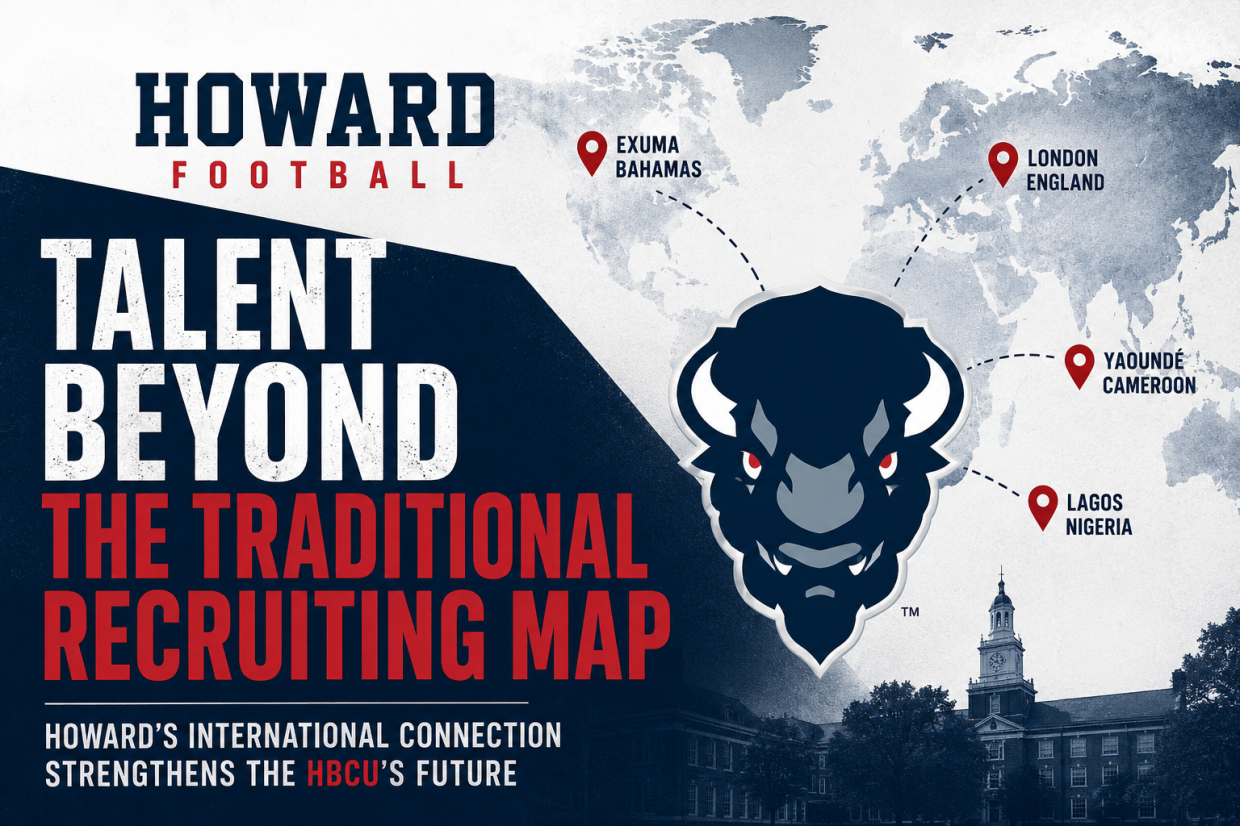
Delano Bowe Jr., a defensive lineman, is listed from Exuma, Bahamas. Offensive lineman Chimidiya Aniyam comes from Lagos, Nigeria. Tight end Jorim Bangue is from Yaoundé, Cameroon, while graduate defensive lineman Ryan Odita is from London, England.
That’s four countries represented on the Howard football roster, mostly by players occupying some of the hardest positions to fill at the FCS level. Aniyam is 6-foot-4 and 300 pounds. Bangue stands 6-foot-4 and 250, while Odita gives Howard a 6-foot-5, 265-pound body along the defensive front.
Nobody at Howard has publicly called this an international recruiting strategy, and four players aren’t enough to make that declaration for them. But the Bison have something worth paying attention to as Ted White takes over the program. Howard is finding football players whose paths to Washington began well outside the usual MEAC recruiting map.
Howard has seen this work before
Anim Dankwah makes the current group harder to dismiss as an interesting collection of hometowns.
Dankwah became one of Howard’s most important offensive linemen during the Larry Scott era. Howard listed him from Ontario, Canada, after he attended the Taft School in Connecticut, while the university also identified him as a native of Accra, Ghana.
At 6-foot-8 and well over 300 pounds, he arrived with something coaches can’t teach. Howard still had to develop everything that came with it.
By 2022, Dankwah was starting every game at offensive tackle and earned first-team All-MEAC honors as Howard claimed a share of its first conference championship since 1993. He earned first-team All-MEAC honors again in 2023, when the Bison won another MEAC title and advanced to the Celebration Bowl.
His college career eventually put him in front of professional scouts. Dankwah landed on preseason FCS All-America lists and later accepted an invitation to the East-West Shrine Bowl.
That’s the part of his story that matters here. Howard has already taken an internationally connected prospect with unusual physical tools and developed him into one of the conference’s better offensive linemen.
Big bodies are always worth finding
There isn’t much mystery about why this could matter to Howard.
Everybody needs linemen. Everybody wants length. Everybody would happily take a 300-pound athlete who can move.
Finding those players before everyone else does is the problem.
Howard recruits in a neighborhood crowded with programs looking for the same talent. The Bison have to protect the DMV while working traditional HBCU recruiting areas throughout Virginia, the Carolinas, Georgia and Florida. They also have to navigate a transfer market that can change a position room in a matter of weeks.
That makes the current international group interesting beyond where the players were born.
Aniyam gives Howard another 300-pound offensive lineman. Odita and Bowe add bodies to the defensive front. Bangue brings size to tight end along with an unusual athletic background that includes collegiate track and field.
None of those things guarantees production. They do give Howard physical traits worth developing, which is where Dankwah becomes a useful reference instead of simply an interesting piece of program history.
Their roads to Howard weren’t the same
Howard also didn’t pluck all four players directly from overseas.
Aniyam attended University School in Indiana. Bowe went to Tabor Academy in Massachusetts. Bangue attended Pretoria Boys High School in South Africa before his college athletic career eventually brought him to Howard.
That makes the recruiting possibility more realistic than sending Howard coaches around the world searching for football players.
International prospects are already entering American prep schools, high schools and college programs. Once they do, Howard can evaluate them the same way it evaluates everybody else. There is film to study, verified size to consider and competition against players coaches already understand.
The transfer portal makes that process even easier. A player can begin somewhere else, develop against college competition and become available after answering some of the questions coaches had when he first arrived in the United States.
Howard doesn’t need an overseas scouting department for that. It needs to recognize players who might fit once they enter a recruiting system the Bison already know.
Howard can sell Howard
Finding the player is only half the job. Howard still has to convince him to come to Washington.
Football will handle most of that conversation. Players want to know who is coaching them, where they fit on the depth chart and whether the program can develop them. They want to win, graduate and, for some, find out how far football can take them.
Howard has another part of the pitch available once those questions are answered.
The university’s connection to Africa, the Caribbean and the larger Black diaspora doesn’t have to be created for recruiting. Howard’s international student community already brings students from around the world to an HBCU whose name carries significance well beyond Washington.
Dankwah offered a glimpse of how that environment can resonate with a football player. His Howard biography says he chose the school because he loved the environment and people and felt he belonged.
That doesn’t tell us why Bowe, Bangue, Aniyam or Odita came to Howard. Their motivations belong to them. It does show that Howard has previously had an internationally connected football player identify belonging as part of his experience choosing the university.
D.C. makes the pitch feel less abstract
Then the player walks off campus and he’s still in Washington.
That’s an important piece of this story because Howard’s connection to the Black diaspora isn’t confined to a university brochure. The Washington metropolitan area has substantial African and Caribbean communities alongside one of the country’s deepest concentrations of Black American culture.
For a player whose journey began in Nigeria, Cameroon or the Bahamas, those worlds can exist around him while he plays college football at an HBCU.
That doesn’t mean every international Black athlete is looking for the same cultural experience. A recruit from Lagos isn’t interchangeable with one from Exuma, and neither should be treated that way. Football recruiting is personal long before it becomes philosophical.
Still, location is part of recruiting. Schools sell beaches, college towns, warm weather and big cities every December. Howard can sell Washington and an HBCU environment that already reflects pieces of the world represented on its roster.
Four players don’t make a pipeline
There is a temptation to look at the current roster and declare Howard has discovered something. We’re not there.
The Bison have four international players, not an established international recruiting operation. Their paths are different, and there isn’t public evidence showing White plans to make international prospects a specific priority as he builds his roster.
What Howard does have is history.
Dankwah was part of the program from 2019 through 2023 and developed into a two-time first-team All-MEAC lineman. Odita, Bowe and Aniyam appeared on Howard rosters before this season. Bangue now adds Cameroon to a 2026 group already representing the Bahamas, Nigeria and England. That’s enough to make future rosters worth checking.
If White’s upcoming classes continue bringing internationally connected players to Washington, particularly at developmental positions along the offensive and defensive fronts, Howard may have something that can become intentional. If the numbers don’t grow, the current group still shows another route players can take into HBCU football.
For Howard, that’s probably the right way to view this for now.
The Bison still need to recruit the DMV. They still need to win traditional HBCU recruiting battles, develop linemen and use the portal wisely. None of that changes because four players came to Washington from different parts of the world. What changes is the map. Howard already knows a football journey that begins thousands of miles away can end with All-MEAC honors and championships at an HBCU. Dankwah proved that much. Now there are four more reasons to keep looking.