
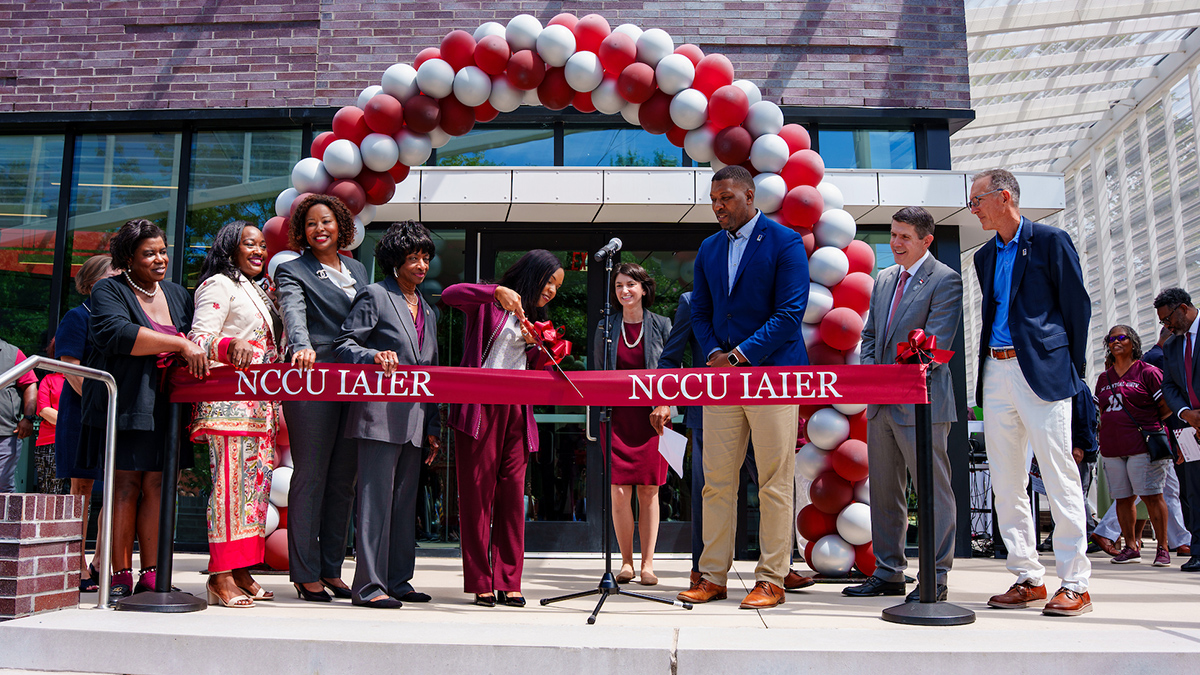
North Carolina Central University has opened what it says is the nation’s first dedicated artificial intelligence institute building at an HBCU, giving the Durham institution a physical home for research, education and workforce development in one of the fastest-growing areas of technology.
The Institute for Artificial Intelligence and Emerging Research officially opened its new facility on Aug. 10 at the corner of Fayetteville and Lawson streets. The roughly 5,000-square-foot building cost $7.2 million and was funded through a combination of federal Title III dollars and NCCU trust funds.
At the center of the effort is Dr. Siobahn Day Grady, the institute’s founding director and a woman whose own path through higher education has been deeply rooted in HBCUs.
Grady is a three-time HBCU alumna, earning her bachelor’s degree in computer science from Winston-Salem State University in 2005, a master’s degree in information science from North Carolina Central in 2009, and both a master’s degree and Ph.D. in computer science from North Carolina A&T in 2018. She also became the first woman to earn a doctorate in computer science from NC A&T.
Now she is helping position NCCU to have a voice in how artificial intelligence develops.
Grady brings three-HBCU foundation to NCCU AI push
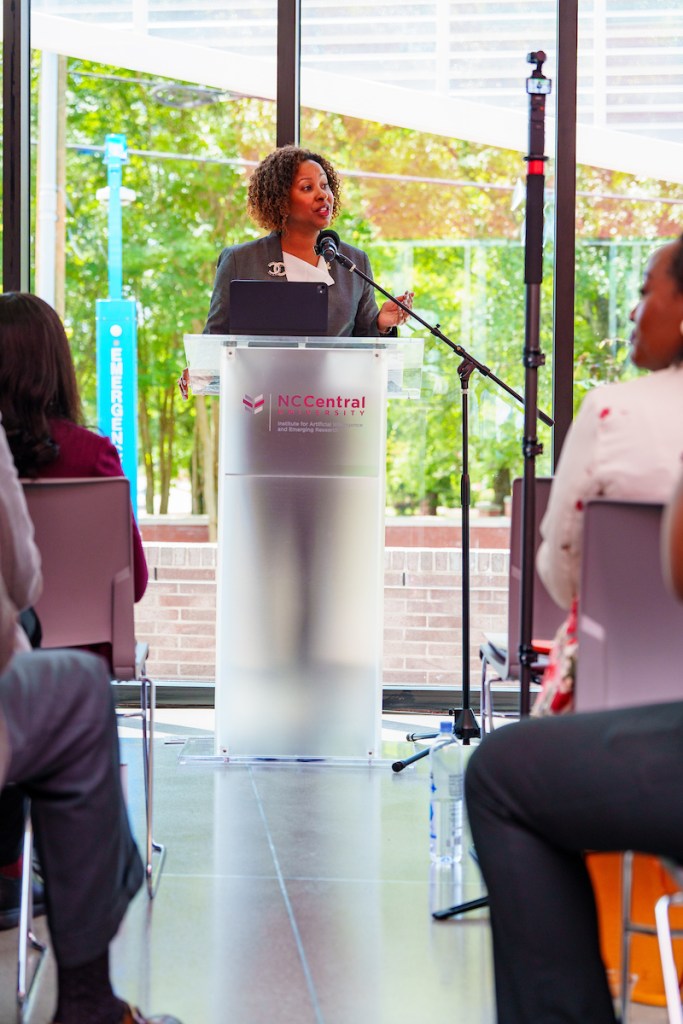
Grady serves as an associate professor in NCCU’s School of Library and Information Sciences in addition to leading the institute. Her research has focused on artificial intelligence, human-computer interaction, algorithmic bias, misinformation and autonomous systems.
Her work also extends beyond the laboratory.
Grady has established six STEM-focused endowed scholarships across HBCUs in the University of North Carolina System, including Winston-Salem State, NCCU, NC A&T, Fayetteville State and Elizabeth City State. She also serves on the Winston-Salem State University Foundation board.
That background gives NCCU’s newest initiative a distinctly HBCU-centered foundation.
“Today, we are establishing a framework, a blueprint and a launching point for what ethical, responsible and human-centered artificial intelligence can look like in higher education and beyond,” Grady said during Monday’s opening.
The institute itself was formally approved by NCCU’s Board of Trustees in December 2025, though the effort began earlier. IAIER launched in January 2025 with $1 million in support from Google.org.
NCCU building more than an AI lab
The new facility includes several specialized spaces rather than functioning as a traditional computer lab.
Among them are an AI Literacy Studio, Machine Learning and Data Science Studio, Robotics and Emerging Tech Lab, XR Innovation Sandbox, Ethics and Governance space and an Innovation Atrium.
That setup reflects NCCU’s attempt to make artificial intelligence part of a broader campus conversation.
Beginning in fall 2025, the university added an AI component to its required Introduction to University Education course for incoming freshmen. This fall, NCCU is also introducing an artificial intelligence minor through its Department of Mathematics and Physics.
The institute has also established partnerships aimed at workforce development. Through a partnership with Google, students can pursue career certificates and training in fields including artificial intelligence, data analytics, cybersecurity and project management.
NCCU Chancellor Karrie Dixon said the university wants students to do more than simply learn how to use the technology.
“Artificial intelligence is transforming nearly every industry,” Dixon said. “We want to not only prepare students but help them shape AI.”
An HBCU stake in the future of artificial intelligence
The significance of the institute extends beyond NCCU.
Artificial intelligence is already changing fields ranging from media and education to health care, transportation and finance. At the same time, questions surrounding bias, access and representation have become an increasingly important part of the conversation around the technology.
That makes who is developing AI — and who is training the people who will work with it — important.
U.S. Rep. Valerie Foushee made that point during the institute’s opening, arguing that the future of technology cannot be shaped solely by major technology companies and elite research universities.
For NCCU, that creates both an opportunity and a responsibility.
The university is placing itself in a field that figures to drive a significant portion of the next generation of jobs and research funding. At the same time, it is doing so under the leadership of someone whose academic journey connects three of North Carolina’s HBCUs.
Grady went from studying computer science at Winston-Salem State, to information science at NCCU, to making history at NC A&T.
Now she is back at North Carolina Central helping build a pipeline designed to make sure HBCU students are not simply consumers of artificial intelligence.
They can help determine what it becomes.