
When Sonja Stills described the MEAC as “the Ivy League of HBCUs” during an interview with The Pivot at MEAC Football Media Day, she wasn’t introducing a new slogan. The Commissioner revived one that has followed the conference almost since its creation more than five decades ago.
The phrase has long inspired both pride and debate.
To some, it reflects the conference’s collection of research universities, doctoral programs and longstanding academic reputation. To others, it raises uncomfortable questions about hierarchy among historically Black colleges and universities.
That tension makes the label as fascinating today as it was when the Mid-Eastern Athletic Conference first came together in 1970.
The Foundation of The MEAC
The MEAC was founded by seven institutions — Howard, Morgan State, Delaware State, Maryland Eastern Shore, North Carolina A&T, North Carolina Central and South Carolina State. The vision that extended beyond athletics. Six of those schools departed the CIAA, while South Carolina State joined after competing in the SIAC. Their goal wasn’t simply to create another sports league. They wanted an athletic conference that reflected the ambitions of universities pursuing Division I competition while emphasizing high academic standards and institutional growth.
In fact, the conference’s original objectives specifically referenced organizing athletics among “a compact group of educational institutions of high academic standards” while seeking Division I membership.
That founding philosophy helps explain why Stills immediately turned to academics when asked about the MEAC’s identity.
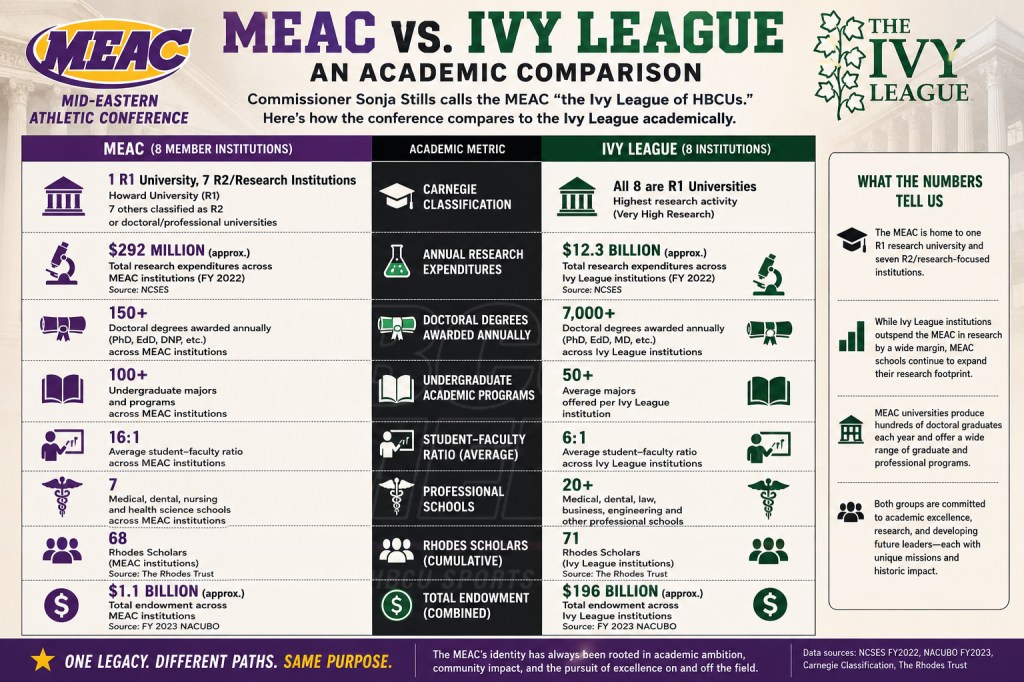
“We have all research-based institutions,” she said. “Howard leads off with R1, and then the rest with R2 and research-centered institutions. … I feel like we’re part of the Ivy League of HBCUs.”
What did she mean?
Stills wasn’t suggesting the MEAC mirrors the Ivy League in wealth, admissions selectivity or billion-dollar endowments.
She was talking about institutional profile.
Today, Howard University is classified as an R1 research university under the Carnegie Classification. That places it among the nation’s highest research institutions. Several other current MEAC members, including Morgan State, Delaware State and Maryland Eastern Shore, have long been recognized as research universities. And the conference has consistently highlighted its role in producing STEM graduates and advancing research across HBCUs. (Mid-Eastern Athletic Conference)
In other words, the comparison centers on scholarship and research—not prestige for prestige’s sake. That’s an important distinction.
The Ivy League itself is an athletic conference whose identity eventually became synonymous with elite academics. Formally organized during the 1950s, it united eight private universities around shared academic standards and athletic governance.
The MEAC’s founders envisioned something different, but with a similar emphasis on institutional quality alongside athletics.
More than athletics
Stills returned to that idea later in the interview when discussing the conference’s growing media footprint.
“Athletics is the front porch to the university,” she said.
That philosophy explains why the conference has invested heavily in the MEAC Network and, more recently, expanded its national television partnership with ESPN. Athletics may draw attention, but the conference wants broadcasts to showcase more than sports. Research, alumni achievement and institutional initiatives highlighted alongside football and basketball.
It is a message that reflects the conference’s long-standing belief that sports should elevate the universities—not overshadow them.
Why the phrase creates debate
Still, “Ivy League of HBCUs” has never been universally embraced. Within Black higher education, many scholars and alumni have resisted comparisons that appear to measure HBCUs against predominantly white institutions.
The concern is understandable.
Historically, HBCUs were founded to serve different missions. Some became major public research universities. Others remained smaller liberal arts colleges. Some became faith-based institutions focused on teaching, leadership development and community service.
Comparing them through an “Ivy League” lens can unintentionally suggest that one institutional model is inherently more valuable than another.
That debate echoes an older conversation in Black intellectual history.
W.E.B. Du Bois argued for cultivating a highly educated “Talented Tenth” to help lead broader Black advancement. Critics later questioned whether that philosophy unintentionally reinforced divisions within Black America by elevating one segment above another.
The “Ivy League of HBCUs” label can produce a similar reaction.
Some hear “research excellence.” Others hear “academic superiority.”
Those are not necessarily the same thing.
Identity versus hierarchy for HBCUs
Viewed through Stills’ comments, however, the phrase appears less about ranking HBCUs than describing the MEAC’s identity.
Each HBCU athletic conference has developed its own personality.
The SWAC is celebrated for its massive football crowds, deep traditions and cultural influence.
As the MEAC predecessor, the CIAA has long been synonymous with Division II excellence and one of Black America’s signature basketball tournaments.
The SIAC blends historic rivalries with some of the nation’s oldest private HBCUs.
The MEAC has increasingly positioned itself around another strength: research institutions with Division I athletics.
Whether one agrees with the “Ivy League” comparison or not, the conference has consistently highlighted that distinction since its earliest days.
An old idea for a new era
As college athletics continues to evolve through conference realignment, NIL and revenue sharing, conferences are searching for ways to define themselves beyond wins and losses.
Stills appears to believe the MEAC’s future lies in embracing what made it distinctive from the beginning.
Its universities are producing research.
The campuses are educating future scientists, engineers, doctors and public servants.
Its athletic programs continue to provide national visibility through football, basketball and events like the Celebration Bowl.
Calling the MEAC the “Ivy League of HBCUs” may continue to spark debate.
Perhaps that’s the point.
More than 50 years after the conference was founded by institutions seeking to pair Division I athletics with ambitious academic goals, the phrase still forces people to ask the same question:
What, exactly, makes the MEAC different?
And more than half a century later, the conference’s answer remains much the same.