
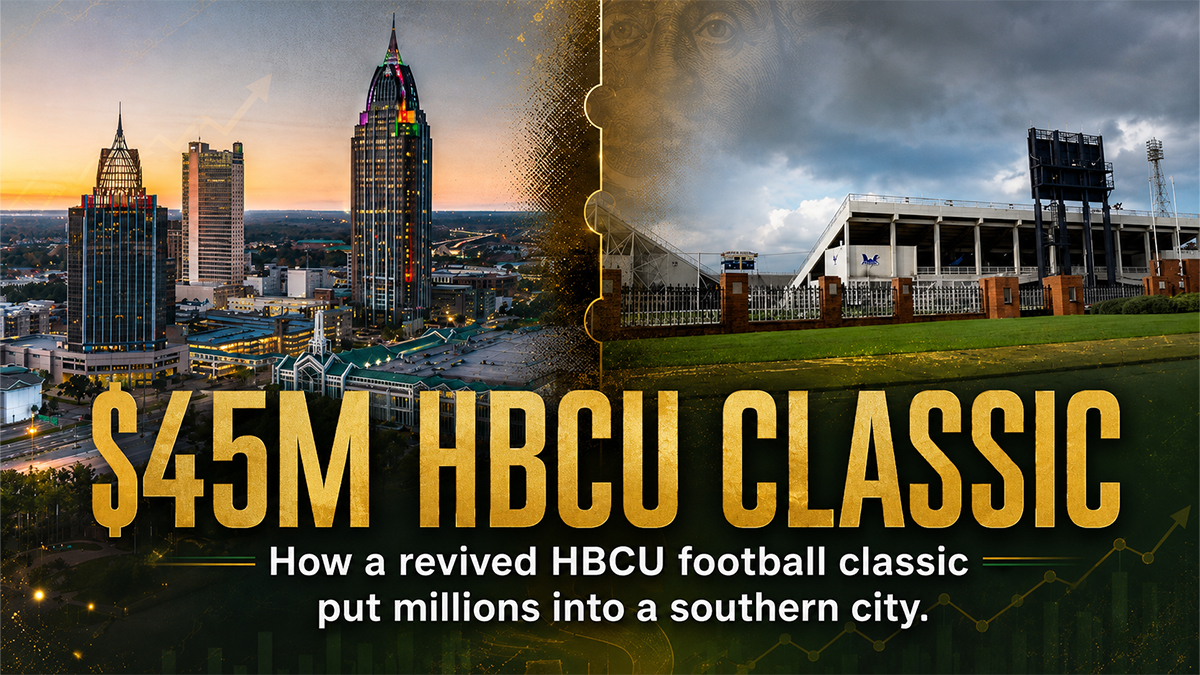
HBCU football has become big business in Mobile, Alabama, and the Gulf Coast Challenge is the clearest example.
The event, which returns Oct. 3 with Jackson State facing Alabama A&M at Lad-Peebles Stadium, is not just another neutral-site game. It is the latest chapter in a long relationship between Mobile, Alabama and Black college football.
That relationship stretches back decades. Danny Heard, executive director of the Mobile Sports Authority, said Mobile hosted the former Gulf Coast Classic football game for 35 years before it went away after 2009.
“So the foundation had already been set years ago,” Heard said during the 2026 Gulf Coast Challenge press conference.
Mobile did not stay out of the HBCU football business for long. Heard said the Mobile Sports Authority helped bring HBCU football back to the city in 2016 with the Fifth Quarter Classic. That event later evolved into what is now the Gulf Coast Challenge.
The name has changed and the structure has grown. The economics have become impossible to ignore.
According to Heard, the past eight Gulf Coast Challenges have generated an estimated $45 million-plus for the local economy. The event has also drawn an estimated 135,000 attendees to the Mobile region during that span.
“That’s big business, folks,” Heard said. “And that is why this game is so important to our community.”
A football game built like a festival
The Gulf Coast Challenge works because it is not built as a one-day football game. It is structured as a multi-day HBCU football and culture festival.
The 2026 schedule begins Thursday, Oct. 1 with a College and Career Fair. Organizers said students will come from at least 35 high schools across surrounding areas and other states, including Florida and Mississippi.
That same night, Grammy-winning gospel legend Fred Hammond will headline the Gospel Explosion. Friday brings the Team Luncheon, an upscale event featuring student-athletes, cheerleaders and alumni. HBCU Fest follows that night with more entertainment and cultural programming.
Saturday begins with the Gulf Coast Challenge Parade, a Mardi Gras-style event through downtown Mobile. Then the focus shifts to Lad-Peebles Stadium for a 4 p.m. kickoff between two SWAC programs with strong traveling fan bases.
That kind of schedule matters for economics. Fans do not just come for four quarters. They book hotel rooms, eat at restaurants, buy tickets, attend concerts, participate in the parade and spend money throughout Mobile, Alabama.
For the city, the Gulf Coast Challenge is both a cultural event and a tourism product. It gives Mobile a way to bring alumni, students, families, bands, corporate partners and fans into one weekend.
CJ Small, Mobile City Council president made it simple.
“It’s an economic driver for the Gulf Coast region, generating tourism, supporting local businesses, and showcasing Mobile as a city that knows how to host an event like this,” he said.
That is why HBCU football classics remain valuable even as college athletics keeps changing. They are not just about who wins the game. They are about who benefits from the gathering.
Mobile has already seen the answer. The Gulf Coast Classic created the foundation. The Fifth Quarter Classic brought the tradition back. The Gulf Coast Challenge has turned that tradition into a modern economic engine.
For Mobile, Alabama, HBCU football is no longer just part of the city’s past. It is part of its business model.
6/25/26
This a business model that All HBCUs should utilize for all of their Home Games, not just during Homecoming. Regional Transportation, City Economic Development Investmemt, Restaurants, City Parking, and Hotels should impose a $1 Economic Development Tax over the 4 day weekend. Track the Economic Impact and share publically the revenues generated by local businesses and HBCUs. Add a Casshey Raffle to each game https://www.casshey.com
Charles E. Campbell-Allen, Black Race Man, HBCU Grad (JSU 90) Founder & CEO
Cuptoopia.com, Inc. (Casshey Raffle)