
Women’s flag football is one of the fastest-growing sports in America. For HBCUs and the Mid-Eastern Athletic Conference (MEAC), however, the sport’s appeal may extend far beyond the field.
As athletic departments continue searching for ways to expand opportunities for women, increase enrollment, and strengthen recruiting pipelines, women’s flag football is emerging as a potential solution that addresses multiple institutional priorities at once.
The sport’s inclusion in the 2028 Olympic Games in Los Angeles has only accelerated interest nationwide. While many fans view flag football as an exciting new competition, athletic administrators may see something else: a chance to add participation opportunities, attract new students, and position their institutions for the future.
The question is no longer whether women’s flag football is growing.
The question is whether HBCUs and the MEAC are prepared to benefit from that growth.
Why Women’s Flag Football Matters to HBCUs
When athletic departments evaluate a new sport, the conversation goes beyond wins and losses.
Administrators must consider enrollment, recruiting, facilities, staffing, budgets, and Title IX participation requirements. The challenge is particularly important at institutions that sponsor football, where roster sizes can often exceed 100 student-athletes.
Women’s flag football offers a unique opportunity because it can potentially address several of those needs simultaneously.
Unlike some sports that require significant facility investments, flag football can utilize existing football fields, athletic training resources, strength and conditioning programs, and game-day infrastructure. That makes it a relatively accessible option for schools looking to expand women’s athletic opportunities.
For HBCUs operating in an increasingly competitive higher education environment, that flexibility matters.
MEAC Schools Already Face Different Participation Challenges
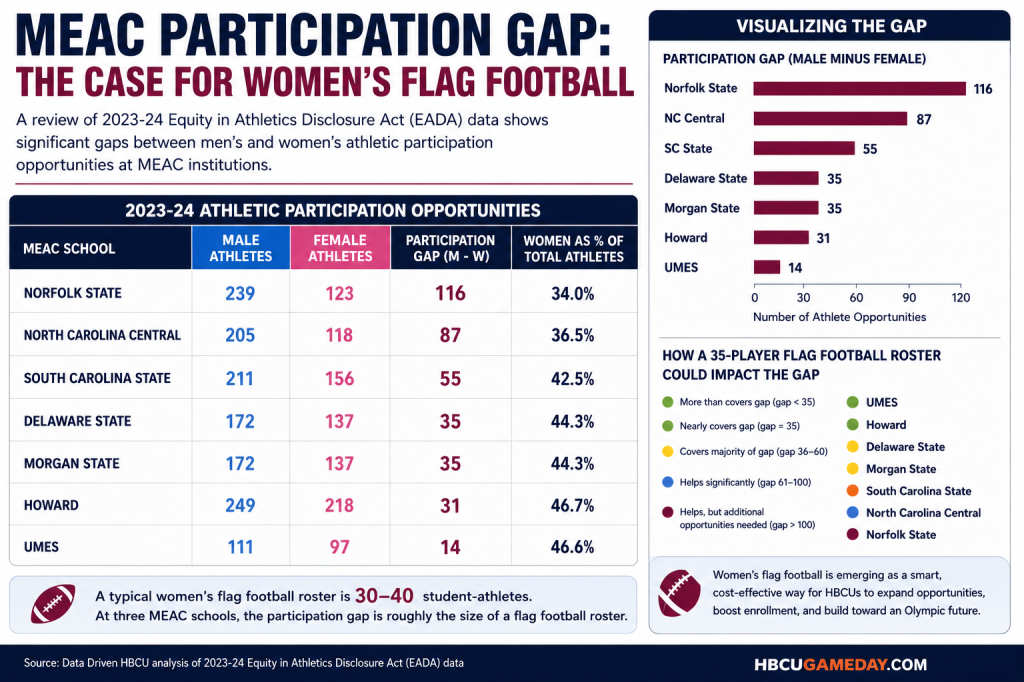
While every institution faces unique circumstances, the numbers reveal an interesting trend. At several MEAC institutions, the participation gap falls within the range of a typical women’s flag football roster. Norfolk State and Maryland Eastern Shore have committed to fielding teams so far.
That does not mean women’s flag football is the answer for every school. However, it does help explain why athletic administrators across the country are beginning to pay attention to the sport.
Women’s Flag Football Could Create New Recruiting Opportunities
The recruiting potential may be just as significant as the participation numbers.
Girls flag football continues to expand across the United States. States such as Florida, Georgia, Alabama, Nevada, California, and New York have seen rapid growth in participation, while additional states continue exploring sanctioning opportunities.
That growth creates an entirely new recruiting market.
Many flag football athletes are multi-sport competitors who also participate in basketball, soccer, track and field, lacrosse, and softball. Those athletes represent potential students who may not have previously considered attending an HBCU.
Schools that move early could establish recruiting pipelines before the market becomes crowded. The CIAA has held a championship in each of the past two seasons.
For HBCUs, that means women’s flag football could become more than a sport. It could become another pathway for attracting students to campus.
Enrollment Could Be a Major Benefit
Every student-athlete is also a student.
That reality makes women’s flag football particularly intriguing for institutions focused on enrollment growth.
A roster of 25 to 40 athletes represents more than additional participation opportunities. It represents tuition revenue, housing occupancy, campus engagement, and future alumni support.
HBCUs have long used athletics as a tool for attracting students and building community. Women’s flag football offers access to a growing population of prospective students at a time when participation opportunities remain limited compared to demand.
For institutions seeking innovative ways to grow enrollment, the sport deserves consideration.
The Olympic Pathway Could Change Everything
The 2028 Summer Olympics may become the biggest catalyst for the sport’s growth.
When a sport enters the Olympic movement, perceptions change. Athletes begin taking the sport more seriously. Families invest more resources. Colleges pay closer attention.
Women’s flag football appears to be heading down that path.
For HBCUs, the Olympic opportunity creates an additional layer of potential value. Historically, HBCUs have produced Olympians in track and field, basketball, and other sports. There is no reason an HBCU could not eventually help develop future Team USA flag football athletes.
Schools that invest early could find themselves positioned at the forefront of that movement.
Could Women’s Flag Football Be the Next MEAC Sport?
The MEAC has already demonstrated a commitment to expanding opportunities for women through sports such as women’s golf and other championship offerings. The CIAA has shown a blueprint at the Division II level.
Women’s flag football may represent the next conversation.
The sport sits at the intersection of several important issues facing HBCU athletics today: Title IX participation, enrollment growth, recruiting expansion, and Olympic visibility.
Few emerging sports can claim to impact all four areas simultaneously.
Whether women’s flag football eventually becomes a conference-sponsored sport remains to be seen. However, the growth of the game, combined with the challenges and opportunities facing HBCUs, makes it increasingly difficult to ignore.
As the sport continues to expand nationwide, HBCUs and the MEAC may soon face an important question:
Will they help shape the future of women’s flag football, or will they be forced to catch up later?