
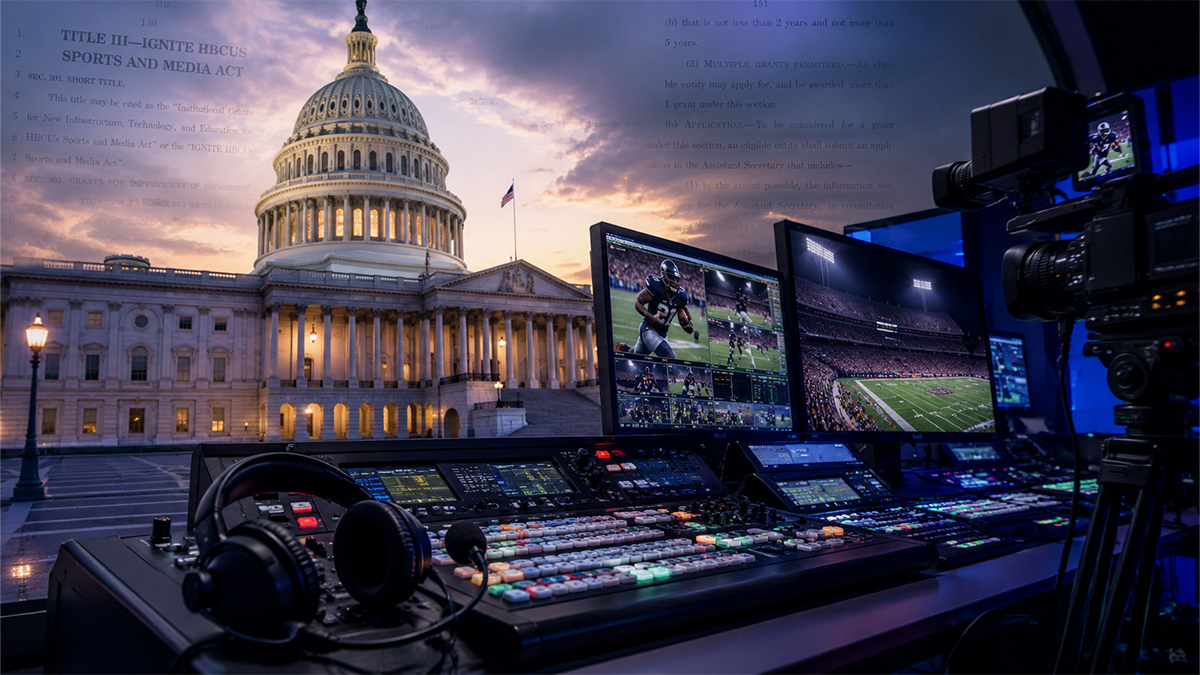
Congress could give HBCUs new federal support for sports broadcasting, broadband technology and student journalism through The Protect College Sports Act of 2026, now before the Senate.
The Protect College Sports Act of 2026 has received attention for its proposed rules involving NIL, athlete compensation, transfers and NCAA authority.
However, the bill also includes a section designed specifically for HBCUs.
Title III is called the IGNITE HBCUs Sports and Media Act. It would create competitive grants for long-term improvements to broadband, information technology and media infrastructure at eligible Black colleges.
Those projects could include equipment and technology used to produce, transmit and distribute live coverage of college athletic events. The grants could also support local journalism programs that provide hands-on training for students.
Bill targets HBCU broadcast infrastructure
The proposal would allow federal grants to support sports production and broader campus media needs.
That could include cameras, control rooms, editing systems, broadband improvements and transmission technology. Schools could also use the funding to strengthen student media operations and journalism instruction.
The grant period would last between two and five years. Eligible institutions could apply for and receive more than one grant.
Applications would require schools to describe their planned projects and explain how those investments support long-term institutional goals.
Schools would also need to assess the broadband service available across campus and to their students. They must explain how improved technology and media production would support sports coverage and local journalism.
For many HBCUs, those investments could address a major competitive disadvantage.
College conferences increasingly require institutions to produce their own games for streaming platforms. That work requires reliable internet service, trained staff and professional equipment.
Schools without strong production infrastructure may struggle to meet broadcast standards. They may also lose opportunities to sell sponsorships, create original programming or control their athletic archives.
Congress considers wider college sports changes
The Protect College Sports Act was introduced by Sens. Ted Cruz, Maria Cantwell, Eric Schmitt and Chris Coons.
The Senate Commerce Committee advanced the bill by a 19-9 vote on June 18. The measure was then sent to the full Senate for consideration.
The broader legislation would establish national rules for NIL, transfers, recruiting and eligibility. It would also provide scholarship and healthcare protections while preserving college athletes’ nonemployee status.
The measure recently regained momentum after the SEC and Big Ten agreed to support a revised version. Their backing followed negotiations over athlete compensation, third-party NIL groups and conference authority.
Still, the bill must clear the Senate and House before reaching the president.
HBCUs could gain more control over their content
The media provisions could have significant implications for the MEAC, SWAC, CIAA and SIAC.
The MEAC and SWAC have long-term ESPN relationships, with both extending them this summer. Meanwhile, the CIAA and SIAC are navigating their next media-rights chapters following the expiration of previous HBCU GO agreements.
Improved campus production facilities could give conferences more flexibility when negotiating future deals.
Schools could produce more games internally, build direct-to-consumer networks and create documentary programming. They could also train students for careers in sports media, television production and journalism.
That creates a connection between athletics and academics.
A broadcast facility can serve football and basketball on weekends. The same equipment can support journalism classes, campus news programs and student internships during the week.
The IGNITE proposal does not guarantee funding for every institution. Grants would be awarded competitively, and schools would need detailed plans.
Still, the language gives HBCUs a specific place within a bill largely shaped by the growing financial power of major college sports.
As Congress debates how to stabilize the industry, the HBCU provision could help Black colleges improve how they produce, distribute and ultimately monetize their own stories.