
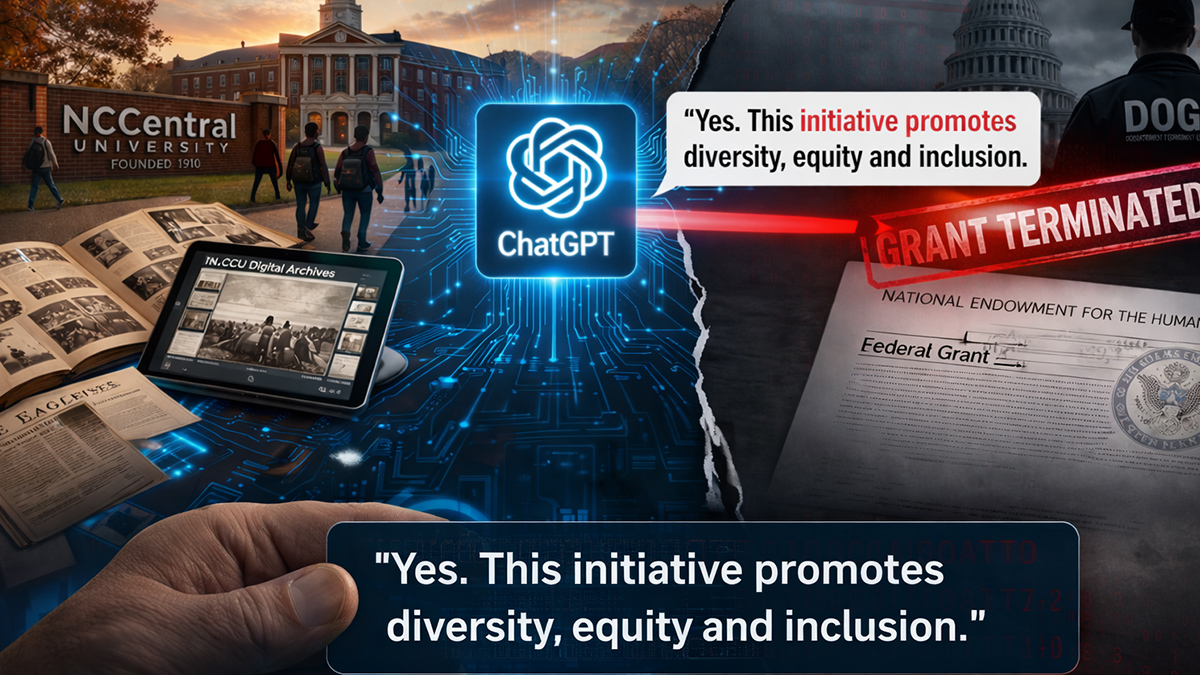
Documents reveal that a DOGE worker used Chat GPT to determine whether or not HBCU North Carolina Central got funding cut. NCCU revealed that a federal grant was terminated after the government used AI to evaluate whether the project related to diversity, equity and inclusion (DEI).
DOGE review puts NC Central grant in crosshairs
According to discovery documents in an ongoing lawsuit involving the National Endowment for the Humanities, staffers connected to the Department of Governmental Efficiency, better known as DOGE, used ChatGPT to help decide which federally funded programs should be cut.
Among the grants reviewed were three tied to NC Central. In one case, ChatGPT was asked whether a university project related “at all to DEI.” The project focused on helping faculty and staff use materials from Digital NC and the NCCU Archives to create teaching resources and course modules, while also engaging the broader university community and Durham residents. ChatGPT answered that the initiative did relate to DEI. It was said to promote diversity, equity and inclusion through archival materials and community engagement.
That grant was later terminated in April 2025, according to NC Central spokesperson Quiana Shepard. The award totaled $89,110 over four years. By the time the grant was cut, however, the school had already spent most of the funds. It had only $5,977 remaining that it could no longer use.
Lawsuit challenges use of ChatGPT
The grant termination surfaced through discovery in a lawsuit filed by four organizations. They are the American Council of Learned Societies, the Authors’ Guild, the American Historical Association and the Modern Language Association. The groups are seeking to restore NEH funding and argue that the federal government’s actions violated constitutional protections, including free speech and equal protection.
Court filings argue that DOGE staffers relied on ChatGPT outside the NEH’s established review process. The suit claims the chatbot was used to identify grants associated with a disfavored viewpoint, especially those perceived to promote DEI. The plaintiffs also argue that the government did not establish a clear definition of DEI for ChatGPT to apply. Nor did it take steps to make sure the tool would not discriminate against constitutionally protected classes.
That allegation raises broader questions about how AI tools are being used in federal decision-making, especially when public funding for universities, museums and historical projects is on the line.
Bigger questions for HBCU funding and public history
The NC Central case also fits into a larger pattern in the grant review list. The documents show DOGE staffers asked ChatGPT about more than 1,100 NEH grants. Other North Carolina-related projects were flagged as DEI-related as well. These include a PBS documentary about the 1898 Wilmington coup and massacre. Even a High Point Museum grant to replace its HVAC system.
For HBCUs, the situation is especially significant. NC Central’s project was rooted in preserving and teaching its own institutional history through archives and digital humanities work. What appears to supporters as standard academic scholarship and community engagement was instead interpreted by ChatGPT as grounds for federal scrutiny.
The result is a striking example of how HBCU programs can be swept into political battles over DEI. With AI now playing a direct role in those decisions.