

Tennessee Titans Revisit HBCU Football Legacy That Shaped Franchise History
The image reads like a roll call of Black college greatness, spanning five decades and 24 programs. From Grambling State to Wiley College, from Prairie View A&M to Tennessee State, the franchise’s roots in HBCU football run deeper than many fans realize.
This wasn’t nostalgia.
It was acknowledgment.
The HBCU Pipeline That Built a Power
Long before HBCU scouting became fashionable, the Houston Oilers were already living in those locker rooms.
In the late 1960s, while much of pro football still treated Historically Black Colleges as secondary markets, Oilers general manager Don “Wink” Klosterman saw something different.
Klosterman became the architect of one of the league’s most forward-thinking scouting departments. At a time when racial bias still shaped draft boards across the NFL, he treated the SWAC and MEAC as primary hunting grounds — not fallback options.
The results reshaped the franchise.
In 1967, Houston drafted Prairie View A&M safety Ken Houston. He developed into one of the greatest defensive backs in NFL history, making 12 consecutive Pro Bowls and returning nine interceptions for touchdowns — an NFL record at the time. He entered the Pro Football Hall of Fame in 1986.
A year later came North Carolina A&T defensive end Elvin Bethea. Bethea spent his entire 16-year career in Houston, played 210 games for the franchise, made eight Pro Bowls, and eventually earned his place in Canton in 2003.
Then, in 1969, the Oilers selected Grambling State’s Charlie Joiner. Though he would later blossom into a record-setting receiver with the Chargers, his selection further proved Houston trusted evaluations coming out of HBCU powerhouses — especially from legendary coaches like Eddie Robinson, whose word carried weight inside the Oilers’ front office.
Klosterman’s approach wasn’t symbolic. It was strategic.
While other franchises were still catching up to integration, the Oilers were building competitive advantages by mining HBCU talent others overlooked.
That foundation carried into the “Luv Ya Blue” era under head coach Bum Phillips in the mid-1970s.
Phillips didn’t just draft select HBCU players in the NFL Draft — he built the identity of his defense around them. His most impactful move came in 1975 when he selected Jackson State linebacker Robert “Dr. Doom” Brazile with the sixth overall pick. Some evaluators questioned whether an HBCU linebacker could command a complex NFL defense. Phillips never blinked.
Brazile became the emotional engine of Houston’s 3-4 defense, earning seven Pro Bowl selections and anchoring a team that nearly reached the Super Bowl. Decades later, he received his Hall of Fame jacket in 2018 — validation for both player and philosophy.
Phillips also leaned heavily on personal relationships with HBCU coaching legends. He trusted the evaluations of men like Eddie Robinson implicitly. That trust turned into draft picks. Those draft picks turned into Pro Bowls. And those Pro Bowls turned into playoff runs.
By the time the franchise transitioned from Houston to Tennessee in the late 1990s, the pipeline wasn’t just history.
It was identity.
The McNair Era
By the time the franchise transitioned from Houston to Tennessee in the late 1990s, the pipeline wasn’t just history.
It was identity.
Then came Steve McNair.
Drafted third overall in 1995 out of Alcorn State, McNair became the bridge between eras — the HBCU star who carried the Oilers into Nashville and turned the Tennessee Titans into a Super Bowl contender. At the time of his selection, he was the highest-drafted Black quarterback in NFL history.
He later became the first Black quarterback to win the AP NFL MVP award in 2003, sharing the honor with Peyton Manning.
And in doing so, he cemented the franchise’s reputation for finding transformative talent outside the traditional blue-blood pipeline.
Nearly three decades later, that thread resurfaced in a different form.
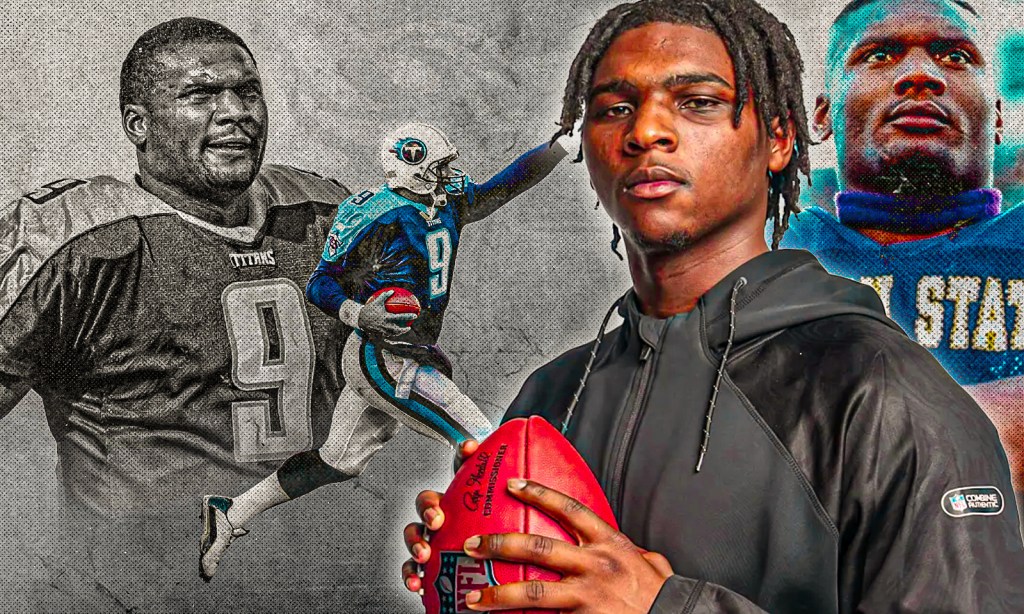
Walking in the Footsteps of an HBCU legend
When the Titans selected Cam Ward with the No. 1 overall pick, the comparisons to McNair were immediate. Like McNair, Ward’s journey didn’t begin on a Power Four pedestal. McNair rose from Alcorn State, dominating the FCS level before climbing into NFL stardom. Ward began as a zero-star recruit at Incarnate Word, another FCS program, before elevating his game at Washington State and Miami en route to becoming the top pick in the draft.
The parallels were hard to ignore.
Analysts during NFL Draft coverage repeatedly invoked McNair’s name when describing Ward’s arm strength, mobility, and fearlessness in the pocket. Ward himself acknowledged the weight of the comparison, calling it a blessing to step into a situation once occupied by the Titans icon — while making it clear he intends to carve his own path.
From Ken Houston patrolling the secondary in the AFL days…
to Robert Brazile anchoring “Luv Ya Blue”…
to McNair redefining quarterback leadership in Tennessee…
to Ward now stepping under center as the franchise’s next hope…
The through line is unmistakable.
The franchise didn’t just draft from HBCUs.
It was built around them.
By the Numbers
The Tennessee Titans’ graphic highlights 24 HBCU programs represented across the Oilers/Titans history at the NFL Draft.
Grambling State leads all schools with seven selections. Alcorn State follows with six. Programs across the SWAC, MEAC, CIAA, and SIAC, as well as schools like Maryland Eastern Shore, which suspended its program in 1979, underscore how expansive the scouting footprint once was.
From Texas Southern to Johnson C. Smith, from Morgan State to Winston-Salem State, the Oilers treated Black college football as fertile ground rather than fringe territory.
And it paid off.
From Players to Coaches
The impact didn’t stop when careers ended.
Current Alabama State head coach Eddie Robinson Jr. once suited up as a linebacker for the Oilers/Titans organization. He was recently announced as a 2026 Black College Football Hall of Fame inductee during Legacy Bowl weekend — another reminder of how the pipeline now flows from the field to the sideline.
Why It Matters Now
The Titans’ tribute arrives while HBCU football is as visible as it’s ever been. The Allstate HBCU Legacy Bowl continues to grow. NFL scouting presence at the HBCU combine and pro days has increased. Conversations about equity in player evaluation are louder than they’ve been in decades.
This weekend’s post wasn’t just a graphic.
It was a reminder that before hashtags, before themed recognition games, before league-wide campaigns — one franchise was already betting on HBCU greatness.
And winning because of it.
The Titans’ roots run deep.
And they run straight through HBCU football.