

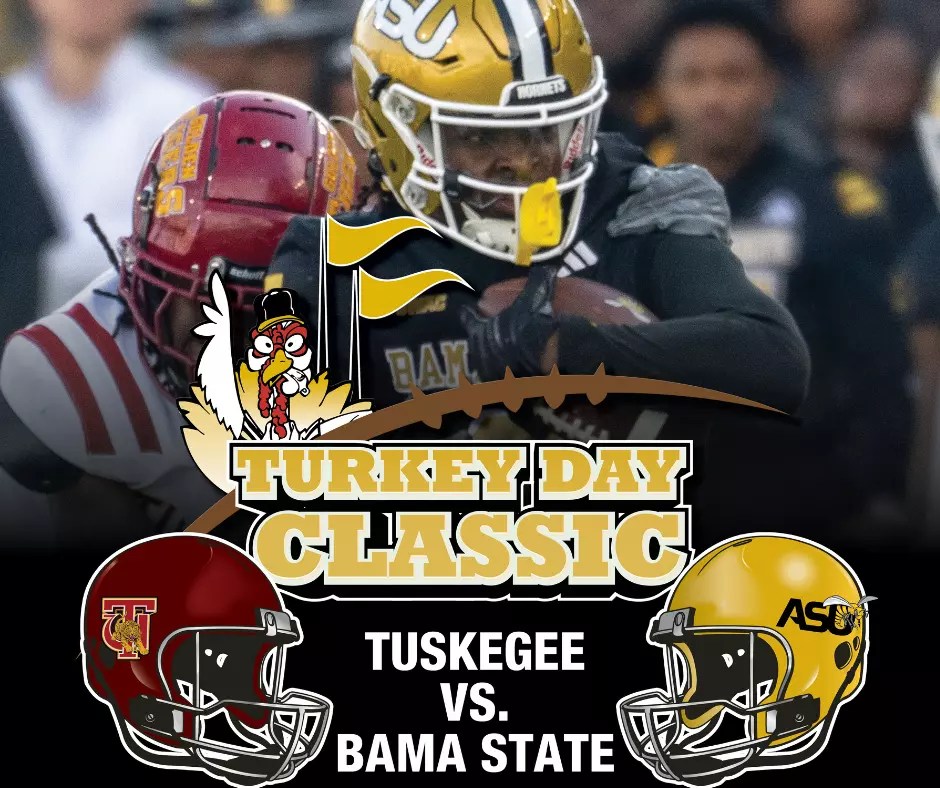
The nation’s oldest rivalry in HBCU football will continue—but with flexibility firmly built in. Alabama State University and Tuskegee University have agreed to a one-year extension that will keep the Turkey Day Classic on the calendar for the 2026 season.
The agreement establishes the 102nd meeting between two of the most historic programs in Black college football, while stopping short of a long-term commitment.
That distinction matters.
Officials from both institutions finalized the deal through Alabama State Vice President of Intercollegiate Athletics Dr. Jason Cable and Tuskegee Vice President of Intercollegiate Athletics Reginald Ruffin. The game will return on Thanksgiving Day in November 2026, continuing a rivalry that spans more than a century.
A Rivalry That Predates the Classic
Alabama State and Tuskegee first met on the football field in 1901, long before the game became a Thanksgiving tradition. Tuskegee won that inaugural matchup 37–0, launching a rivalry that would grow into a defining pillar of HBCU football.
In 1924, the schools moved the matchup to Thanksgiving Day, officially creating the Turkey Day Classic. The game settled into Montgomery and eventually became a cultural centerpiece. For decades, fans packed Cramton Bowl before the contest moved to ASU Stadium in 2012.
Over time, the Classic grew beyond football. Parades filled downtown streets. Alumni reunions became tradition. The Battle of the Bands evolved into a headline event of its own.
For many families, Thanksgiving in Montgomery started with the Turkey Day Classic.
Why the Deal Stops at One Year
Despite the rivalry’s longevity, postseason realities continue to shape its future.
The one-year extension reflects ongoing scheduling challenges tied to playoff access. Alabama State competes in the FCS as a member of the SWAC. Tuskegee plays Division II football in the SIAC. Both postseason formats begin during Thanksgiving week.
A long-term agreement would limit flexibility. That same conflict disrupted the rivalry from 2013 to 2020, when Tuskegee prioritized Division II playoff runs. The teams resumed the series in 2021 after a pandemic-related cancellation and celebrated the Classic’s 100th anniversary in 2024.
Those tensions remain.
“While longevity is the goal in this type of long-standing rivalry, we at ASU feel this is definitely a step in the right direction,” Cable said. “The Turkey Day Classic is a historic matchup, and we look forward to continuing this tradition on Thanksgiving.”
The 2025 Season Reframed the Conversation
The context behind the short-term deal sharpened during Alabama State’s 2025 season.
The Hornets finished 10–2 overall and 7–1 in SWAC play. It marked their strongest season since 2004. Yet Alabama State missed both the SWAC Championship Game and the FCS playoffs after losing the head-to-head tiebreaker to Jackson State.
Despite owning a better record than several playoff teams, the Hornets sat idle during the postseason.
“We had received intel that we were being considered for an at-large bid,” Cable told the Montgomery Advertiser. “But the NCAA never contacted the university directly.”
That uncertainty forced Alabama State University administrators to prepare for multiple outcomes. NCAA rules prohibit teams from playing non-conference games during the FCS playoffs. The Turkey Day Classic overlaps with the first round.
“If we were offered a chance to host an FCS playoff game at home,” Cable said, “the university would have strongly considered cancelling the Turkey Day Classic.”
That calculus never disappeared. It directly influenced how both schools approached the 2026 agreement.
Recent Results, Enduring Stakes
On the field, Alabama State has seized control of the rivalry. The Hornets have won six straight meetings from 2018 through 2025. That stretch includes a 58–21 win in the 101st Turkey Day Classic last November.
Tuskegee University still leads the all-time series 62–40–3. However, recent momentum belongs to ASU.
Still, wins and losses have never defined the Classic on their own.
The Turkey Day Classic remains one of the most important events in the HBCU football landscape. It serves as an economic driver for Montgomery, a cultural gathering point, and a living symbol of Black college football’s endurance.
The game has survived segregation, shifting divisions, and modern postseason pressures.
A Measured Step Forward
The 2026 agreement does not guarantee long-term stability for the HBCU football rivalry. It does, however, keep the rivalry alive while acknowledging modern realities.
In today’s HBCU football ecosystem, programs must balance tradition with access, exposure, and championship opportunity. The one-year deal reflects that balance rather than retreating from it.
For now, Alabama State and Tuskegee University will meet again on Thanksgiving Day. The next chapter will follow. What comes after 2026 may depend on how postseason access evolves—and whether the sport can continue making room for both history and ambition.
As long as the Turkey Day Classic kicks off, HBCU football will continue doing what it has always done: honoring its past while navigating its future.