
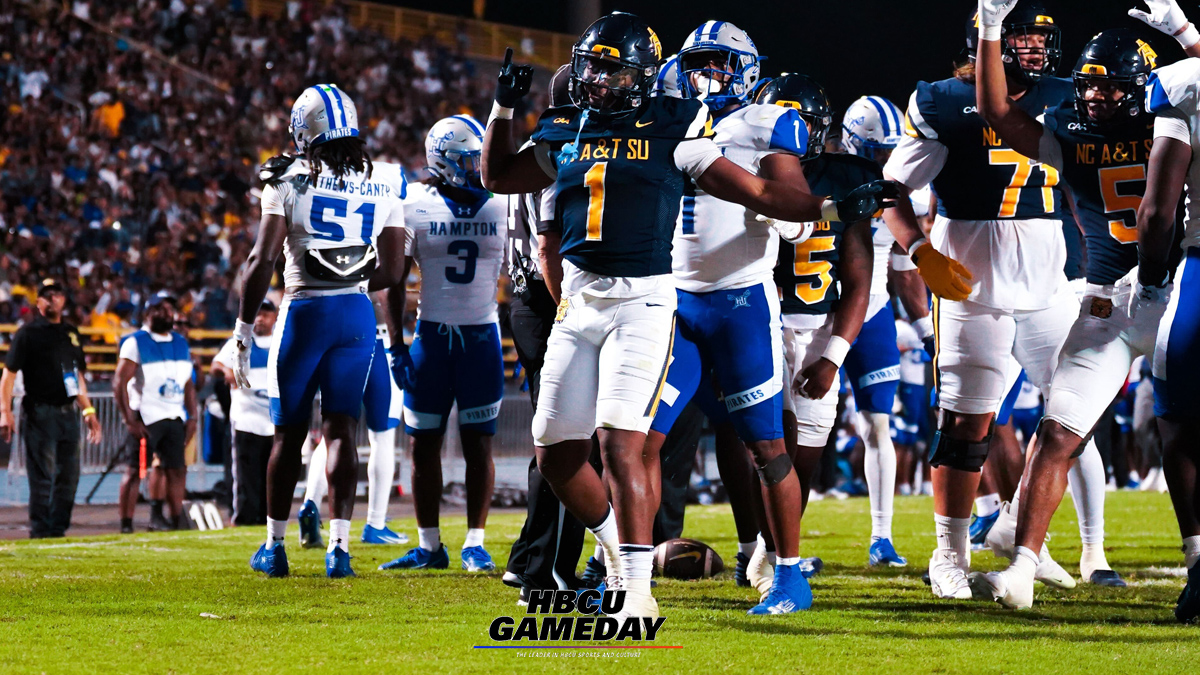
GREENSBORO — North Carolina A&T continues to struggle and the HBCU world continues to say ‘we told you so.”
NC A&T 63 more points on Saturday, the fourth time this season an opponent has hung 60-plus on the Aggies, and the third time Truist Stadium has seen a visiting team light up the scoreboard like it’s a spring scrimmage. Monmouth — now a nationally ranked CAA contender — rolled into Greensboro with athletes A&T simply could not match. The Hawks put up 696 yards of offense, featuring a national-class receiver in TJ Speight and a running back in Rodney Nelson who hit the corner like he was shot out of a cannon.
After the game, Shawn Gibbs didn’t sugarcoat anything.
“Honestly, those guys are bigger, stronger and faster. They wore us out… We better get on this recruiting trail and get us some dudes.”
The problem for A&T is that this wasn’t an isolated mismatch — this has been the story of their CAA tenure. And every time it happens, a familiar chorus rises from around the HBCU landscape:
“They need to go back to the MEAC.”
I don’t subscribe to that — and never have.
A&T’s Struggles Aren’t an Accident — They’re a Consequence of Strategy
Let’s be clear: North Carolina A&T didn’t stumble into the CAA. Hampton didn’t either. These weren’t rogue-AD decisions. These were presidential decisions — Dr. William Harvey at Hampton and Chancellor Harold L. Martin at A&T — based on their strategic visions for the entire institution, not just football.
Whether people agree with those visions is another conversation entirely.
But the moves — as well as the one to leave for the Big South initially — were made intentionally, not emotionally.
And they weren’t made solely for athletics. They were made for political positioning, perceived academic alignment, visibility, fundraising opportunities, enrollment strategy — a whole host of institutional factors that don’t fit neatly into the Saturday scoreboard discourse.
But because football is the front porch, football is where the critique lands hardest.

The CAA Is Brutally Unforgiving — And North Carolina A&T Is Learning That in Real Time
North Carolina A&T has two CAA wins to date, both this season. If the Aggies lose the finale to Elon, they’ll finish with their third straight season of one or two wins.
NC A&T is struggling defensively. It hasn’t had a 100-yard rusher all season — something that hasn’t happened since 2004. Their quarterback play is developing in real time. Eight straight starts for Kevin White. Freshman Nelson Layne showing flashes. One 100-yard receiving game from Jayvonne Dillard. A kicker — Andrew Brown — who is legitimately elite, with three field goals over 50 yards against Monmouth.
These are bright spots in a season filled mostly with growing pains.
And yet — this is the price of choosing the PWI-conference path.
This is the terrain North Carolina A&T leadership chose to walk.
The HBCU Backlash Is Real — But Also Reveals Something Deeper
Every time A&T gives up 50, 60, 63… there’s a certain segment of the HBCU world waiting to laugh. And I get it — I’m a Winston-Salem State guy. If anybody loves a good North Carolina A&T jab when I see one, it’s me.
But the joy isn’t just rivalry.
It’s resentment.
It’s “jilted lover” syndrome by people who felt abandoned when the largest HBCU left the MEAC — especially while it was dominating the conference.
Yet the “go back to the MEAC” refrain misses an important point:
If A&T’s struggles mean they should come home, what does that say about how people view the MEAC?
That it’s the “safe place?”
The “soft landing?”
The league to go to when you can’t survive elsewhere?
That’s not fair to the MEAC. And it’s not accurate.
North Carolina Central was one of the four schools that put 60 on North Carolina A&T. Other HBCUs have, too. The idea that A&T would automatically thrive again in the MEAC is nostalgia — not reality.
North Carolina A&T (and Hampton Chose) This Road — And They Must Own It
These decisions were made at the highest level. Both schools aligned themselves with different institutions, different resources, different competitive realities. That path comes with costs — competitive, cultural, and emotional.
But it’s their path.
The Aggies don’t need to “come back home.” They need to recruit, stabilize, invest, and build a roster that can compete in the CAA — the conference their leadership chose.
North Carolina A&T may get there. It may not.
But either way, the MEAC shouldn’t be the punchline to A&T’s struggles. And North Carolina A&T shouldn’t be expected to reverse its institutional strategy because football hit turbulence.
They are where the leadership wanted to be.
Now we wait to see whether they can rise to meet it. It’s a challenge that the largest HBCU in America should be up for. But only time will tell.
Great article Steven as usual. Simply put they are out of their league. All around. Morgan has already qualified for R1, Howard is there already sooooo A&T can miss me with the hype. The MEAC made A&T. And you CAN be a R1 school in the MEAC. Stop the cap A&T!