

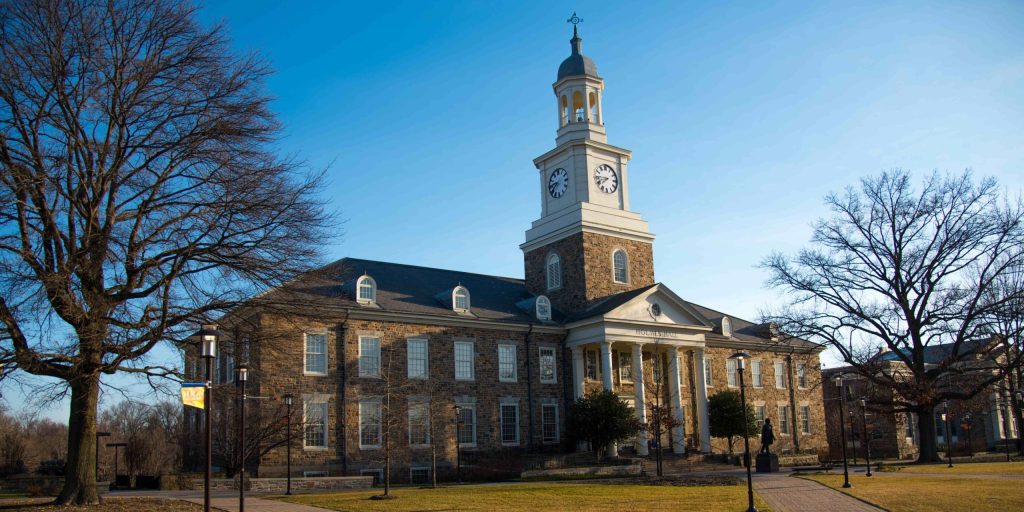
When Morgan State University President David Wilson declared in 2020 that the Baltimore-based HBCU would join the nation’s top tier of research institutions within a decade, it sounded like an ambitious long game. In 2020, Wilson announced that Morgan State—a 158-year-old HBCU—would aim for the coveted “Research 1” or “R1” Carnegie classification within a decade.
At the time, only one HBCU, Howard University in Washington, D.C., held the designation, which requires at least $50 million in annual research expenditures and the conferral of 70 or more research doctorates each year.
Back then, Morgan State’s numbers fell well short: $17.2 million in research spending and 71 doctorates awarded. By 2030, Wilson predicted, those figures would align with R1 requirements.
Instead, Morgan State has already surpassed them, according to a report by the Baltimore Banner. For 2024, the university secured more than $65 million in research funding, with projections reaching $75 million next year. Doctoral graduations are also on pace to exceed 100 by spring.
“We are very close to becoming a tenant on the penthouse level of research in this country,” Wilson told the Banner. “When we get there, we won’t be like anyone else currently on that floor. We are distinctly Morgan.”
Building an R1 Playbook
Wilson’s approach relied less on state appropriations and more on strategic investment. He actively sought backing from politicians and philanthropic leaders, urging them to “invest in Morgan” rather than merely fund it.
The results are measurable. Faculty grant submissions have more than doubled—from 165 in 2020 to 333 last year—driving a surge in awards. Multi-year funding now totals $95.29 million from federal sources, $7.5 million from Maryland, and $1.25 million from local foundations.
The Carnegie classifications are updated every three years, with the next round in 2028. If current trends hold, Morgan State will join the ranks of top-tier R1 institutions in that cycle.
Infrastructure to Match Ambition
Morgan State’s research push has been matched by major investments in campus facilities. Last year, the university opened its $171 million Health and Human Services building. This spring, construction began on a $337 million science center—designed by the largest African American-owned architecture firm in the nation—that will house the School of Computer, Mathematical, and Natural Sciences and advanced laboratory spaces.
The new science building represents the largest state contribution in Morgan’s history. At the May groundbreaking, Maryland Gov. Wes Moore highlighted that funding for the state’s four HBCU institutions has risen nearly 60% since he took office in 2023.
“Baltimore knows that Morgan State is Baltimore’s University,” said Baltimore Mayor Brandon Scott. “This groundbreaking really is the next step in Morgan’s transformation, an investment in STEM programs…and important progress on the road to becoming a top-tier, R1 research institution.”
Closing Historic Gaps
Despite recent gains, experts caution that the path for HBCUs remains challenging. Lynn Pasquerella, president of the American Association of Colleges and Universities, noted that historically, these institutions have faced chronic underinvestment from external sources.
For Wilson, Morgan State’s progress signals more than a climb up the Carnegie ladder—it represents a redefinition of what an HBCU can achieve in the modern research landscape, even amid tightening federal budgets.