
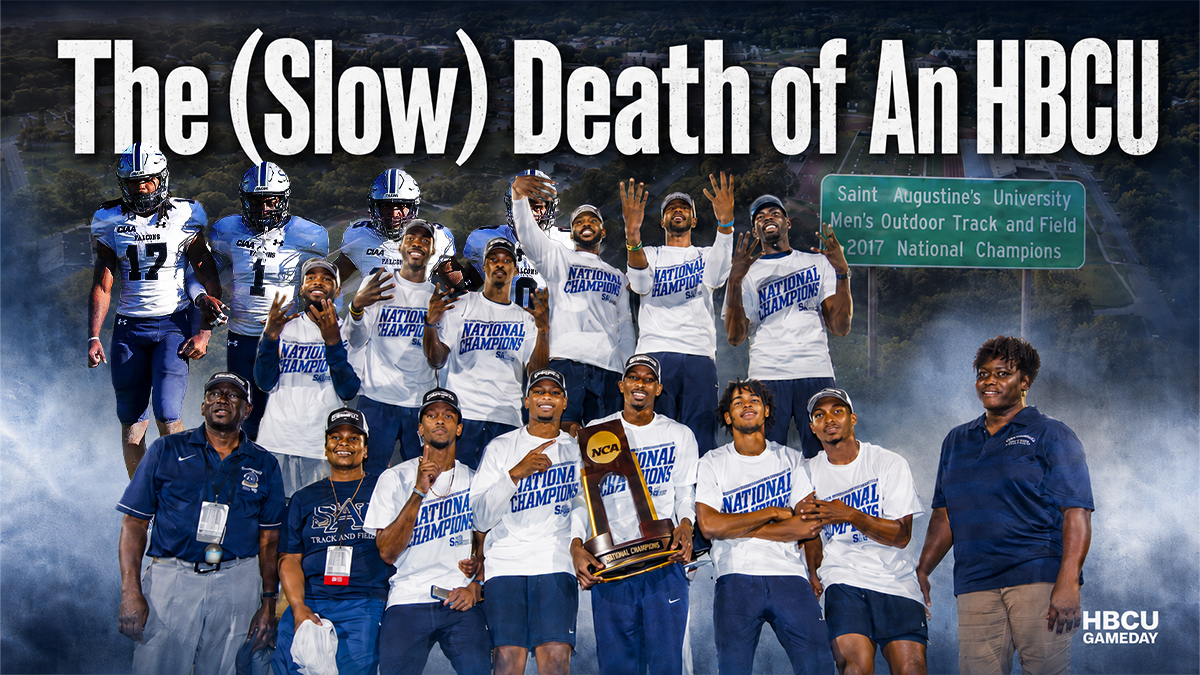
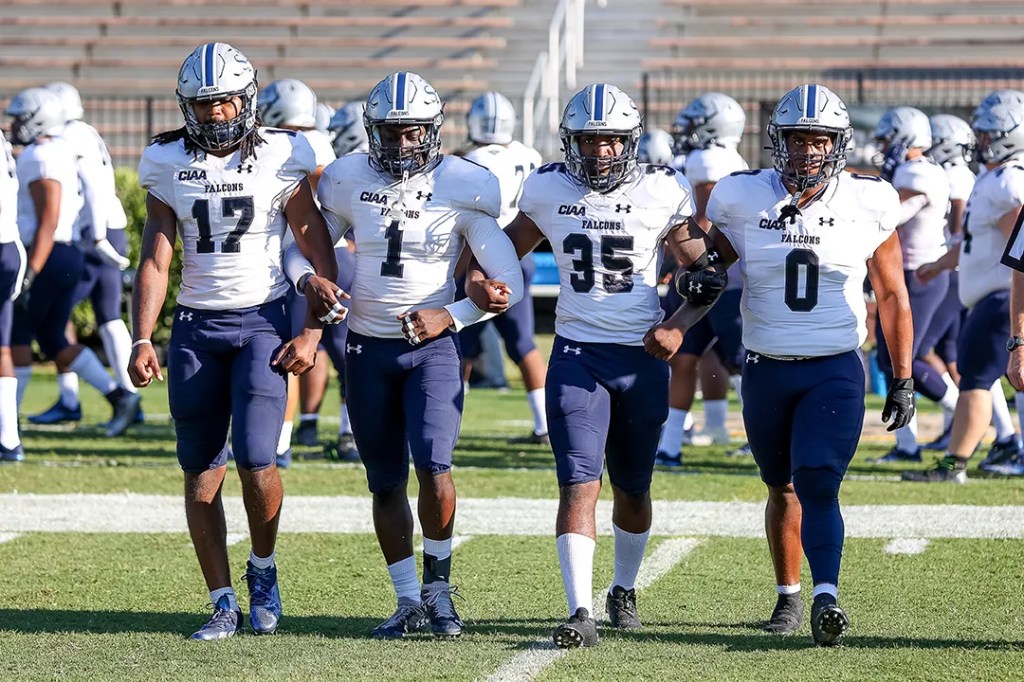
Football could not save what was already cracking
Athletics have always been tied to the story of Saint Augustine’s, but not always in the same way.
Track built the school’s national athletic brand. Football was brought back in the early 2000s with a different kind of hope. Like several small HBCUs, Saint Augustine’s believed football could help drive enrollment, school spirit and visibility.
For a while, that idea seemed possible.
There was excitement. There was a stadium and young men putting on the Falcon uniform and giving the campus another fall identity.
Then the cracks widened.
Financial trouble around the university started showing up around athletics. The football program cycled through coaches. Resources became an issue. Students and parents complained. By the end, reports around the program were not about wins, rivalries or recruiting classes. They were about basic conditions.
That is how decline often works.
It does not always arrive as one dramatic collapse. Sometimes it shows up as missing equipment. Then it shows up as unpaid bills. Then it shows up as a field that cannot be properly used. Ultimately, a program gets suspended. Eventually, people stop asking when things will get better and start asking whether the institution can survive at all.
Saint Augustine’s football did not kill the university.
It also could not save it.
That is an important distinction, because athletics are often treated as either the miracle cure or the easy villain in HBCU financial conversations. The truth is usually harder. Athletics can bring visibility, enrollment and community energy. Athletics can also expose institutional weakness when the foundation underneath is already unstable.
At Saint Augustine’s, the foundation was already cracking.
The land may be worth more than the school
There is one thing Saint Augustine’s still has that everybody understands has value.
Its land.
The university owns 105 acres in Raleigh, property reportedly valued at around $200 million. In a fast-growing city where development pressure is everywhere, that land is not just land. It is a prize.
That is where the sadness becomes complicated.
The university itself has no students. Its degree-granting power is gone for now. Its debt is massive. Payroll is being supported by a financial partner. The campus needs security. Its records and sensitive data need protection. Even its physical archives have become something the court had to mention.
Meanwhile, the land sits there. Valuable. Historic. Vulnerable.
There are people who believe this was always the endgame. They believe Saint Augustine’s was weakened from the inside, mismanaged into crisis, and left exposed so that its land could eventually be carved up. Whether that is true or not is murky. It is not my job here to declare conspiracy as fact.
What we do know is bad enough.
A 160-year-old HBCU is now in a position where its most valuable asset may not be its students, because it has none. It may not be its academic programs, because accreditation is gone. It may not be its athletics, because the CIAA already suspended the program.
The most valuable thing Saint Augustine’s has left may be the dirt beneath its feet.
For an HBCU, that is a brutal reality.
Land has always mattered to Black institutions. Land meant permanence and protection. Land meant a place where Black people could gather, learn, worship, organize and imagine something larger than survival.
Now, Saint Augustine’s land may be the thing that pays its creditors.
That may be legally necessary. It may even be unavoidable. But it is still painful.
This is bigger than one campus
The loss of Saint Augustine’s would not belong only to Saint Augustine’s.
It would belong to its alumni and the students who had to transfer out. Employees who are owed money, but still kept showing up to work until they couldn’t. It would belong to Raleigh, a city that has grown around a historic Black campus while that campus has struggled to keep its doors open.
It would also belong to HBCUs everywhere.
Saint Augustine’s is not just another small private school. It is one of the oldest HBCUs in the South. It began as a school for formerly enslaved people. Institutions like this were not built because America was generous. They were built because Black people needed somewhere to go when most doors were closed.
As a Winston-Salem State University graduate, I cannot look at Saint Augustine’s as some distant institution with no connection to my own story. The HBCU ecosystem is connected by more than conference affiliations and old rivalries. It is connected by founders, teachers, ministers, coaches, alumni and communities that believed education could change the direction of Black life.
Simon Green Atkins did not build in a vacuum when he helped lay the foundation for what became Winston-Salem State. He was part of a larger movement of Black institution-building across North Carolina and the South. Schools like Saint Augustine’s were part of that same world.
That is why this hurts.
When an HBCU dies, it is not just a campus closing. It is a piece of collective memory being boxed up. A set of traditions losing their home. It is a place where somebody became the first in their family to earn a degree becoming another redevelopment conversation.
Maybe Saint Augustine’s finds a path.
Perhaps certification programs help create a bridge and reaccreditation becomes possible one day. Maybe the people still working for the university somehow pull off the kind of comeback that would make every HBCU person stand up and applaud.
We should not root against resurrection.
But we should not lie about death, either.
Right now, Saint Augustine’s feels like a beloved elder whose breathing is faint. We — the family — are still in the room. The prayers are still being said. The memories are still powerful.
That does not make the ending hurt less. It only gives us time to understand what we are losing.