
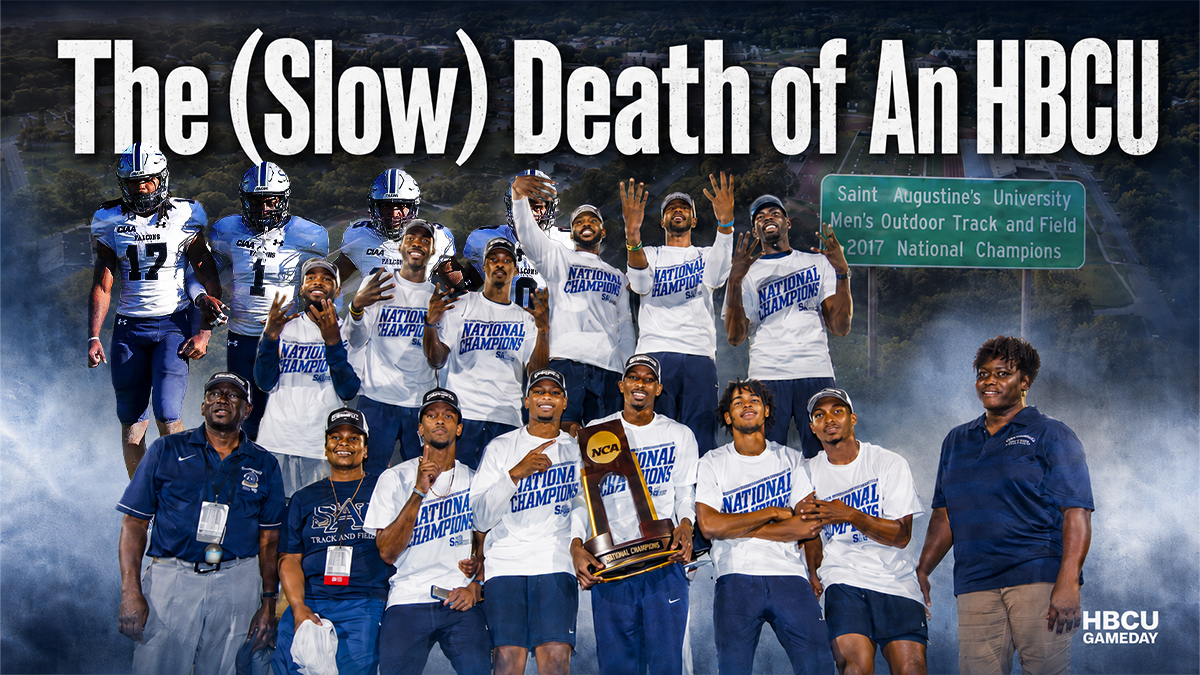
In Raleigh and around the HBCU world, we are watching the death of Saint Augustine’s University in real time.
HBCU history is often written in moments of triumph, but the current state of Saint Augustine’s University forces us to sit with something far more painful.
This is not yet an obituary. The final words have not been written on the tombstone of Saint Augustine’s University. There are people still fighting for it. Alumni still praying over it. There are employees still trying to keep some kind of heartbeat inside an institution that has meant something for 160 years.
Still, facts are facts.
Saint Augustine’s has no students. It has lost its accreditation. It is in bankruptcy and the campus is largely empty. The school reportedly owes approximately $74 million to hundreds of people and entities. Its cash on hand is listed at just $426,000.
That is not a rough patch or a bad semester. SAU is an institution on its final legs.
It feels like visiting a relative in hospice. They are still breathing. Hands are still being held. Yet everyone in the room understands what is happening, even if nobody wants to say it too loudly.
Saint Augustine’s University may still say it has a future. We should respect the people trying to make that true. But we also have to be honest about the present.
And the present is heartbreaking.
From national titles to bankruptcy court
The timing of this latest update is especially cruel.
Late May is when NCAA track and field champions are crowned. For decades, this was the season when Saint Augustine’s made headlines. Not because of bankruptcy, accreditation fights or unpaid bills. It made headlines because its athletes were standing on podiums.
Under legendary coach George Williams, Saint Augustine’s became one of the great track and field dynasties in NCAA Division II history. The Falcons and Lady Falcons won 39 NCAA Division II national championships under Williams. They produced hundreds of individual titles. They produced Olympians. Williams himself coached at the Olympic level.
All of that came from a small HBCU in Raleigh.
It didn’t happen in Chapel Hill. Not Durham or any Power Five giant with unlimited resources. Not a massive public university with a sprawling donor base.
Saint Augustine’s took athletes from all over the country and the world, brought them to a small campus in southeast Raleigh, and turned them into champions. It went beyond athletic success and helped shape institutional identity.
Some schools have football Saturdays. Some have big basketball arenas. Saint Augustine’s had track.
Track was not some side note. It was the pride of the university. It was proof that small HBCUs could produce world-class excellence. In an era when HBCUs had to fight for every inch of recognition, Saint Augustine’s track and field program gave the school a national name.
That is what makes this moment feel even heavier.
A university that once collected national championship trophies in May is now answering questions in bankruptcy court in May.
That sentence alone tells a story.
(Read More on Page II)