
The CIAA Tournament remains the financial engine of the oldest HBCU conference, but the move Baltimore from Charlotte represents change in a number of ways.
That is the clearest takeaway from public tax filings and recent comments from CIAA officials. The tournament is still the conference’s biggest business asset. It is still the event that separates the CIAA from most Division II leagues. It is still the platform that gives the conference its national profile.
But the tournament’s business model is no longer as simple as it appeared in Charlotte.
In Baltimore, the event runs through a broader package. It includes direct tournament revenue, sponsorships, media rights, city support, tourism value and major arena costs absorbed outside the tournament revenue line.
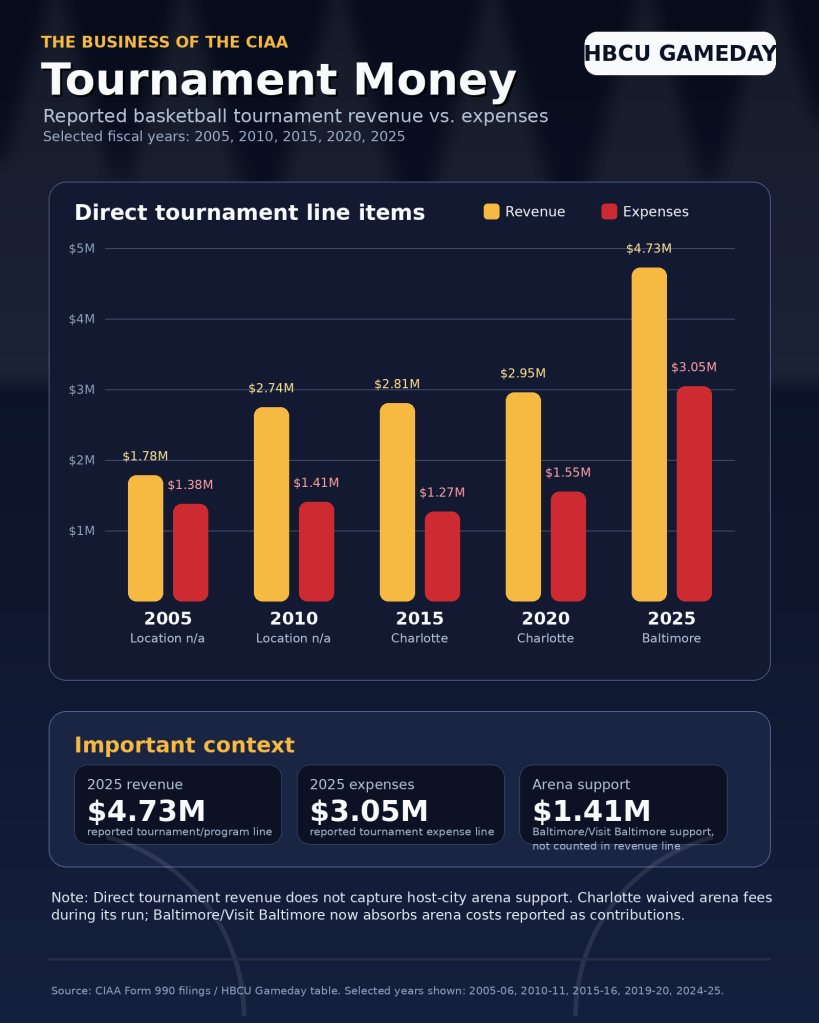
The CIAA’s most recent Form 990 calls the basketball tournament one of the largest in the country and the conference’s “major activity.” The same filing says revenue does not include $1.409 million in arena rental costs paid directly by a donor and reported as contributions. HBCU Gameday has confirmed that support is part of the Baltimore and Visit Baltimore package.
That detail is central to the story. It means the public tournament revenue line does not show the full value of the Baltimore arrangement. A major cost of staging the event is being handled through the host-city package.
That makes the tournament bigger than the line labeled “basketball tournament.”
CIAA Tournament had a cleaner Charlotte model
For years, Charlotte was the center of the CIAA Tournament business model.
The event filled hotels, restaurants and nightlife venues. It brought alumni and fans into uptown Charlotte. It also gave the CIAA a revenue source most Division II conferences could not match.
The filings from the late Charlotte era show a cleaner tournament picture.
In fiscal year 2016, before the HB2 era and before the move to Baltimore, the CIAA reported about $5.97 million in total revenue. The basketball tournament was still the obvious driver. That year, the conference reported about $2.61 million in basketball tournament revenue and roughly $1.27 million in basketball tournament expenses. That was easier to read.
Tournament revenue came in. Tournament expenses went out. The event produced a clear spread that helped fuel the conference.
But that model also created risk. The CIAA depended heavily on one event, one city and one annual revenue cycle. When North Carolina’s HB2 legislation disrupted the state’s sports and events climate, the conference’s most valuable asset was exposed.
Marcus Clarke, the CIAA’s senior associate commissioner for athletic administration and external operations, said the timing mattered.
“We were recovering from HB2,” Clarke told HBCU Gameday. “The commissioner inherited a $750,000 deficit. Paying our institutions on the same giving level was something she wanted to continue. Getting hit with HB2 made it hard to continue that same mindset.”
Clarke said the board had to think about the conference’s long-term financial position.
“The board understood we had to help get the conference out of a deficit, remain whole and build a potential fund balance,” Clarke said. “The board made the decision to reduce what was distributed to make sure the conference as a whole could be whole.”
That is the backdrop to the Baltimore move.
The CIAA felt it didn’t just need a new home. It needed a more durable model.

CIAA Tournament money changed in Baltimore
Baltimore gave the CIAA a different kind of deal.
The city is not just hosting basketball. It is investing in an HBCU sports tourism event. The CIAA brings the brand, the fan base and the weeklong programming. Baltimore and Visit Baltimore help carry the platform.
Clarke said the arena support is not from a private individual.
“There’s no individual donor,” Clarke said. “That would be city responsibility per our agreement with Baltimore.”
That matters because the 990 language can make the arrangement look less clear than it is. The filing calls it a donor-paid arena cost. The reporting shows that it is part of the Baltimore package.
The numbers show how the model has changed.
In fiscal year 2024, the CIAA reported $9.95 million in total revenue and $10.09 million in expenses. That filing said revenues did not include $1.338 million in arena rental costs paid directly by a donor and reported as contributions.
In fiscal year 2025, the CIAA reported $10.05 million in total revenue. That included $5.04 million in contributions and grants, $4.73 million in program service revenue and $276,959 in other revenue. The conference reported $9.88 million in expenses and ended the year with $1.03 million in net assets.
That is a much larger conference office than the CIAA had in the late Charlotte years.
But the tournament itself is not a simple profit center.
CIAA Tournament costs are rising
The Baltimore model has helped the CIAA grow its overall revenue. It has also introduced new costs.
Clarke said the conference is trying to get the tournament closer to even.
“We’re trying to find a way to break even,” Clarke said. “Visit Baltimore and the city of Baltimore help offset some of our costs.”
He said some expenses were different than expected when the tournament moved.
“There are costs that were not factored in initially with the move to Baltimore,” Clarke said. “Travel, union costs, hotel expenses and personnel have gone up.”
That quote helps explain the difference between the Charlotte and Baltimore filings.
In the Charlotte era, the basketball tournament revenue line often looked stronger against tournament expenses. In Baltimore, direct tournament expenses are higher. The event also carries costs tied to travel, labor, hotels and personnel in a new city.
The 2025 filing lists $3.05 million in basketball tournament expenses. It also lists $2.72 million in advertising and promotion, $592,199 for other sports and $496,812 for officials.
Those figures show why the tournament cannot be judged only by ticket or event revenue.
The CIAA Tournament is an event. It is also the core platform that supports the league’s broader championship and media structure.
Clarke said the tournament still drives a large share of the conference’s money.
“Our tournament revenue is just over 40% of our revenue,” Clarke said. “The tournament allows us to provide for a lot of our other championships.”
That is the heart of the business model. The tournament does not just pay for itself. It helps support the rest of the conference operation, per the conference.
What counts as CIAA Tournament revenue?
The most direct tournament line is “basketball tournament” revenue. But that line does not capture the full tournament business.
The 2024 filing shows program service revenue split between sponsorships and rights fees, basketball tournament revenue and football championship revenue. Sponsorships and rights fees were listed at $3.32 million. Basketball tournament revenue was listed at $1.23 million. Football championship revenue was $53,746.
That is the key accounting point.
The basketball tournament line captures direct tournament revenue. But the tournament’s full value also runs through sponsorships, rights fees, host-city support and media exposure.
That is especially true in Baltimore.
A sponsor may not be buying only the basketball games. It may be buying access to the CIAA’s biggest brand moment. A media partner may not be valuing only one week. It may be valuing the tournament as the anchor of the conference’s larger sports inventory.
That is why the Baltimore model is harder to read from one line on a Form 990.
CIAA Tournament makes Division II look bigger
McWilliams-Parker has framed the CIAA’s position clearly.
“We have honestly been in a better position than some of my other D2 conferences,” she said in an HBCU Sports interview. “I think our schools are in a better position.”
She also pointed to the league’s unusual visibility.
“I don’t even know half the time if people know that we’re Division II,” McWilliams-Parker said. “We try to operate like we’re big time all the time.”
The CIAA Tournament is the clearest proof.
Most Division II basketball tournaments are championships. The CIAA Tournament is a business and cultural property. It involves city officials, tourism agencies, corporate partners, national media platforms, alumni travel and weeklong programming.
But McWilliams-Parker also acknowledged the limits.
“We’re Division II, non-profit trying to raise money to manage all the good stuff that we’re doing,” she said.
That is the tension.
The CIAA operates an event that looks larger than Division II. But it remains a nonprofit conference serving Division II schools. The tournament has to fund ambition while surviving real costs.
Baltimore brings new CIAA Tournament question
Charlotte proved the CIAA Tournament could be a revenue machine for the city and conference. Baltimore is trying to make it a sports tourism platform in late February.
That may be a better long-term model. It spreads value across more areas and gives the CIAA a host-city partner willing to absorb a major venue cost. It also connects the tournament to tourism strategy, sponsorship growth and media exposure. But it is harder to explain.
The old question was whether the tournament made money. But perhaps the new question is where the value shows up.
Some of it appears as tournament revenue. Some appears as sponsorships and rights fees, others as contributions. Some appears as costs Baltimore absorbs. Some appears as exposure that helps the league sell the rest of its inventory.
The CIAA Tournament is still the engine. Baltimore changed the fuel, the cost structure and the accounting trail. It also changed the geography of a conference based primarily in North Carolina.
In Part III of The Business of The CIAA, we will look at the evolution of the way the conference rewards its members financially.
Interesting im MEAC live in baltimore and support the venue. Lots of baltimore people are glad that is here w support.
The major point that was not discussed is this, a majority White Govern City Charlotte didn’t fully appreciate nor want the CIAA tournament. They were more accommodating to the ACC Tournament which they gave a much favorable pricing structure. So a majority Black City Baltimore welcomed the CIAA Tournament as a vested Business partnership. Further, the difference between a progressive State Maryland for us Black folk and one like North Carolina….
Whatever Bmore did well. Great. Count it as a learning experience and Bring it back to Charlotte.
Charlotte and it’s “Black Tax” price gouging along with fans not going to the Games is why it should never go back to the city! No one wants to go where they are not wanted by the Host City! The locals made it clear they did not want all those Black people downtown!
The move from Charlotte to Baltimore is a move which appears to be with good intent. The City of Baltimore of course as well as neighboring cities should and will benefit from the CIAA Tournament. If the CIAA Tournament in Baltimore can generate a higher yielding revenue to “break even” and maybe even exceed experiences it should be a win for the CIAA, the City of Baltimore and HBCU’s as well. Looking forward to a successful CIAA Tournament future.
As an HBCU grad and an enthusiast for the tournament. I would love to see it return to Charlotte. Clearly, the”Queen City”. misses the crown jewel in the Black sports calendar. We have billionaire name Favid Tepper who owns the Carolina Panthers and Charlotte FC. I’m sure he can offer of the CIAA a better deal than Baltimore.
The bottom line the tournament is about making money it’s up to the board to figure out if Baltimore or Charlotte brings in the most money what I can say the energy, the fan participation and the overall atmosphere go to Charlotte hands-down. I would say 80% of the local Baltimore population. Doesn’t know what the CIAA is.
The city does a good job of promoting it.
I’ve attended the CIAA Tournament almost every year since I was a student at Virginia State back in the 70’s and of all the cities (Norfolk, Richmond, Winston-Salem, Raleigh and Baltimore) that have hosted the tournament, Charlotte was my least favorite, primarily because they didn’t want us there. They only wanted our money and when they introduced the “Black Tax” and then relegated the opening round games to Bojangles Arena, it was the last straw and a clear indication that it was time for the CIAA to find a new home. Enter Baltimore which stepped up with a great financial package and incentives and has done an awesome job with promoting the tournament and the city, residents and businesses have embraced it. In addition, it’s a good fit since it comes at the end of Black History Month and Baltimore is a predominantly Black city, as well as Maryland having the only African American governor in the nation. Consequently, when Charlotte snubbed its’ nose, the CIAA realized that it was time to “come home to Baltimore.”
As a resident of Charlotte, the city and partygoers did not know it was a basketball tourney. The city did not want it here. As an alumna of WSSU, I appreciate the event in Baltimore and the return to seeing the arena full of fans.