
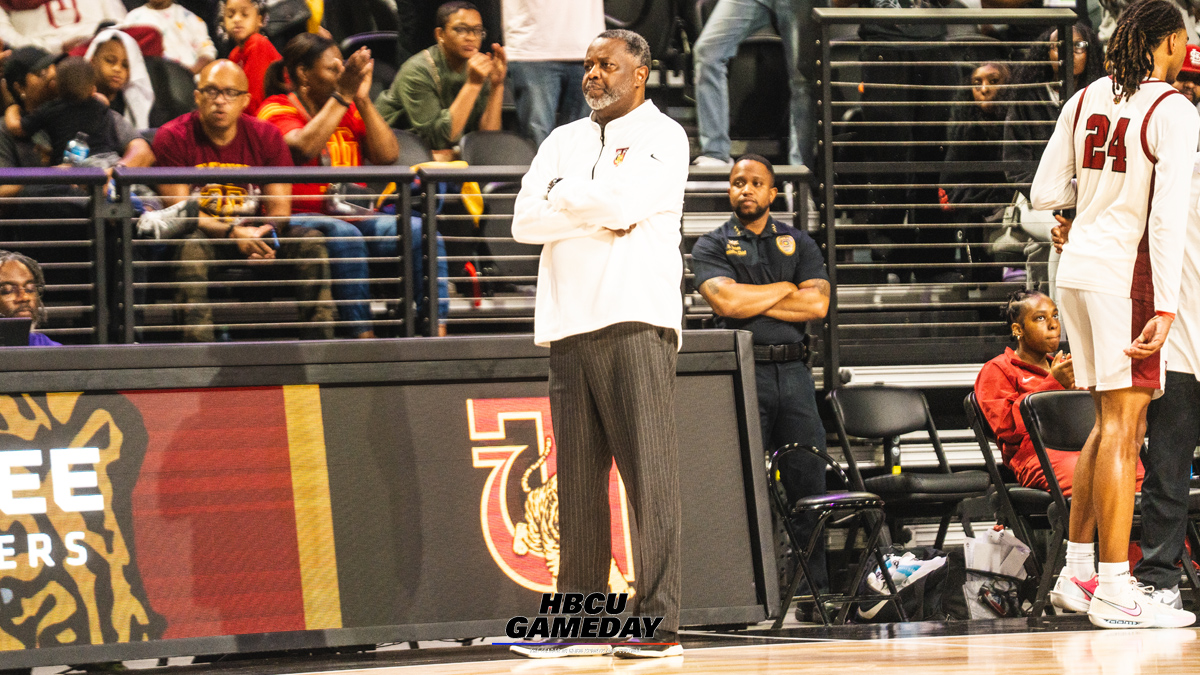
MORROW, Ga. — HBCU powerhouses Tuskegee and Morehouse met again at the SIAC championship, and ESPN broadcasted the game.
Unfortunately for both institutions, it also brought up an extremely unpleasant memory from this year.
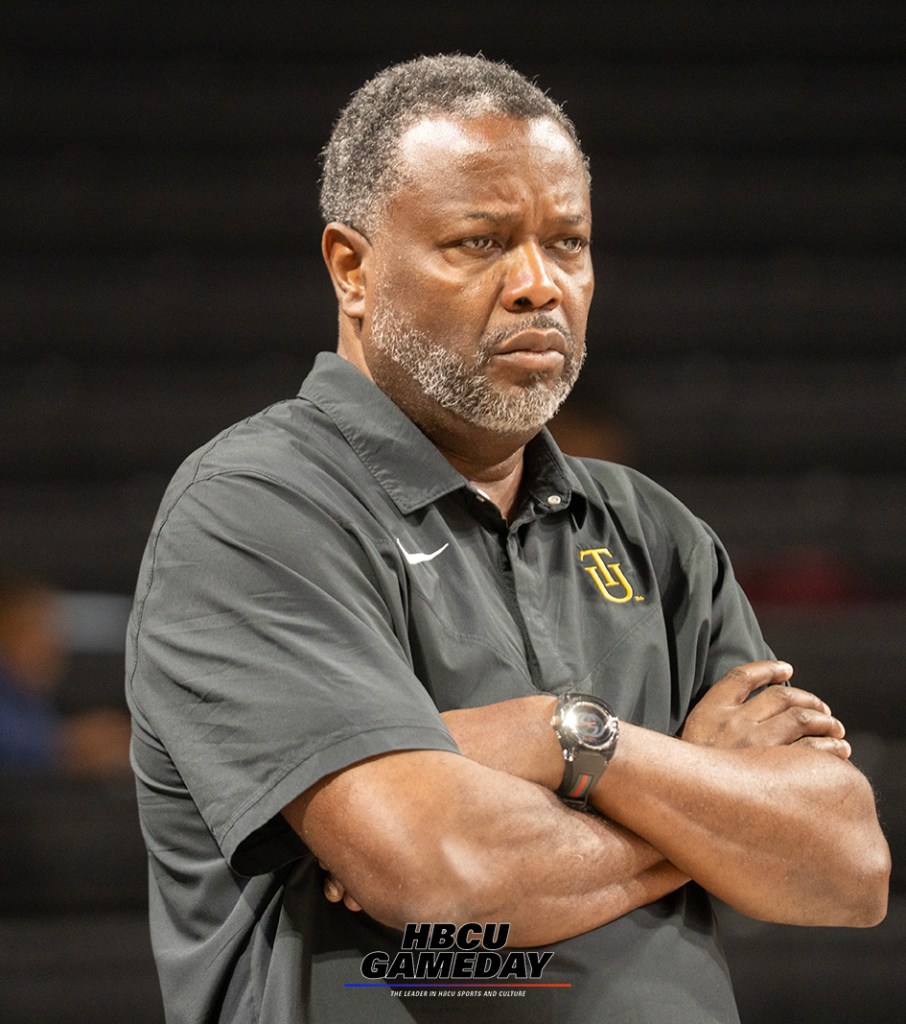
Tuskegee Vice President of Intercollegiate Athletics and Athletic Director Reginald Ruffin told HBCU Gameday’s Steven J. Gaither he was frustrated about how his head coach, Benjy Taylor, has been portrayed since the Feb. 1 incident at Forbes Arena. That night, after a Morehouse-Tuskegee game ended, Taylor was briefly detained in handcuffs. Tuskegee and Morehouse leadership later acknowledged the incident was wrong, and the two institutions, Ruffin said, worked to move forward.
But during the SIAC championship in Morrow, Ruffin said, the past was dragged back into the present.
ESPN broadcast shown on Jumbotron
Early in the title game, ESPN aired a recap of the handcuffing incident. The footage was also simulcast on the jumbotron inside the Clayton County Convention Center. Tuskegee led 10-8 with 15:06 left in the first half when the clip played, and the mood changed immediately.
Morehouse Athletic Director Harold Ellis rose from his seat on the sideline and walked toward the broadcast area, appearing to confront ESPN personnel about the video being shown. SIAC Commissioner Dr. Anthony Holloman approached as well, and Tuskegee University President Dr. Mark A. Brown also went toward the broadcast seats. The tension was visible.
Ruffin said his coach believed the matter had been put to rest.
“My coach didn’t agree to that,” Ruffin told HBCU Gameday. “He said this is behind us. We’ve moved on. So why would you play this.”
Ruffin said the decision was especially damaging because it was not just a TV segment — it became an in-arena moment for the teams to relive.
“That should not have been a live feed on the game for my team to bring back all those memories to see their coach,” Ruffin said. “That was wrong for ESPN to play that on the jumbotron.”
He went further, noting that the ESPN feed had not been broadcast before Championship Saturday.
“ESPN is dead wrong,” Ruffin said. “Out of all the games played in the arena, you never went a live feed. Not one game was there a live.”
HBCU Sports graphic upset many people
Ruffin’s anger wasn’t limited to ESPN. He also pointed to what he sees as an unhealthy pattern in HBCU media coverage, where the most sensational angle becomes the lasting label, even when it harms Black coaches and players. HBCU Sports posted a social media graphic after Taylor was named SIAC coach of the year. The graphic, which appears to have been replaced, referred to Taylor as “hand-cuffed HBCU coach.”
“It’s wrong to say ‘the hand cuffed coach wins coach of the year,’” Ruffin said. “What narrative are we putting out? That’s the false narrative.”
Ruffin said the coverage ignored what Taylor represents daily.
“Why not the coach who is educating young black men?” he said.
He argued that mistakes, controversies, and embarrassing incidents happen across sports, but HBCU programs get treated like spectacle.
“That’s unprofessional,” Ruffin said. “Do they bring up when coaches get drunk, coaches get DUIs? That’s stupid. That ain’t professional. We hurt us.”
Ruffin said the incident should have been a short-lived news cycle, not a defining identity.
“That was a story for one day,” he said. “And nobody else talks about it. And we go above and beyond when it happens at HBCUs. It’s wrong on all levels.”
Morehouse and Tuskegee look to move on
Ruffin repeatedly framed the original incident as something that harmed both sides — Morehouse and Tuskegee — and something both institutions acknowledged was wrong. He said the public replaying of it continues to “tarnish” two respected programs that, in his words, were trying to move on.
“It was two great institutions that played in a basketball game,” Ruffin said. “That incident tarnished the image of two great institutions. We both acknowledged that it was wrong.”
While he wasn’t as openly demonstrative as Ellis, Ruffin characterized the moment in the same way.
Ruffin said both men called it “Bush League,” because it injected controversy into a championship setting and turned an already emotional moment into a public spectacle.
Tuskegee coach and players impacted
For Tuskegee, Ruffin said this is about protecting his coach and his team’s mental health, not about winning an argument with ESPN or media outlets.
“That’s tacky man,” Ruffin said. “I’m gonna fight for my coach.”
While he didn’t blame the moment for the loss, Ruffin said the continuing narrative has had a real cost.
“It broke my coach. It broke my team,” he said, describing the toll as “mentally” and “physically.”
He emphasized that Taylor, and his players, are not criminals — and should not be packaged that way for clicks or a dramatic TV tease.
“As a black man, who is not incarcerated,” Ruffin said, “that’s showing African-American men how to be a man. And we put him in handcuffs.”
Ruffin said Taylor does not deserve to keep being “beat up,” and he worries that repeated framing erases the real story of Tuskegee basketball and its people.
“Benjy don’t deserve to keep getting beat up,” Ruffin said. “Our history is being erased. And nobody thinks it’s a problem.”
The tournament setting was meant to showcase the best of HBCU basketball on ESPN. Ruffin said the message should have been about excellence, achievement, and two programs competing for a title — not replaying an image that, to him, never should have existed in the first place.