
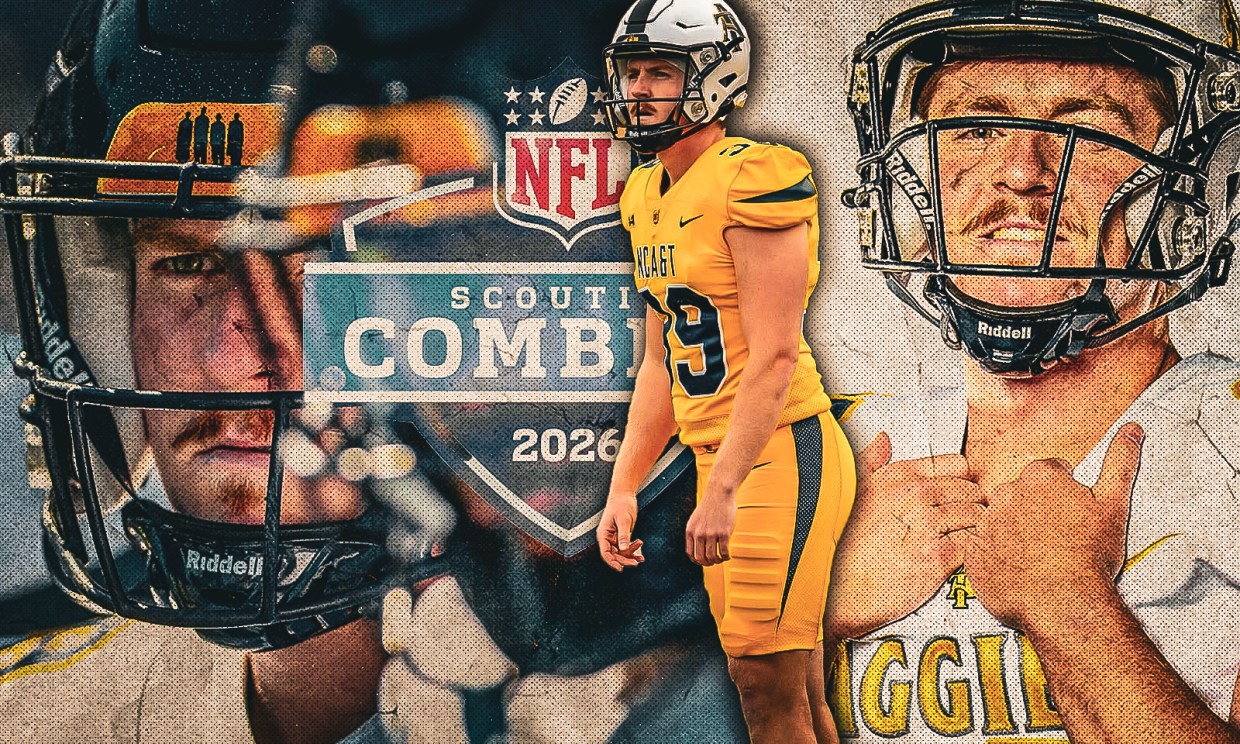
For weeks, the headline around HBCU football and the 2026 NFL Combine felt settled. No current HBCU players were invited. That narrative shifted the moment Andrew “Money” Brown got the call. On Saturday at the HBCU Legacy Bowl inside Yulman Stadium, the North Carolina A&T kicker helped Team Gaither secure a win.
Then, somewhere between warmups and whistles, he received official word: he was headed to Indianapolis.
Brown is now the first kicker in North Carolina A&T history to earn an NFL Combine invitation — and notably, the only current HBCU player participating in the league’s Specialist Showcase.
The moment hit fast.
“I was a little surprised, to be honest, kind of shocked,” Brown said in an article on ncataggies.com. “But I was pretty grateful for it, just because it’s an experience that only one percent of the one percent get to do.”
From Soccer Dreams to Combine Spotlight
Originally, Brown didn’t grow up dreaming about field goals.
Instead, soccer was his first love. He expected to stay with it for years — until his middle school didn’t field a team. At that point, his father encouraged him to try football.
That pivot changed everything.
Now, the same right leg that once chased goals is chasing NFL history.
The 2025 HBCU Special Teams Player of the Year leaves North Carolina A&T as the program’s all-time leader in field goals made (51). Additionally, he drilled all five of his 50-yard attempts this past season. Most impressively, he set the Aggies’ longest field goal record by launching a 56-yarder against Towson on November 1, 2025.
Clutch isn’t just branding. It’s documented production.
His former head coach, Shawn Gibbs, believes the stage won’t overwhelm him.
“He’s got ice water in his veins,” Gibbs said. “No moment is too big for him, and I know that if he’s given the opportunity, he’ll do well for anything.”
The Only Current HBCU Name in Indianapolis
When the NFL released its 319-player list for the 2026 NFL Scouting Combine, HBCU circles immediately noticed one detail.
Zero current HBCU players appeared on the main invite list.
As a result, the absence sparked broader conversations about exposure and evaluation. In today’s transfer portal era, visibility often follows relocation.
Two former HBCU players will participate after transferring to Power Four programs. Virginia running back J’Mari Taylor began at North Carolina Central. Missouri wide receiver Kevin Coleman Jr. started at Jackson State.
However, Brown’s invitation carries a different tone.
He didn’t relocate for exposure. He didn’t attach a Power Four logo to his résumé. Instead, he built his case through performance and consistency at North Carolina A&T.
Consequently, he now stands alone among current HBCU players in Indianapolis.
He is one of just eight specialists selected nationwide for the Showcase. Meanwhile, the other seven come from programs like Florida, Georgia, Iowa, Syracuse, Michigan State, and Michigan.
That contrast matters.
Specialists will complete on-field drills and then interview with representatives of NFL franchises. The Specialist Showcase airs live on NFL Network.
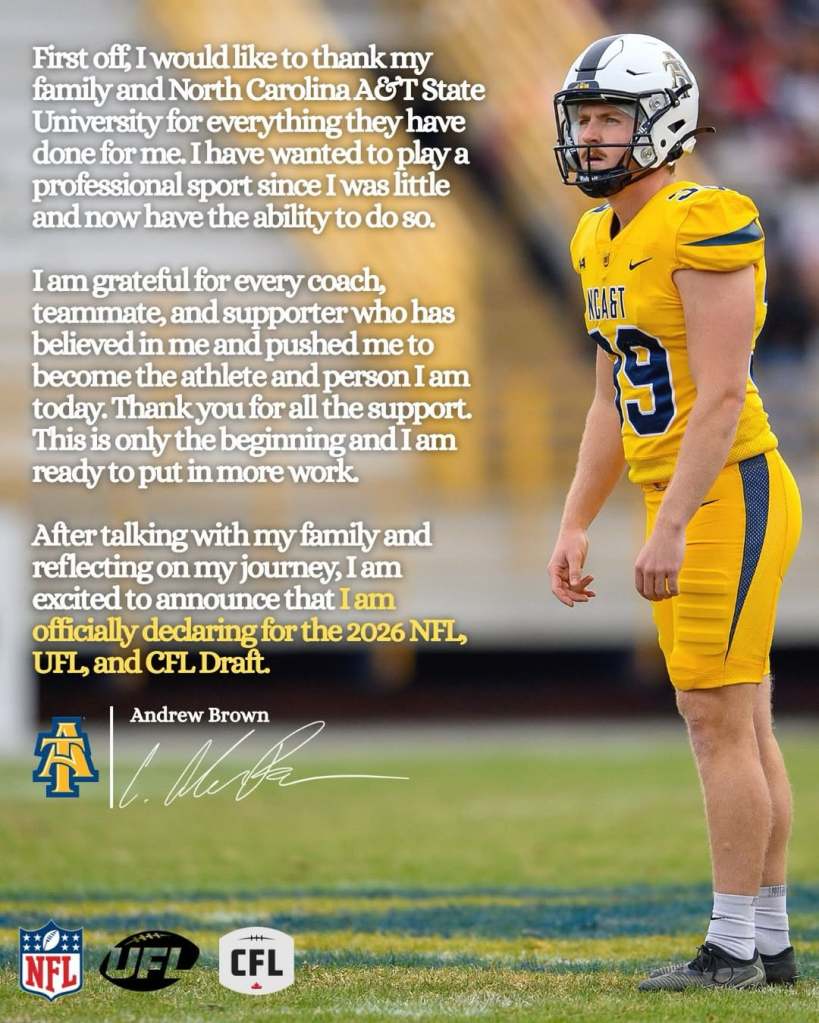
A Whirlwind Built for Opportunity
There wasn’t much time to process the moment.
After finishing the HBCU Legacy Bowl on Saturday, Brown boarded a 5 a.m. flight Sunday back to Birmingham. Following one day of rest, he caught a 7:30 a.m. Tuesday flight to Indianapolis.
It’s a tight turnaround. Nevertheless, it’s exactly the kind of chaos he embraces.
At the Legacy Bowl, he reflected on what this stage means beyond football.
“Have fun. That’s the most important thing,” Brown said, “If you’re not having fun, you’re not doing it right… always try to get better. It’s always good to be at the best of your ability at any given time, because you never know when [your time] is gonna come.”
Bigger Than One Invite
Historically, HBCU football helped build professional football. Between 1960 and 1970, HBCUs produced nearly one-third of all pro draft picks. In total, 35 Pro Football Hall of Famers emerged from HBCU programs.
Over the last three decades, however, Combine representation has declined.
The NFL launched the HBCU Combine and continues to support the HBCU Legacy Bowl because league stakeholders recognized the visibility gap between HBCU football and the NFL. Even so, modern college football economics often push elite talent toward the transfer portal to gain broader exposure.
As the only current HBCU player entering the 2026 NFL Combine environment, his kicks represent more than distance.
They represent validation.
And sometimes, it only takes one specialist with ice in his veins to shift the entire conversation.