
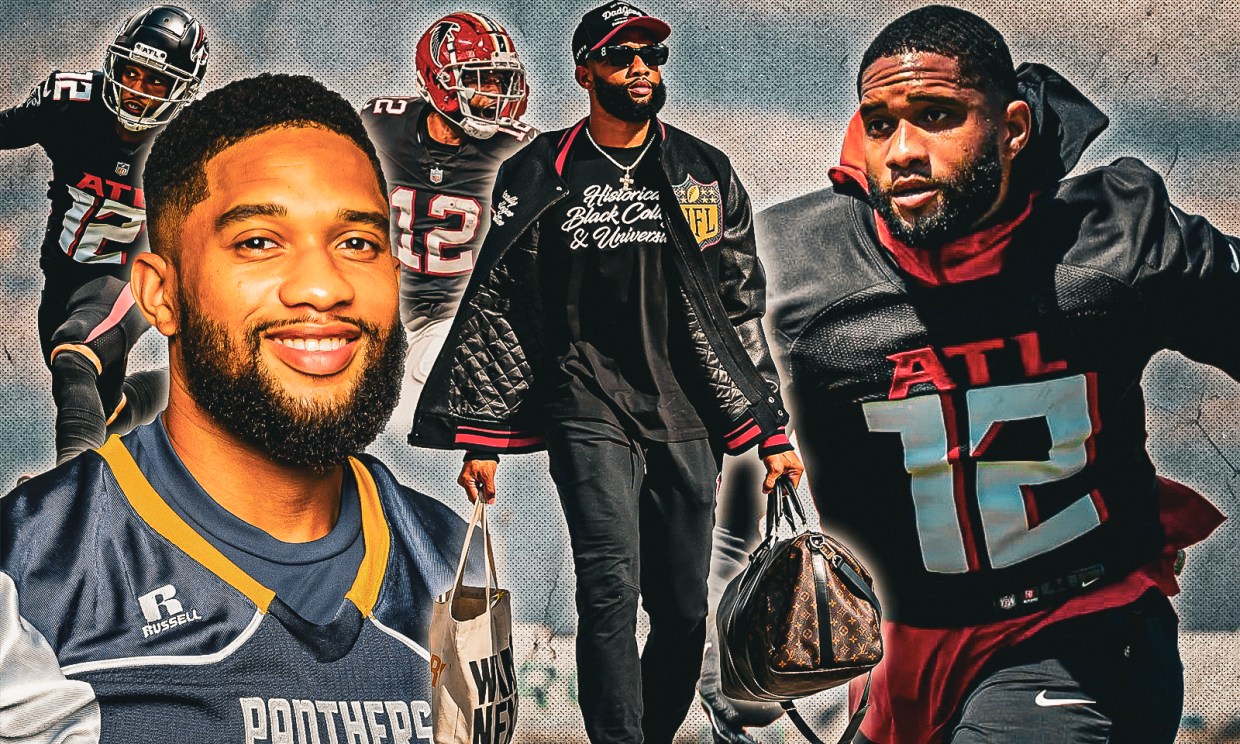
During Black History Month, the Atlanta Falcons didn’t just post a graphic or drop a commemorative video. Instead, they went back to the source. The organization traveled to Prairie View A&M University, highlighting the HBCU football journey of Falcons wide receiver and Pro Bowl special teamer KhaDarel Hodge—and in the process, shined a national spotlight on the role Historically Black Colleges and Universities continue to play in the NFL.
The visit, documented through team video and editorial coverage, offered a rare inside look at how one HBCU helped shape an NFL career—and why those roots still matter.
From small-town Mississippi to the NFL
Hodge’s path to the league was never linear. He grew up in a Mississippi town of roughly 300 people and initially committed to Alcorn State, inspired by his late cousin, NFL legend Steve McNair.
“I started out at Alcorn,” Hodge said in the Falcons’ video. “That was my decision coming out of high school because my late cousin Steve McNair was a quarterback, and I was a quarterback.”
After a redshirt season and a stop at junior college, Hodge found his footing at Prairie View A&M—where his career, and identity, took shape.
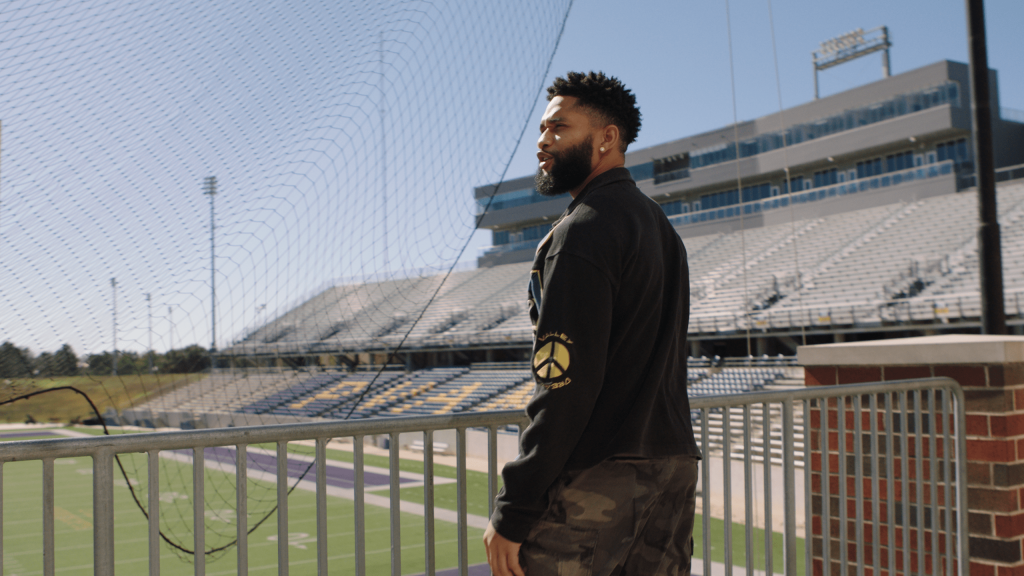
“We’re here at my alma mater, Prairie View,” Hodge said. “I’m going to take you around campus right now.”
As he walked through the athletic facilities and back onto the field, the emotion was evident.
“It feels good to be back,” he said. “You kind of get chills just getting closer to the field.”
“This is where I grew up.”
Hodge’s return to Prairie View during Black History Month wasn’t symbolic—it was personal.
“This is where I grew up,” Hodge said during his visit. “I became a man here at PV.”
That sentiment echoed throughout both the video and the Atlanta Falcons’ written feature, which traced how Prairie View A&M helped turn potential into production. By the time Hodge finished his college career, he had totaled 1,797 receiving yards and 21 touchdowns, earning first-team All-SWAC honors and Black College All-American recognition.
But the impact went beyond football.
“I came here an athletic student,” Hodge said in the video. “I left a student-athlete. They didn’t play about the grades.”
That balance, he explained, is central to the HBCU football experience.
“One thing, if we get parents to send their kid here, we got to get them a degree,” Hodge said. “School first.”
Changing the narrative around HBCUs
Throughout the Falcons’ Black History Month feature, Hodge directly addressed how HBCU athletes are viewed—and undervalued—within the broader football ecosystem.
“I know that HBCU athletes are slept on,” Hodge said. “You just gotta take that to heart.”
Despite going undrafted in 2018, KhaDarel Hodge carved out an NFL career through persistence, eventually landing in Atlanta in 2022 and establishing himself as one of the league’s most reliable special teams contributors.
“We’re D1 just like y’all are D1,” Hodge said. “(Other programs) probably have a little more resources than we have right now, but we are just as good as you are.”
The Falcons’ feature also underscored how systemic change is slowly taking place. The NFL launched its annual HBCU Combine in 2022, while organizations like HBCU Elite—which Hodge partnered with during My Cause My Cleats—continue to increase exposure.
HBCUs and the NFL’s foundation
The Falcons’ article placed Hodge’s story within a larger historical context—one that many fans may not fully realize.
Since 2010, only 36 HBCU players have been drafted into the NFL. Yet nearly 10% of the Pro Football Hall of Fame members attended HBCUs.
Legends like Jerry Rice (Mississippi Valley State), Michael Strahan (Texas Southern), Bob Hayes (Florida A&M), and Walter Payton (Jackson State) all trace their roots back to HBCU campuses.
Those institutions, the Falcons noted, remain “essential threads in the fabric of the NFL’s history.”
For KhaDarel Hodge, Prairie View A&M is one of those threads—and one he proudly carries.
“I came here lost,” Hodge said. “I didn’t really know what I was going to do as far as my football career or academically.”
He paused, then added:
“This is where I found who I was.”