
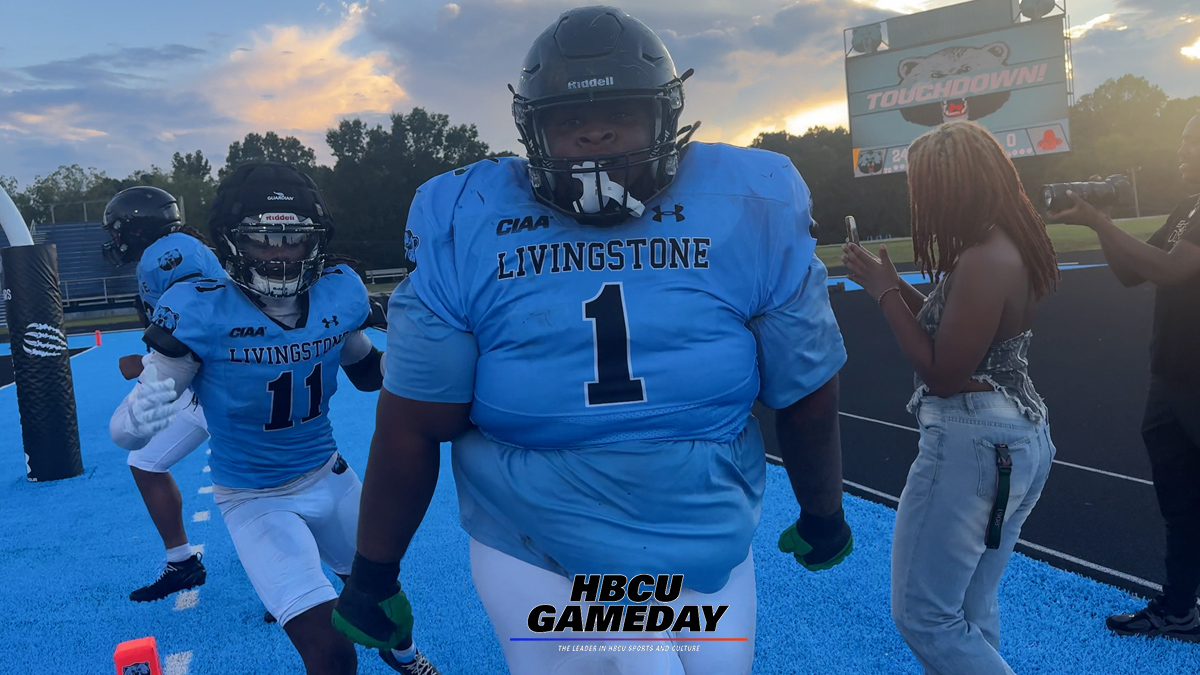
HBCU football has a way of producing the kinds of stories that feel too big to fit inside a highlight clip, and Livingstone College defensive lineman David Jones is the latest reminder.
Most fans first met Jones the same way: a massive No. 1 rumbling into the end zone.
The moment happened against Lincoln (Pa.), when Livingstone College handed the ball to its 6-foot-2, 350-pound defensive tackle in a short-yardage package. Jones scored. The clip hit the internet like a bowling ball. It bounced from timeline to timeline. It went viral on HBCU Gameday. And for a few days, Jones became a familiar punchline and a folk hero at the same time — “the Refrigerator Perry of the CIAA,” a big man with surprising feet.
But Jones’ story is deeper than a goal-line carry. The touchdown was the payoff but the journey was the point.
“I’m not going nowhere where, cool, they got all the glitz and cameras,” Jones told HBCU Gameday. “I’m going somewhere where I feel like I’m wanted and I know I can bring a change to the program.”
That’s the kind of line you don’t forget. It’s also the kind of line that explains why Jones’ path to Division I — and now Mississippi Valley State — didn’t come from five-star fanfare. It came from the long way around.
The long way to Salisbury
The Augusta, GA native graduated high school in 2022, right as the sport was still feeling the ripple effects of COVID. Extra eligibility. Crowded rosters. Seniors staying put. Fewer openings for younger players trying to climb.
“That was a year after COVID, and everybody — our old guys end up staying in school,” Jones said. “So it was hard for us to even get into college.”
So he went to a club program. Not as a backup plan. As a proving ground. They played against junior college teams — the type of competition that can expose you fast if you aren’t ready.
“We played a lot of JUCO teams like Georgia Military,” Jones said. “My first year, I had a decent year. But it showed me that, okay, cool — Georgia Military had power five… their whole O-line went power five — so I had some work to do.”
He nearly made a jump to Fort Valley State, but an injury in a national championship game changed the timeline again. Jones came back another year. Then another. More reps. More film. More chances to test himself against players with Division I futures.
Then came another harsh lesson: nothing is promised.
“I set out a semester because I have some offers on the table,” Jones said. “But they end up getting pulled and some coaches end up retiring.”
So he went home and did what most people do when dreams get delayed: he worked at UPS for a semester.
“End up coming back home, working a 9 to 5,” he said.
And then he started building the next opportunity with discipline. Every Sunday, he and his trainer emailed coaches. Not a handful. Not a few. Everybody.
“Every Sunday, [we] emailed every coach starting from Georgia, Florida, Alabama, Mississippi,” Jones said. “All the way from D1 to D3… and we did that every day consistently.”
Eventually, that grind landed in North Carolina. And one email landed on the desk of Livingstone College assistant coach Mark Williams.
The response was almost immediate.
“Mark sent the [message] back immediately, like in less than 20 minutes,” Jones said. “Then he set up a visit… less than an hour, two hours.”
Jones had another visit lined up at Benedict. But he said the decision came down to something far more basic than facilities or hype.
“I just felt more at home at Livingstone College, like I was wanted,” he said.
The film doesn’t lie
Williams says he sees hundreds of messages a day in his recruiting inbox. The volume is impossible to fully keep up with. The key, he said, is knowing what to look for.
“You have to present yourself a certain way on your film,” Williams told HBCU Gameday. “Because your film doesn’t lie.”
And then Williams shared a recruiting trick that sounded simple, but revealed how coaches really evaluate players.
“It’s not about the player that you’re looking at,” he said. “It’s about somebody else on his team. You watch their film… and you can see the plays that the players take off… I want to see the lazy plays. I want to see how much effort you put in when you get tired.”
It’s an approach built for development programs — the kind that have to spot hungry prospects and turn them into impact players. It’s also the kind of approach that fit Jones, who didn’t have a traditional recruiting profile but did have something that keeps coaches interested: urgency.
And Jones, in his own way, tested that urgency on the other side.
He slipped a surprise into his highlights — clips of him running the ball — just to see who really watched.
“I put little gems in my highlight tape to see if my coach actually even watch it,” Jones said. “Like I put some of my running plays in the middle of the highlight.”
Williams noticed.
“At the end of his film, man, he had like two or three clips of him running the ball,” Williams said. “Some coaches… might look at that and see, ‘Man, this joker 6-2, 6-3, 360 pounds — why is he running the ball like Refrigerator Perry?’ But you never know when you may need to use that skill set.”
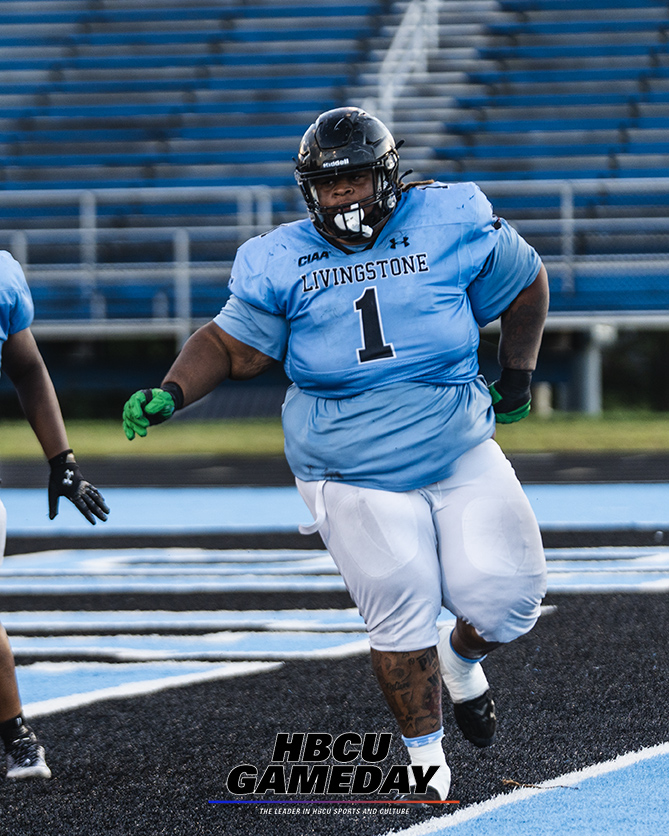
From disruptor to touchdown machine
Jones arrived at Livingstone College in 2024. The adjustment wasn’t about learning football. It was about learning the CIAA’s brand of size and force.
“The CIAA, the guards are bigger… chunkier,” he said. “The centers… can move a little bit, but they’re bigger. So it’s like, I was already expecting a double team.”
His first season brought a humbling moment before he ever really got started.
“I wasn’t able to play the first game because of some paper issues,” Jones said. “So I sat out that game and that game humbled me.”
He watched Charleston run the ball while he stood in uniform, helpless. That kind of experience can break a player. Jones says it sharpened him.
By 2025, opponents weren’t surprised anymore. Opposing HBCU coaches game-planned him. They shifted protections. They tried to avoid his side. Jones responded by accepting a role that interior linemen understand well: do the dirty work, even when the stats don’t reward you.
“If you don’t double me and you try to run the ball, that’s my play to make,” he said. “If you do double me, I know my linebackers are free.”
Then came the other part — the part that made him famous.
Jones kept asking coaches to let him run. They laughed it off at first.
“They like, ‘typical Dave,’” he said. “I’m always having fun at practice. I’m going to bring a smile with everybody.”
Then the idea became real. One day in practice, they put it in. Jones scored in an inside drill.
“Coach Gilbert was like… it’s so natural, he didn’t even know I had the ball,” Jones recalled.
The package debuted after a brief delay. The coaches initially considered it for Bowie State, but didn’t like the defensive looks. So they waited — then pulled it out against Lincoln.
Jones scored his first touchdown. Then he kept scoring.
Williams confirmed Jones finished with three rushing touchdowns — against Virginia-Lynchburg, Elizabeth City State, and Lincoln — and that he tied for second on the team in rushing TDs.
It wasn’t a joke anymore. It was production.
Betting on himself — again
Now Jones is taking the next step, transferring to Mississippi Valley State. For Jones, it’s not a rejection of Livingstone College. It’s a continuation of his belief in himself.
“This will be my third school I’m going to,” he said. “All I know is, okay, Dave, you gotta go bet on yourself.”
He said the move was made with respect for his coaches — and with honesty about the reality of modern football.
“I’m just trying to really go feed my family,” he said. “Football, really a business right now.”
There was also a practical layer. He acknowledged what most Division II athletes know.
“In D2… it’s not really no full ride,” Jones said.
At Valley, he said, that changes. A full scholarship is a different baseline. And if NIL opportunities come, they’re part of the landscape.
Williams sees it as a double-edged sword — difficult for programs like Livingstone, but potentially life-changing for players.
“Some of these kids are able to change their families’ lives,” Williams said. “If that happens to mean that they have to go somewhere else, we’ve done our job.”
Jones is also approaching the move to a new HBCU like a reset. He said he wants to drop weight and arrive in the best shape of his life, targeting 330 to 335.
“I really want to perfect my craft,” he said. “A good person does it one time… a great person does it until you can’t get it wrong.”
That line fits him. Because the viral clip was one moment. The real story is repetition — the emails, the work, the waiting, the belief, the humility, the constant decision to try again.
And in the ecosystem of HBCU football, that’s the kind of journey that travels farther than a highlight ever will.