
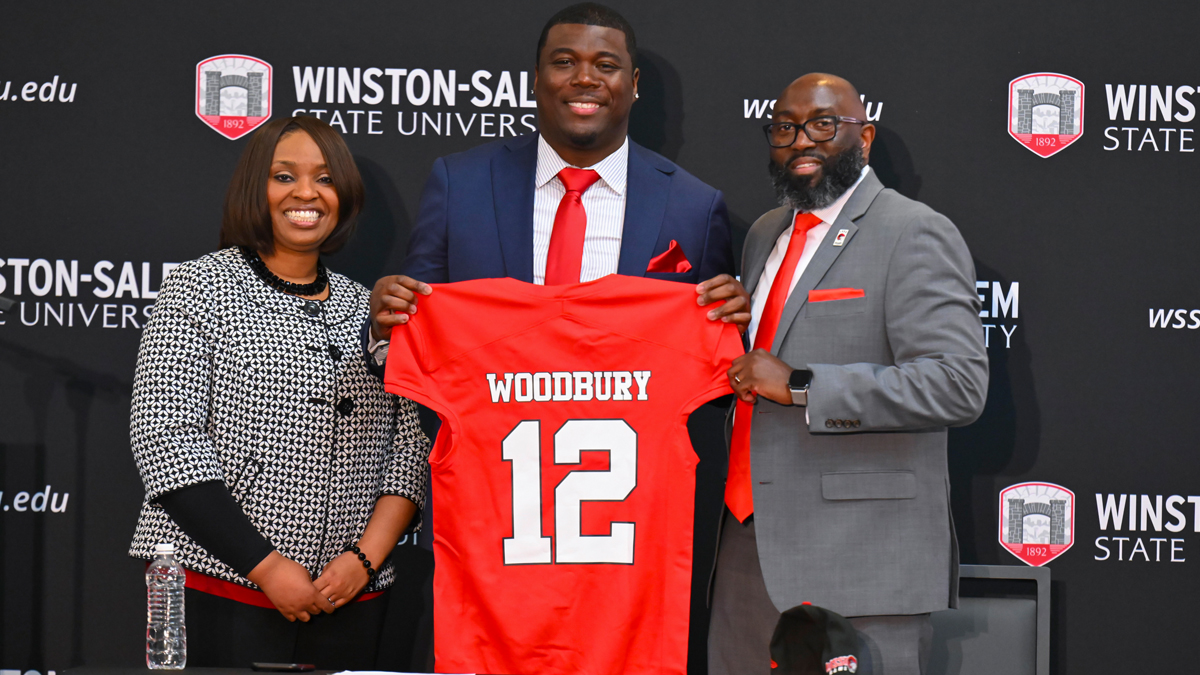
New Chapter
As the press conference wrapped and people drifted back into the snow, one thing became clear: WSSU didn’t just hire a coach — it made a statement about identity. And that statement was best articulated not by Tory Woodbury, but by Chancellor Bonita Brown, who opened the day with a reminder of why this hire mattered beyond football.
“We all know that athletics is the front door for the university,” she said. “I was looking for somebody who understands the students… who will take care of the students… who can bring the community together and bring excitement and energy.”
That framing adds a layer most coaching hires don’t carry. This isn’t just about wins and losses — this is about relevance, perception, and reestablishing connection. This is a time when many HBCU programs are reconfiguring their place in a fast-changing college football environment, including WSSU.
The homecoming narrative around Tory Woodbury is familiar and easy to celebrate, but the Chancellor’s criteria were far more specific. She wasn’t looking for nostalgia; she was looking for alignment. For someone who could talk about student support, community engagement, fundraising, and on-field expectations with equal fluency — and do so without prompting. And in her words, Woodbury “hit all four effortlessly.”
Still, alignment doesn’t erase the reality in front of the program. WSSU hasn’t consistently matched its championship pedigree in nearly a decade, and the CIAA has shifted underneath it. Other programs have built up infrastructure, invested in coaching, and capitalized on the transfer era more effectively.
So yes, Woodbury’s return is significant — but it doesn’t rewrite the task. It simply gives WSSU a leader who understands the assignment before Day One. As Brown’s comments made clear, the bar isn’t soft. She said she wanted someone who could “regenerate energy,” reconnect fans, and, ultimately, win. Those expectations don’t go away because the hire feels good; they intensify because the hire feels familiar.
This isn’t a reset as much as a continuation. An opportunity to finally turn a page the program has been stuck on for years.

Putting the WINS back in Winston-Salem State
Once the applause faded and the room emptied, the job began in earnest. And it’s a big one. Woodbury inherits a roster in transition, a program that has struggled for consistency, and an HBCU football landscape where resources, retention, and recruiting shape outcomes more than slogans.
Chancellor Brown didn’t shy away from that reality either. In her remarks she said plainly: “We wanted somebody that was going to win.”
That’s not the language of a ceremonial hire — that’s the language of expectation.
Woodbury spoke often about building a disciplined, fast, violent football team, but he also talked about academics, about relationships, about understanding why a player might struggle off the field. And while that messaging resonates, especially in this moment, the results will hinge on the unglamorous parts: bandwidth, funding, stability, and buy-in.
As Lamonte reminded, the program is still four scholarships away from being fully resourced — a reality that has nothing to do with the coach and everything to do with the ecosystem he’s stepping into.
That’s why Brown’s emphasis on fundraising and community commitment wasn’t filler — it was an acknowledgment of the work ahead. WSSU can’t rebuild itself on nostalgia. It has to rebuild on infrastructure.
What Woodbury does offer — and what may make the difference — is clarity. He’s not promising shortcuts. He’s not selling quick fixes. His message was consistent: be present, build relationships, evaluate everything, and expect accountability. And whether you’re an alum, a player, or someone who watched him sneak into Bowman Gray as a kid, that’s the kind of approach that feels durable in a conference that has no sympathy for sentiment.
The snow will melt. The enthusiasm will settle. And the real test will begin — not in how Woodbury talks about the program, but in how the program grows around him.
Chancellor Brown said she wanted someone who could push the students, unite the community, raise the standard, and win. Now we get to see whether the alignment she saw — the one that “checked every box” — can translate into something tangible on Saturdays.
For the first time in a while, WSSU has clarity at the top. What comes next depends on whether clarity becomes structure — and whether structure becomes results.