
More than a coach
Hayes’ story is bigger than wins.
Before he became WSSU’s head coach, he played at North Carolina College under Herman Riddick. Hayes still speaks of Riddick with reverence.
“Herman Riddick taught me a standard that I followed,” Hayes said. “You want to emulate your coach in your actions, the way you act, the way you dress, the way you present yourself.”
That standard shaped Hayes. So did his time at Wake Forest, where he became one of the first Black assistant coaches in ACC history.
Hayes said Wake Forest coach Chuck Mills pushed him into spaces that Black coaches had rarely entered. Once, Mills asked him to speak in his place at Raleigh Country Club.
“I said, ‘Coach, don’t you realize the Raleigh Country Club is segregated?’” Hayes recalled. “He said, ‘I tell you what, if it’s segregated, it won’t be after you leave.’”
Hayes also remembered scouting at places like Ole Miss and Clemson, where Black workers understood what his presence meant.
“A lot of the Black folk that were working at the schools as janitors, as cooks, as really servants, were amazed when they saw me in my role,” Hayes said. “They took care of me.”
He took those experiences and turned them into fuel.
“I learned that first of all, I had to be first,” Hayes said. “I’m going to beat everybody to work, and I’m going to outwork everybody.”
That explains much of his career.
Bill Hayes became a program builder
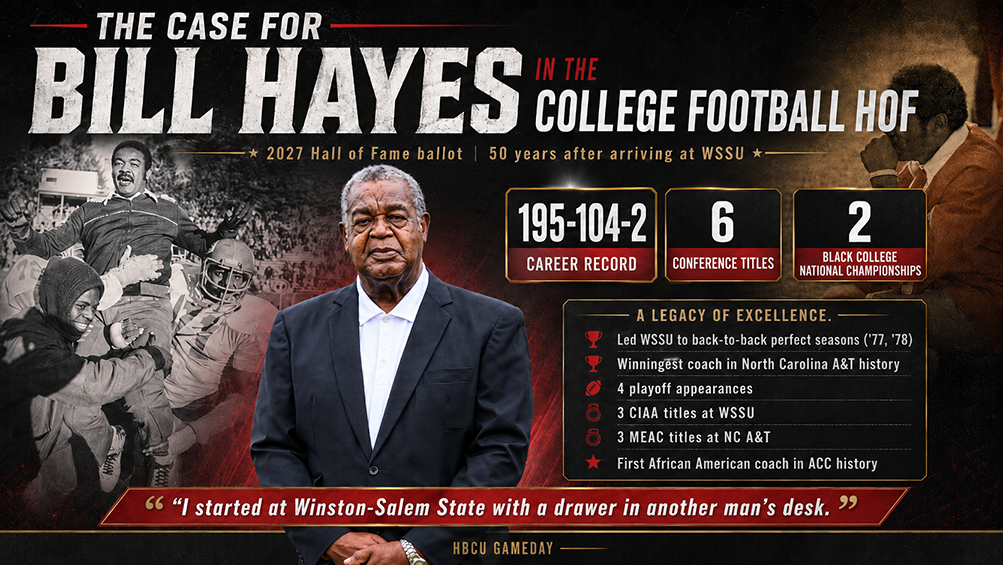
Hayes later took that same standard to North Carolina A&T, where he became the winningest coach in program history. He finished his coaching career with 195 wins, six conference championships and two Black college football national championships. He remains the all-time winningest coach at North Carolina A&T. His WSSU record was eventually passed by his star QB, Blount.
Then he moved into administration.
Hayes became athletic director at North Carolina Central, Florida A&M and finally WSSU, where he returned in 2010. His second act at Winston-Salem State was not ceremonial. It was transformational.
He hired Connell Maynor. WSSU football reached the NCAA Division II national championship game in 2012. The department won across multiple sports.
Hayes said his expectations were clear when he returned as athletic director.
“I remember Thursday morning at 8:30, we met as a staff,” Hayes said. “I would ask each coach, ‘What is it I need to do to help you win the championship?’”
He did not limit that expectation to football.
“I expect you to win a championship in every sport,” Hayes said. “Everybody around the table got one championship. What do I need to do to help you win it?”
That approach worked because Hayes had lived every layer of HBCU athletics. Bill Hayes knew what it meant to recruit without enough money. He knew what it meant to coach without enough staff. He knew what it meant to build pride when the resources did not match the ambition.
That is why his retirement did not really look like retirement.
After leaving WSSU in 2014 that he would spend the rest of his life raising money for HBCUs and underserved high schools.
“I always wanted to give back,” Hayes said. “I made up my mind that I was going to spend the rest of my life raising money to give back to historically black colleges and depressed high schools in our area.”
The College Football Hall of Fame moment is now
Bill Hayes turned 83 in June. He still moves well and talks with energy with a twinkle in his hazel eyes. He still remembers the names, the games, the slights, the struggles and the details.
But Hall of Fame moments are not guaranteed forever.
The College Football Hall of Fame is supposed to preserve the people who shaped the game. Hayes shaped it in ways that stretch beyond a record book.
Bill Hayes helped break racial barriers in the ACC. He built WSSU football into a championship program. He turned North Carolina A&T back into one. Hayes helped produce coaches who kept winning after him. The man nicknamed “Wild Bill” became a successful athletic director at multiple HBCUs. He returned to Winston-Salem State and helped launch another golden era.
He hasn’t stopped giving.
When asked what WSSU means to him, Hayes paused. He has been part of North Carolina Central, North Carolina A&T, Florida A&M and Wake Forest. But Winston-Salem State holds a different place.
“I would say probably Winston-Salem State is probably my mother of all the schools that I’ve been,” Hayes said. “There’s a love and devotion to Winston-Salem State in this community that exceeds all the rest of them, even my alma mater.”
Then he made it plain.
“I consider Winston-Salem State home.”
Fifty years after he arrived, home has his name on the field and his statue above it.
Now The College Football Hall of Fame has a chance to put Bill Hayes where his career says he belongs.