
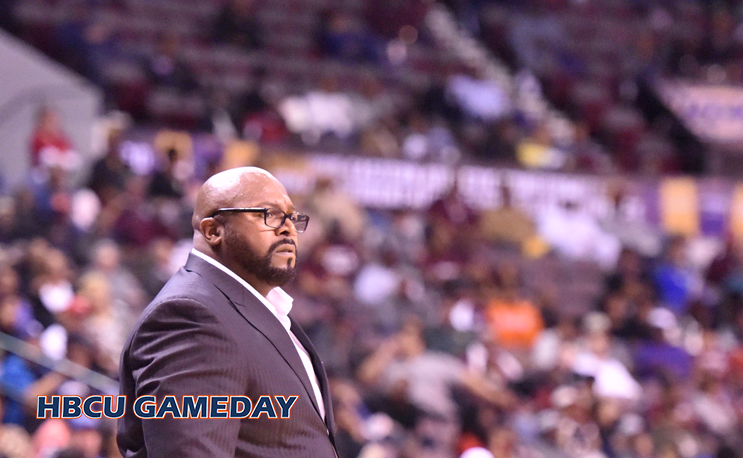
Veteran HBCU coach Bobby Collins has resigned as Shaw University’s head coach, according to a report from Olivia Antilla.
The decision comes after Collins led the Bears to a 16-10 overall record during the 2025-2026 season. A follow-up mark of 11-17, however, appears to have shifted the trajectory of the program. For a program still trying to regain consistent footing in the CIAA, leadership opted to make a change.
Collins was hired on March 24, 2020, tasked with rebuilding an HBCU program that had struggled prior to his arrival. Before he took over, Shaw had finished 5-23. In his first season, the Bears improved to 10-11, a five-game jump that signaled progress. By his second year, Shaw posted a 16-14 record and advanced to the CIAA Quarterfinals, also earning the CIAA Tournament Men’s Basketball Sportsmanship Award.
That 2022-23 campaign was widely viewed as a turning point. Shaw finished with a winning record and began to resemble a competitive factor in the conference. The Bears also finished .500 in CIAA action for three consecutive seasons during his tenure, showing stability even if the breakthrough season never fully materialized.
Collins arrived in Raleigh with a deep HBCU résumé.
Before Shaw, he served as an assistant coach at South Carolina State and previously spent four seasons as head coach at Maryland-Eastern Shore. At UMES, he engineered one of the most impressive turnarounds in program history. In his first season, the Hawks went 18-15 — their best record in 41 years — and finished third in the MEAC. Collins earned MEAC Coach of the Year honors and was later named the 2015 Ben Jobe Coach of the Year, one of the highest distinctions in Black college basketball.
His most notable stretch, however, came at Winston-Salem State University. From 2010 to 2014, after the Rams returned to Division II, Collins compiled a 79-35 record. His teams won at least 10 CIAA games each season during that span and captured the CIAA Championship in 2011-12. The 2012-13 squad reached as high as No. 7 nationally in Division II and secured a No. 2 regional seed after finishing 21-7 overall and 13-3 in conference play.
That body of work established Collins as one of the more respected HBCU coaches of his era.
Now, Shaw faces another reset.
The Bears showed flashes of growth under Collins, particularly in restoring competitiveness and improving culture. But in today’s college basketball climate — even at the Division II level — patience is limited. Programs want sustained upward momentum, not incremental gains followed by regression.
For Collins, his résumé ensures he will remain a viable candidate within HBCU and mid-major circles. For Shaw, the next hire becomes critical. The foundation has been steadied. The question now is whether the program can take the next step and consistently contend in the CIAA.