
At a glance, scoring across HBCU men’s basketball looks remarkably similar. Most games land in the low-to-mid 140s, with most teams scoring around 70 points, and no conference appears dramatically faster or slower than the others.
But when you isolate conference games only—and look at how points arrive, who produces them, and how games finish—clear differences emerge across the SWAC, MEAC, CIAA, and SIAC.
A Snapshot of Scoring Across the Four HBCU Leagues
(Conference games only | Early January–Early February 2026)
- SWAC: 74.4 team points per game | 148.8 average game total
- MEAC: 71.3 team points per game | 142.6 average game total
- CIAA: 70.9 team points per game | 141.9 average game total
- SIAC: 70.7 team points per game | 141.5 average game total
Those averages are close enough to blur together—until you look at distribution.
- The MEAC produced close games (decided by 5 points or fewer) nearly half the time
- The SIAC had the fewest blowouts of any league
- The CIAA saw the most 20-point margins
- The SWAC paired the highest scoring environment with competitive finishes
Once you layer in individual scorers, the identities sharpen quickly.

SWAC: Scoring as Sustained Pressure
No league in this comparison places more stress on the scoreboard than the SWAC.
The SWAC averaged nearly 149 points per game, the highest total among the four leagues—and that pace shows up immediately on the scoring leaderboard.
SWAC scoring leaders (conference games)
- Daeshun Ruffin (Jackson State) — 30.3 PPG
- Dontae Horne (Prairie View A&M) — 21.7
- Michael James (Mississippi Valley State) — 21.4
- Michael Jacobs (Southern) — 19.3
- Jakobi Heady (Bethune–Cookman) — 19.2
Ruffin’s 30.3 points per game isn’t just a league high—it’s a system-defining number. He sits nearly nine points clear of anyone else across all four conferences.
And he’s not alone. Three SWAC players average over 20 points per game, and the top ten extends deep into the high teens.
What it means:
In the SWAC, seventy points doesn’t win games—it just keeps you in the conversation. Teams are asked to score again and again, and defensive lapses are punished quickly.
MEAC: Compressed Games, Amplified Consequences
The MEAC’s average scoring environment sits in the middle of the pack, but its defining feature isn’t volume—it’s compression.
Nearly 48 percent of MEAC conference games in this sample were decided by five points or fewer, the highest rate among the four leagues.
MEAC scoring leaders
- Alfred Worrell Jr. (Morgan State) — 21.5 PPG
- Cedric Taylor III (Howard) — 19.0
- Jayden Johnson (South Carolina State) — 19.0
- Ponce James (Delaware State) — 17.2
Worrell Jr. stands out as the league’s lone high-volume outlier. Behind him sits a tightly packed group of scorers clustered between 14 and 19 points per game—often sharing usage with a teammate.
What it means:
The MEAC doesn’t overwhelm opponents with points. It squeezes possessions until execution becomes the only oxygen left.
CIAA: Balance, Depth, and Decisive Outcomes
On paper, the CIAA’s scoring average mirrors the MEAC and SIAC. In practice, its games behave differently.
The CIAA posted the fewest close games and the highest blowout rate in this four-league comparison.
CIAA scoring leaders
- Larry Howell (Fayetteville State) — 20.8 PPG
- Tyre Boykin (Winston-Salem State) — 19.4
- Myles Pierre (Bluefield State) — 18.3
- Ezekiel Cannedy (Fayetteville State) — 17.8
There’s no 25–30 point supernova here. Instead, the CIAA’s top teams often feature paired scorers who can attack from different angles.
What it means:
When CIAA games break open, they tend to stay open. Separation usually comes from matchups and depth rather than one player taking over entirely.
SIAC: Parity with a Soft Scoring Ceiling
The SIAC’s scoring curve is the most even of the four leagues.
Only 7 percent of SIAC games in the sample ended in 20-point blowouts, and the scoring leaderboard reflects that balance.
SIAC scoring leaders
- Elijah Greer Dawson (Lane) — 20.0 PPG
- Rocco Lamuno (Spring Hill) — 18.4
- Aidan Lambert (Fort Valley State) — 18.1
- Ramar Pryor (Central State) — 16.9
There’s one 20-point scorer, followed by a long, steady slope through the mid-teens—spread across many teams.
What it means:
The SIAC doesn’t live on blowouts. It lives on endings. Most nights require four quarters of focus, regardless of opponent.
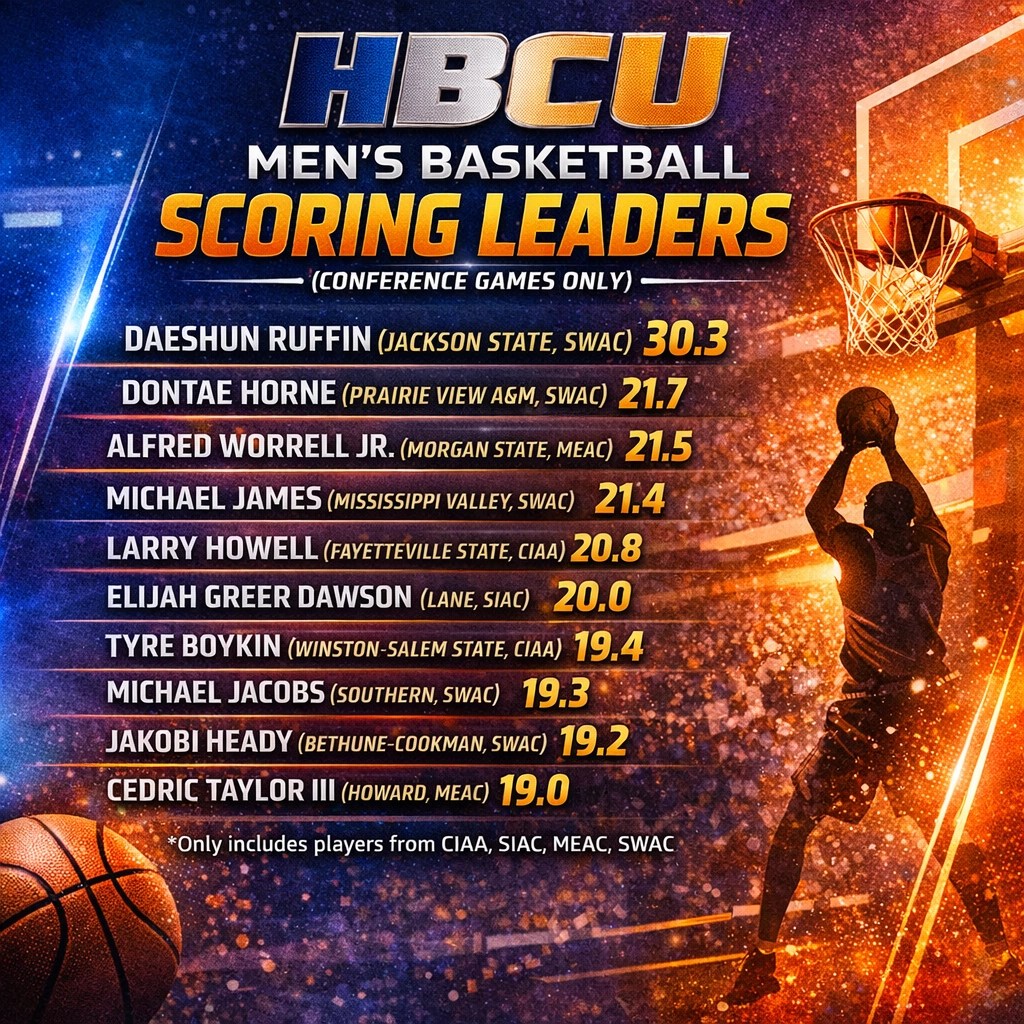
The Master List: Top Scorers Across All Four HBCU Conferences
When the four leagues are combined, the differences become unmistakable.
HBCU men’s basketball scoring leaders (conference games only)
- Daeshun Ruffin (Jackson State, SWAC) — 30.3
- Dontae Horne (Prairie View A&M, SWAC) — 21.7
- Alfred Worrell Jr. (Morgan State, MEAC) — 21.5
- Michael James (Mississippi Valley State, SWAC) — 21.4
- Larry Howell (Fayetteville State, CIAA) — 20.8
- Elijah Greer Dawson (Lane, SIAC) — 20.0
- Tyre Boykin (Winston-Salem State, CIAA) — 19.4
- Michael Jacobs (Southern, SWAC) — 19.3
- Jakobi Heady (Bethune–Cookman, SWAC) — 19.2
- Cedric Taylor III (Howard, MEAC) — 19.0
League representation
- SWAC: 5 players
- CIAA: 2 players
- MEAC: 2 players
- SIAC: 1 player
That distribution mirrors the scoring environments almost perfectly.