
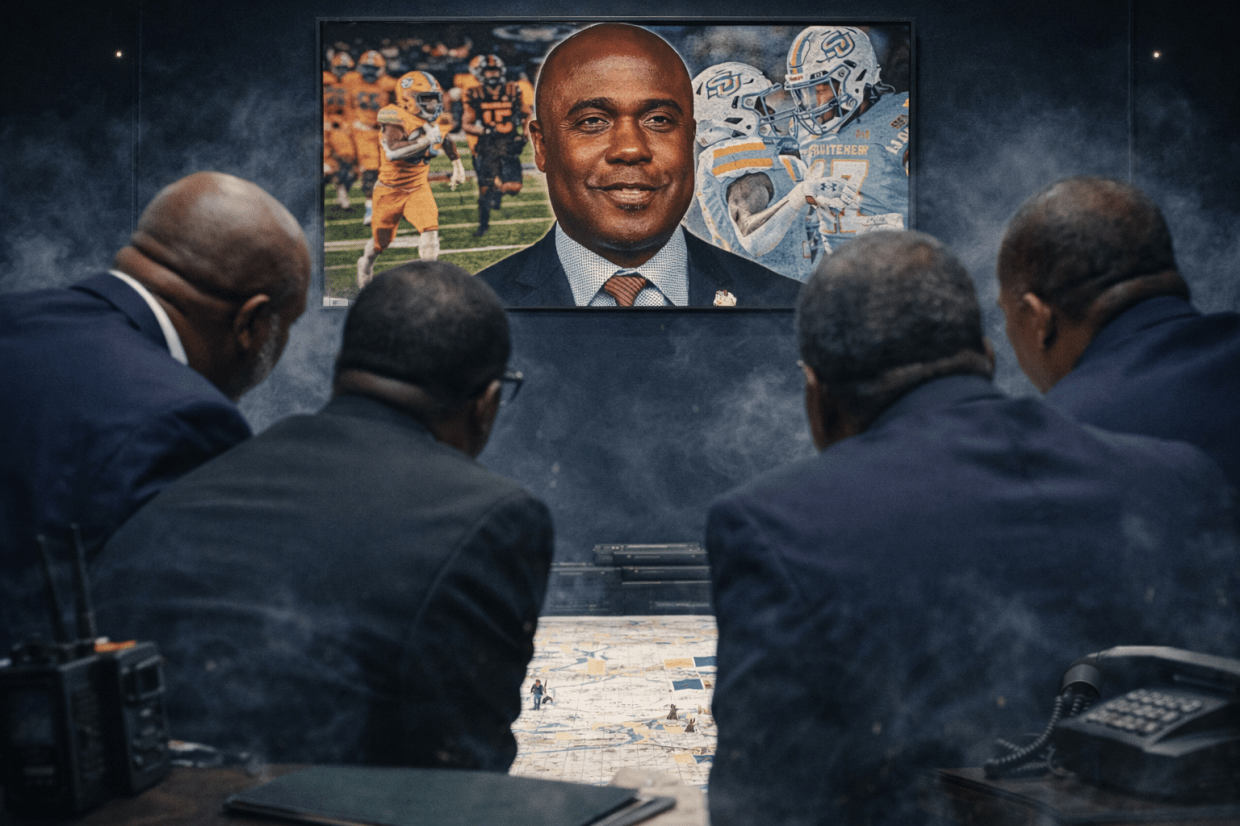
The hiring of Marshall Faulk as head football coach at Southern University represents more than another high-profile coaching move. It reflects a calculated bet by an HBCU seeking to convert celebrity, credibility, and capital into long-term institutional momentum.
From the moment Faulk was introduced, Southern’s leadership made clear this was not a ceremonial hire. It was a strategic one—rooted in fundraising, facilities, recruiting, and a broader shift in how HBCUs position themselves in the modern college football economy.
Few have articulated that vision more forcefully than Tony Clayton, chairman of the Southern University Board of Supervisors.
“This guy is built unlike any other person I’ve seen,” Clayton said on The Carlos Brown Show. “He’s all in. He’s drunk the Kool-Aid.”
Why Marshall Faulk Fit Southern University’s Moment
Marshall Faulk arrives at Southern University during a defining stretch for HBCU athletics, one shaped by visibility, NIL realities, and the pursuit of relevance in a crowded media landscape. His hiring follows a five-year trend that began when Deion Sanders took over at Jackson State University, redefining how an HBCU football program could command national attention.
Since then, several HBCUs have followed suit by turning to NFL legends without traditional HBCU ties. Eddie George at Tennessee State University, Michael Vick at Norfolk State University, DeSean Jackson at Delaware State University, and the short-lived tenure of Ed Reed at Bethune-Cookman University all underscore a new playbook.
Southern University’s approach, however, suggests a deeper commitment to alignment.
“This was a collective decision,” Clayton said. “We had hours of intense conversations with Marshall Faulk. This wasn’t about flash.”
From Headline Hire to Structural Change
Since Marshall Faulk’s hiring, Southern University has moved quickly to address long-standing infrastructure concerns that have lingered across multiple coaching regimes.
“When he toured the facilities, there were leaks in the locker room,” Clayton said. “He said it had to be fixed. We fixed it.”
Plans now include locker room renovations, north end-zone suite redevelopment, and broader stadium upgrades—steps Clayton admits should have come sooner, but which now carry urgency tied directly to Faulk’s presence.
“He’s not asking for more money for himself,” Clayton said. “He’s focused on his assistants and his players.”
That philosophy mirrors what Deion Sanders modeled at Jackson State: leverage visibility to force institutional change. The difference, Clayton argues, is that Southern University is attempting to bake that change into policy, budgeting, and governance rather than personality alone.
The Business of the Modern HBCU
Clayton has been unapologetic in framing Southern University athletics as a business—one that must adapt to survive in today’s HBCU landscape.
“This is a business,” he said. “You gotta pay to play.”
That mindset extends to fundraising, tailgating reform, and even stadium naming rights—topics Clayton raised candidly during the interview. His argument is simple: nostalgia cannot fund progress.
“If you can put a corporate name on a building and bring in real money, you do it,” Clayton said. “You can still honor legacy.”
Such comments underscore how Marshall Faulk’s hire fits within a broader recalibration of what HBCU leadership looks like in 2025—less sentimental, more strategic.
Pressure, Patience, and the Faulk Blueprint
Despite the excitement surrounding Marshall Faulk, Clayton has emphasized that Southern University must balance ambition with patience.
“You can’t expect him to come in and win the SWAC overnight,” he said. “But you have to support him while he builds it.”
That may be the true test of the Marshall Plan. Deion Sanders proved that star power can elevate an HBCU quickly. Marshall Faulk’s tenure will help determine whether that elevation can be sustained through infrastructure, funding, and cultural buy-in at Southern.
For Southern University, this moment is about more than wins and losses. It is about redefining how an HBCU competes—not just on Saturdays, but in boardrooms, donor meetings, and national conversations.
Marshall Faulk brings the name. Southern University must now prove it can build the system.