
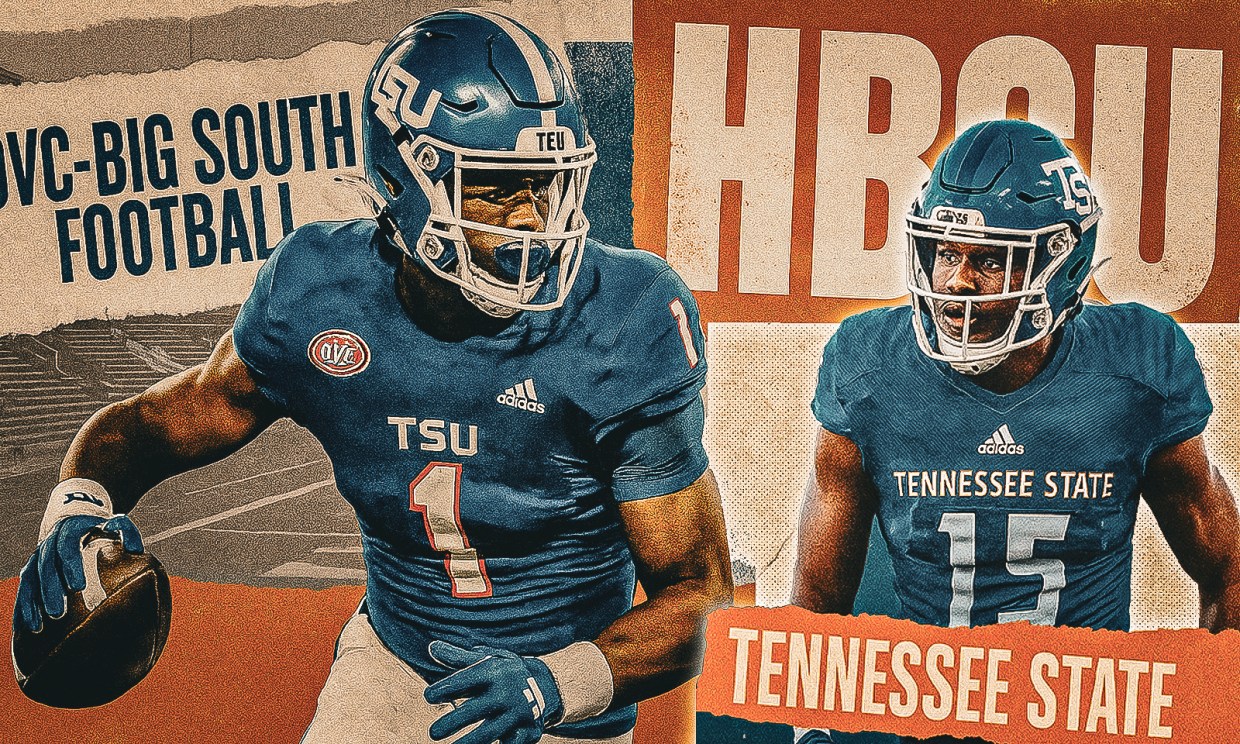
Another domino has fallen in the Ohio Valley Conference–Big South (OVC-Big South) football partnership. This leaves Tennessee State University, the lone HBCU in the league, as an HBCU power in a conference with dwindling membership. Tennessee Tech University announced it will leave the OVC after the 2025–26 season to join the Southern Conference (SoCon).
The move ends a relationship with the OVC that began in 1949. Effective July 1, 2026, the Golden Eagles’ move adds a program fresh off a 2024 football championship and a preseason Top 25 ranking to one of the nation’s oldest and most tradition-rich leagues.
For Tech, the decision is about geography, rivalries, and stability. For Tennessee State University, it’s about what comes next.
A Partnership Born of Necessity — and Now Shrinking
The OVC–Big South football association was formed in 2021 as a lifeline for two conferences struggling with shrinking memberships. The idea was to combine football programs into a single competitive group while maintaining separate league identities in other sports. At its height, the alliance featured nine football-playing schools — not a huge number, but enough to sustain playoff eligibility and healthy competition.
But each offseason has brought change. Bryant, Lindenwood, and others came aboard; Kennesaw State and North Alabama moved on. Now, Tennessee Tech’s exit is the latest hit. Leaving the league flirting with single-digit membership in a sport where stability often means double digits.
In an era where “super leagues” with 12 or more football members are becoming the norm, a slim roster puts you on shaky ground.
Parallels With the CAA’s HBCU Experiment
If this feels familiar to HBCU fans, it’s because two other high-profile programs — Hampton and North Carolina A&T — are in a similar situation. Both HBCU power brands left the MEAC for the Colonial Athletic Association (CAA). They sought broader exposure and tougher competition, but the CAA has faced its own realignment churn.
The CAA and OVC–Big South situations highlight a broader truth: conference realignment rarely stops moving. Every departure reignites the long-standing conversation among HBCU circles about whether these outlier programs should return to the SWAC or MEAC, seek another FCS league, or take an even bigger swing toward FBS.
The Case for a SWAC or MEAC Reunion
Joining the SWAC often tops speculation lists. With its 12 current members, the conference is a powerhouse among HBCU leagues in terms of attendance, alumni visibility in professional sports, and cultural relevance. TSU’s Nashville location would add a major-market program to the conference’s Western Division and instantly revive rivalries steeped in Black college football tradition.
Others point to the MEAC. Currently hosting eight members, six of whom play football, the MEAC has a clear identity, ESPN broadcast ties, and automatic access to the Celebration Bowl. Joining the MEAC would bring TSU into a conference with historic HBCU brands like Howard, South Carolina State, and North Carolina Central. While potentially giving the league a stronger foothold west of the Carolinas.
Interest isn’t just hypothetical. Alumni petitions and media reports reveal spirited calls for TSU to rejoin an HBCU league. Underlining both personal and institutional desire to return to traditional affiliations. At least preliminary conversations with SWAC officials have reportedly taken place, though nothing formal has materialized yet.
The Decision Facing Tennessee State
Tennessee State University’s position is unique. A charter OVC football member since 1988, the Tigers have maintained HBCU cultural ties while chasing championships outside traditional Black college leagues. But with the OVC–Big South’s future uncertain, now might be the moment to consider a change.
On-Field Outlook
On the field, TSU is in a noteworthy moment. Eddie George brought star power when he took over in 2021 and led the Tigers back to the FCS playoffs in 2024 — their first appearance since 2013.
Now, the program hands the reins to Reggie Barlow. Barlow is known for disciplined, physical teams and strong recruiting ties in Black college football. Whether his Tigers are chasing OVC–Big South titles or a new league’s crown in the coming years remains to be seen. But with Tennessee Tech’s exit, one thing’s clear. The clock feels like it’s ticking for Tennessee State to decide where it belongs in the ever-changing college football landscape.